
Prompt frameworks that work: RISEN, APE, GLUE, STAR, ITAP, ALGAE, RACE, COAST

Two people can ask the same AI the same question and get answers worlds apart. The difference is rarely the tool. It is how they ask.
Prompt frameworks fix that. Each one is a short checklist of what to tell the AI, so you stop leaving out the context that makes an answer useful. This guide covers the eight frameworks worth knowing, when to use each and a worked before-and-after for every one.
It was inspired by the "Mastering AI Prompting" infographic from Sonny Side Up, which is worth a look. The examples and the cheat sheet below are our own.
The cheat sheet
Save this and keep it next to your AI chat. Every framework, what each letter means and what it's good for, on one screen.
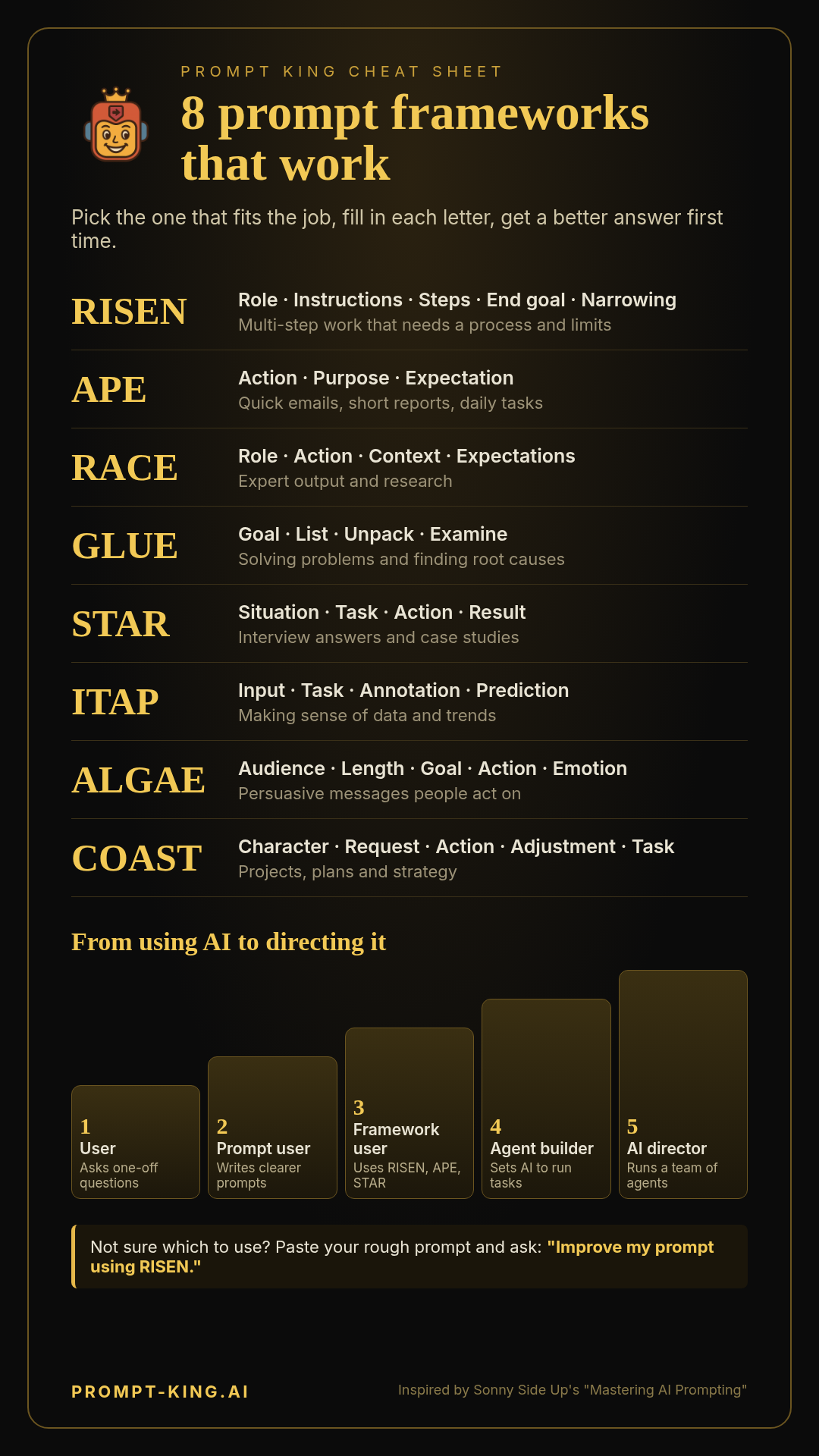
The eight frameworks, with examples
RISEN: Role, Instructions, Steps, End goal, Narrowing
Use it for: bigger, multi-step jobs where you want the AI to follow a process and stay inside clear limits. It's the most complete framework here, which is why people call it a superprompt.
Before:
Write me an onboarding plan for a new hire.After:
Role: You are an experienced operations manager at a 20-person software company.
Instructions: Write a first-two-weeks onboarding plan for a new customer support hire.
Steps: 1) List what they must know by day 3. 2) Plan each day of week 1. 3) Plan week 2 around shadowing and first tickets. 4) Add a check-in agenda for day 10.
End goal: A one-page plan the hiring manager can print and hand over on day 1.
Narrowing: UK English, no jargon, assume they work remotely, keep each day to 3 bullet points.
Got a rough prompt you want rebuilt this way? Paste it into Improve my prompt with RISEN.
APE: Action, Purpose, Expectation
Use it for: quick everyday tasks: emails, short reports, summaries. It's the fastest framework to type.
Before:
Write an email to a supplier about a late delivery.After:
Action: Write an email to our packaging supplier about an order that is 6 days late.
Purpose: Get a firm new delivery date and keep the relationship friendly, because we order from them monthly.
Expectation: Under 120 words, polite but direct, ending with one clear question.
RACE: Role, Action, Context, Expectations
Use it for: professional output and research where expert judgement matters, such as an analysis, a recommendation or a briefing.
Before:
What should I know about opening a second café?After:
Role: You are a hospitality consultant who has helped independent cafés expand.
Action: List the main risks and the first five checks before opening a second site.
Context: My café in Leeds turns over £300k a year, has a 14% margin and a strong head barista. The new site is 3 miles away.
Expectations: A ranked list of risks with one check for each, then a go or wait recommendation with your reasoning.
GLUE: Goal, List, Unpack, Examine
Use it for: understanding a problem and getting to its root cause before you jump to a fix.
Before:
Why are people cancelling my subscription?After:
Goal: Find the main reasons customers cancel in their first 60 days.
List: Here are 40 cancellation comments and our onboarding steps: [paste].
Unpack: Group the comments into themes and count how often each appears.
Examine: For the top two themes, trace back to the onboarding step where the problem most likely starts, and say what evidence would confirm it.
For process failures, the 5 whys prompt goes even deeper.
STAR: Situation, Task, Action, Result
Use it for: interview answers, case studies and performance reviews, anywhere you need to tell a story with a clear outcome.
Before:
Help me answer 'tell me about a time you handled conflict'.After:
Turn this into a STAR interview answer under 200 words.
Situation: Two senior engineers disagreed on a database migration, and the release was slipping.
Task: As team lead, I had to get a decision within a week without losing either of them.
Action: I ran a 45-minute session where each wrote up risks, we scored them together and agreed a test.
Result: We shipped 4 days later with no incidents, and both still work on the team.
Preparing for interviews? This prompt predicts likely questions from your CV.
ITAP: Input, Task, Annotation, Prediction
Use it for: data analysis and spotting trends, where you want the AI to explain what it sees and what might happen next.
Before:
Analyse my sales.After:
Input: Monthly sales by product for the last 18 months: [paste table].
Task: Find the three biggest changes in the trend.
Annotation: For each, explain the likely cause and flag anything that could be a data error.
Prediction: Estimate the next 3 months for our top product, with a low, likely and high case and the assumptions behind each.
ALGAE: Audience, Length, Goal, Action, Emotion
Use it for: persuasive communication: announcements, fundraising asks, emails that need people to do something.
Before:
Write a message asking members to renew.After:
Audience: Members of our running club whose membership ends this month, mostly aged 30 to 55.
Length: Under 150 words, readable on a phone.
Goal: Get at least half of them to renew this week.
Action: Click the renewal link before Sunday.
Emotion: Warm and proud of what the club did this year, with a little friendly urgency.
COAST: Character, Request, Action, Adjustment, Task
Use it for: projects, planning and strategy, where you'll go back and forth to refine the plan. You'll also see COAST written as Context, Objective, Actions, Scenario, Task. Both push the AI to plan before it writes.
Before:
Plan our product launch.After:
Character: You are a launch manager who has run launches for small B2B software companies.
Request: Plan the launch of our new reporting feature on 1 March.
Action: Build a 6-week plan covering emails, in-app messages, a webinar and sales enablement.
Adjustment: We have one marketer and no paid budget, so cut anything that needs either.
Task: Deliver a week-by-week table with an owner and one success measure for each week.
Which framework should you use?
- A quick email or summary: APE.
- Expert advice or research: RACE.
- A multi-step job with rules: RISEN.
- A problem you don't understand yet: GLUE.
- A story with a result: STAR.
- Numbers and trends: ITAP.
- A message that needs people to act: ALGAE.
- A plan you'll refine: COAST.
Still not sure? Pick the right prompt framework for my task recommends one, asks the questions that fill its gaps and writes the finished prompt for you.
The five levels of AI use
Frameworks are level 3 of a simple maturity model. Most people stall at level 1 or 2. Here's the whole ladder and how to move up it.

- User. You ask one-off questions and take what comes back. Next step: add the context you'd give a colleague.
- Prompt user. You write clearer prompts and sometimes reuse good ones. Next step: pick a framework and use it every time for a week.
- Framework user. You use RISEN, APE or STAR so nothing important gets left out. Next step: save your best prompts as templates you can hand to others.
- Agent builder. You set AI up to run tasks without you, with tools and schedules. Next step: design one reliable multi-step agent workflow.
- AI director. You run a small team of agents with clear jobs, handoffs and checks, and you spend your time deciding. Start with the build your first AI agent team prompt.
As the infographic puts it, the best AI users don't have better tools. They have better frameworks.
A quick checklist before you hit enter
- Did you say who the AI should be?
- Did you give the context a new colleague would need?
- Did you describe what the finished answer looks like, including length and format?
- Did you set limits: tone, sources, what to avoid?
- Did you ask it to show its reasoning or flag what it isn't sure about?
Start today
Take a prompt you used this week and rebuild it with RISEN. Compare the two answers side by side. The difference is usually obvious on the first try.
Want 50+ ready-made prompts already written this way? Grab the free Prompt King Handbook, then come back and improve your first prompt with RISEN.