
She Was Quoted $220. The Real Price Was $380.
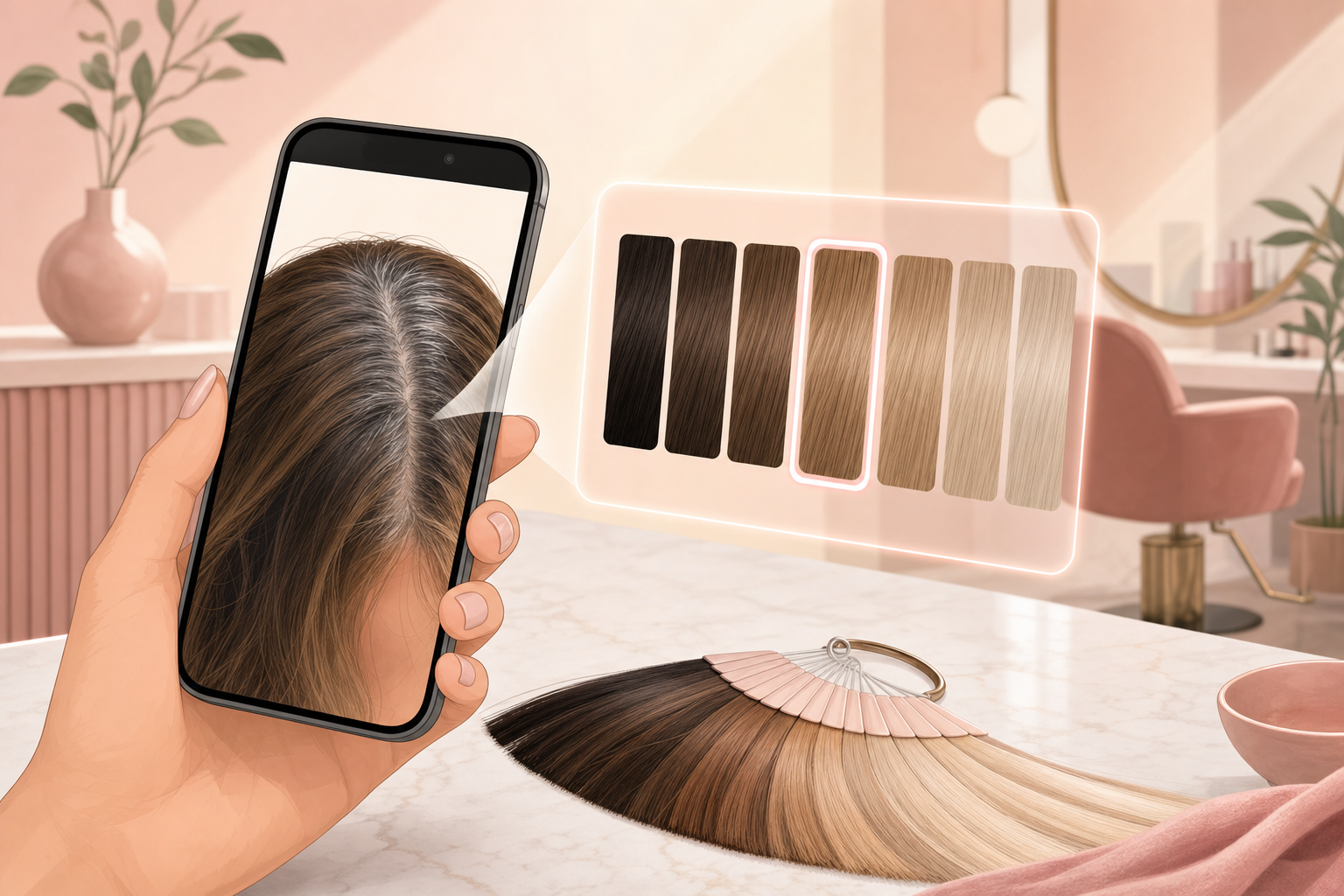
A client books a balayage online for $220, the price listed on the salon's website under "starting at." She sits down, the colorist looks at her roots, and the real number is $380, because her hair has two years of box-dye buildup the website price never accounted for. She's annoyed. The colorist feels like the bad guy for a number they didn't set. Neither of them is actually wrong.
Hair color is one of the few services where the price genuinely can't be known until someone looks at the hair. A "starting at" number isn't dishonest, it's just incomplete, and incomplete pricing is what turns into an awkward conversation in the chair.
The fix is a working blueprint: Hair Salons & Barbershops, AI Color Complexity Assessment & Instant Quote Tool looks at the hair before anyone commits to a number, the same way a colorist would at a consultation, just in under two minutes instead of a scheduled visit.
The problem, specifically
Color pricing depends on variables a phone call or a generic booking form can't capture. Virgin hair colors predictably. Hair with a box-dye history, previous bleaching, or unknown at-home color can process completely differently, sometimes needing a color correction instead of the single service the client thought they were booking. Going more than a couple of levels lighter in one visit often isn't advisable for hair health at all, which turns a "one appointment" expectation into a multi-session reality no one explained upfront.
Salons handle this two ways today, and both cost something. A flat "starting at" price that grows once the stylist actually sees the hair damages trust exactly when it matters most, in the chair, mid-service. A required free consultation before any real quote protects the salon from that awkward moment, but it's slow, and plenty of price-shopping clients simply won't book a separate visit just to find out what something costs.
The timing matters too. Google expanded Local Services Ads eligibility to salons and personal care businesses in 2026, the same program that's driven lead costs up 60-70% year over year in home-service categories like HVAC and appliance repair over the past year. Salons are about to feel that same cost pressure, which makes converting more of what they're already paying for worth solving now, not after costs climb the way they did everywhere else.
How the blueprint actually works
The client uploads photos of their roots, mid-lengths, and ends, answers a short questionnaire on color history and gray coverage, and describes what they want in their own words. A vision-capable AI model looks at the photos the way a colorist would at a consultation: the current visible color at the roots versus the ends (regrowth reveals both the natural base and how long it's been since the last service), condition and porosity that affects how color takes, and any banding or unevenness suggesting a color history the client might not have reported accurately, which happens more than salons expect.
It doesn't just size the service, it's built to catch the two things that cause the worst client experiences. First, the multi-session reality: if someone wants a big color change in one visit, the assessment states plainly that it likely needs two sessions for hair health, rather than promising something that would either damage the hair or simply not be deliverable in one appointment. Second, the safety case: any history of henna, metallic dye, or unclear at-home color triggers a mandatory in-person strand test before any lightening gets priced at all, since those can react unpredictably with bleach in ways no remote photo assessment can safely rule out.
When the photos genuinely don't show enough, roots not visible, poor lighting, a vague goal with nothing specific to size against, the tool doesn't force a number. It routes straight to a free consultation booking instead, honest about the limits of what a photo can tell you rather than guessing with false confidence.
A worked example
Picture a client called Luxe Hair Studio, in Austin, with a $25 booking deposit.
A client uploads three clear photos in good light: visible roots showing a natural level 5 brown, mid-lengths and ends a level 7 with some previous highlights growing out. History: salon-colored only, last service 4 months ago, no gray. Desired outcome: "blend my roots and refresh the highlights, nothing dramatic." High confidence, service assessed as partial highlights with a root blend, single session, price range $130-$180. She books a slot next week and pays the deposit.
Same week, a different client uploads photos showing dark roots against noticeably lighter, slightly brassy mid-lengths and ends, with history marked "box-dye, unsure of exact product." The assessment flags the discrepancy for the stylist's awareness, and since the desired outcome is "go blonde," the safety flag trips: an in-person strand test is required before any lightening, no price given for that portion. She's routed to a free 15-minute consultation instead, arriving already knowing why, rather than being surprised by an unexpected extra step.
Elapsed time from photo upload to a confirmed next step, priced booking or consultation slot, in both cases: under two minutes.
What actually goes wrong in week one
Worth naming directly. Photo lighting is the real early friction point, more than it looks like on paper. A phone photo taken under yellow indoor lighting can make a level 6 look like a level 4, and the AI will generally spot the general service category faster than it nails an exact dollar figure in the first couple of weeks, which is exactly why the build includes a 2-week supervised pilot where the colorist glances at every assessment before the client sees it.
The safety-flag logic will also trigger more often early on than salons might expect, since a meaningful share of clients genuinely don't know their own full color history. That's not a bug in the tool, it's catching a real risk a generic booking form would have no way to know about.
Who should build and sell this
This fits an agency or freelance builder already working with local service businesses, or someone starting there with the salon build as an entry point into a category that hasn't been oversaturated with app-reseller pitches yet. The buyer is an independent salon or barbershop doing $15,000 to $60,000 a month in color and chemical services, currently quoting by phone or requiring in-person consultations for every color inquiry. Find them through Google Maps and Instagram searches for salons and colorists in a target city, local beauty-industry Facebook groups, and salons that have started running Google ads now that Local Services Ads eligibility has opened up to the category.
The pitch is short. Ask how a color inquiry gets priced today. If the answer involves either a vague starting price or a mandatory free consultation, show a photo-to-price flow that gives a real, honest answer in under two minutes, and books the ones that need a closer look without losing them to a scheduling gap.
Worth pointing out to a skeptical salon owner during that pitch: the assessment tool isn't trying to replace the consultation entirely, it's trying to remove the consultation requirement for the majority of straightforward cases while still routing the genuinely complex ones to a real in-person look. That distinction tends to land better than a pitch that sounds like it's cutting the colorist out of the loop.
The economics
Setup runs $2,500 to $4,000 for the build and onboarding. The monthly retainer of $297 to $497 covers hosting plus the OpenAI, Twilio, and Stripe usage costs, along with tuning the pricing table to the salon's real local rates as bookings come in. A performance option is worth offering too: knock $500 to $1,000 off the setup fee in exchange for a flat $10 to $15 fee per confirmed color-service booking (not free consultations) generated through the tool for the first six months. Color services run $65 for a simple root touch-up to $500 or more per session for a color correction, with full balayage averaging $150 to $400, so even modest booking volume clears that performance fee easily while keeping your payout tied to bookings that actually happen.
Average job value through the tool spans that same $65 to $500+ range, skewing toward the middle for typical root-touch-up and partial-highlight bookings and higher for full balayage and multi-session color correction work, the highest-margin services in most salons' menus. Multi-session correction work is worth calling out specifically to a prospective client: it doesn't just mean a bigger single ticket, it means a second appointment already booked into the calendar before the first one's even happened, which is exactly the kind of repeat revenue most booking tools never surface on their own.
Why this isn't just another booking calendar
Plenty of tools let a client pick a time slot from a calendar. That alone doesn't solve the actual problem, because a calendar has no idea what a specific client's hair can support or what it'll actually cost until someone looks at it. A flat menu price bolted onto a booking calendar either underquotes complex hair or overquotes simple hair, and a required consultation for every inquiry just moves the guessing game to a second appointment instead of removing it.
The photo-based color assessment is the actual product. Anyone can build a calendar. Building one that actually looks at the hair, honestly separates what can be priced now from what genuinely needs an in-person look, and catches a real safety consideration most booking tools never think to ask about, that's the part that replaces the guessing game instead of just scheduling around it.
Setting expectations with the client
Part of selling this well is being honest about what it does and doesn't replace. It doesn't replace a colorist's in-person judgment, and it isn't meant to. What it reliably does from day one is remove the blind guess before someone's even in the building, giving both the client and the stylist a real, photo-grounded starting point instead of a vague number stretched to fit whatever the phone call implied. Set the pilot-period expectation up front so early assessments needing a manual nudge reads as the system working as designed.
Why a real app, not just a web link
The build's launch playbook wraps the finished tool as a native app through AppBuild.DIY rather than leaving it as a bookmarked website. A client booking a color appointment trusts an app icon on their home screen more than a link buried in browser history from weeks ago. Push notifications for booking confirmations and appointment reminders get opened at a far higher rate than a text competing with everything else in an inbox. Enabling the Photos/Camera capability means clients upload straight from their native camera instead of a clunky browser file picker, which shows up directly in clearer, better-lit photos and more High-confidence assessments.
Why now
Vision-capable AI models became reliable enough at this kind of nuanced visual assessment recently enough that most independent salons haven't caught up to what's possible yet. Meanwhile, Google's 2026 expansion of Local Services Ads eligibility to personal care businesses means salons are about to face the same lead-cost pressure every other local-service category has already gone through. The salons that add instant, honest color pricing first in their local market get to be the one that answered with a real number in two minutes, while competitors are still asking every color client to book a separate consultation just to find out what something costs.
Get started
The full build, the exact hair-assessment prompt with its pricing reference table and safety logic, the 10-step build playbook, and the step-by-step launch guide covering everything from Twilio's A2P 10DLC step to the AppBuild.DIY wrap are all in the blueprint itself, ready to paste into Lovable and adapt for a first client this week. Nothing in it requires knowing how to code, and nothing in the pitch depends on the salon understanding what's happening under the hood. They just need to see a real price come back from a photo in under two minutes.