
Sixty Names Had to Go. The Argument Lasted Two Hours.
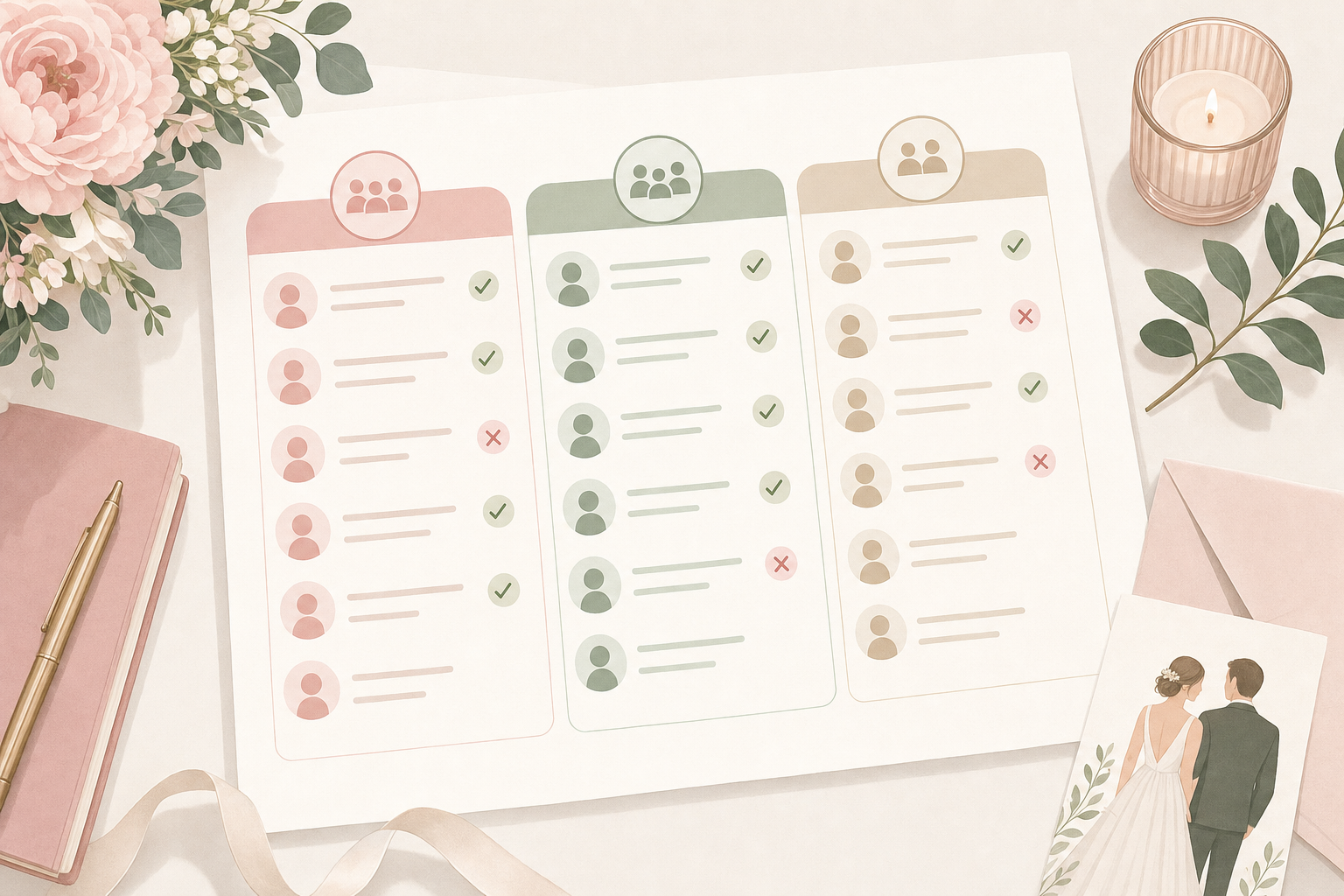
A couple sits down with a guest list at 180 names and a venue that holds 120. Sixty names have to go. By hour two they're arguing about whether Dad's college roommate counts as "family" and whether cutting one cousin but not another is going to start something that outlasts the marriage. The wedding isn't even the hard part anymore. The list is.
Every couple hits this wall eventually, and almost no one has a system for it going in. They just start cutting names one at a time, which is exactly how a reasonable process turns into a two-hour argument about who's owed what.
The fix is having a rule before you start: Cut Your Guest List Without Starting a Family War gives you a structure to cut by, so the decisions feel consistent instead of personal.
Why guest list cuts go badly
The actual problem isn't that couples don't want to make hard calls. It's that cutting one name at a time, in whatever order they come to mind, means every single decision feels like a referendum on that one person. Is Dad's roommate closer to the couple than Mom's second cousin? There's no good answer to that question asked in isolation, and answering sixty of them one at a time is exhausting and inconsistent by nature.
The inconsistency is what actually causes hurt feelings later, not the cuts themselves. If two cousins are equally close and one makes the list while the other doesn't, that's the kind of thing that gets noticed and remembered for years. Most guest list fights aren't really about the wedding. They're about a decision that looked arbitrary from the outside, even when it wasn't meant that way.
How the prompt works
Instead of cutting names one at a time, it sorts the whole list into tiers first: must-invite (immediate family, closest friends), strong-consider (extended family and close colleagues, usually invited or excluded as a group rather than picked apart individually), and optional (broader acquaintances, plus-ones for people the couple doesn't actually know).
Cuts come from the bottom tier first, and within a tier, consistently, not by picking favorites among people who are equally close. It gives a specific number of cuts needed from each tier to hit the target, so the couple isn't guessing how far to go. And it flags the plus-one question directly, since an inconsistent plus-one policy (some single friends get one, others don't, with no clear rule) is one of the most common, most avoidable sources of hurt feelings in the entire process.
A worked example
Say a couple has 180 names against a 120-person venue cap, 60 cuts needed. Sorted into tiers: 70 must-invite (immediate family, wedding party, closest friends), 75 strong-consider (extended family, work colleagues, closer acquaintances), 35 optional (broader friend-of-a-friend connections, plus-ones for people the couple has met once or twice).
The must-invite tier stays untouched. All 60 cuts come from strong-consider and optional, starting with optional (35 cuts gets it to zero) and the remaining 25 from strong-consider, applied by category, not name by name, so if the rule is "cousins are invited as a full group or not at all," that rule holds across the whole extended family instead of some cousins making the cut and others not for reasons no one can quite explain later.
The plus-one note lands here too: a blanket rule ("plus-ones for anyone in a serious relationship or married, not for casual dating") applied consistently avoids the specific scenario that causes the most friction, one single friend getting a plus-one while another, equally close, doesn't.
Where the value actually sits
This isn't really about making the math easier, the math was never the hard part. It's about removing the couple from being the visible decision-maker on every single individual cut. "We're only inviting first cousins as a full group" is a policy. "We decided your cousin makes the cut and yours doesn't" is a grudge waiting to happen. Same outcome in some cases, completely different way of arriving at it, and the difference is what actually gets remembered.
How to use it
- Get the full guest list and the real target number (venue capacity or the count the budget actually supports) before starting.
- Run it through the prompt to get the tiered structure and the specific cut count needed per tier.
- Apply the cuts by category, not by individually re-litigating each name, and decide the plus-one rule once, as a blanket policy, before anyone asks.
The list still has to shrink. That part doesn't change. What changes is whether the process that gets it there feels like a fair, consistent system, or like a series of individual judgments about who mattered more. Only one of those survives past the wedding without leaving a mark.