
The Cake Photo Landed at 11pm. The Price Came Back on Thursday.
The message lands at 11:08pm. A screenshot of a two-tier drip cake with gold sprinkles, then four words: "How much for this?"
The baker sees it at 6:40 the next morning between proofing trays. She needs the date, the servings, whether that's buttercream or fondant, pickup or delivery. So she asks. The customer replies at lunch. The baker replies at 4. By the time a number finally goes back, it's Thursday, and the customer has already paid a deposit to the studio across town that answered in ten minutes.
Multiply that by 20 DMs a week and you have the actual job of running a custom cake business in 2026. The baking is the easy part.
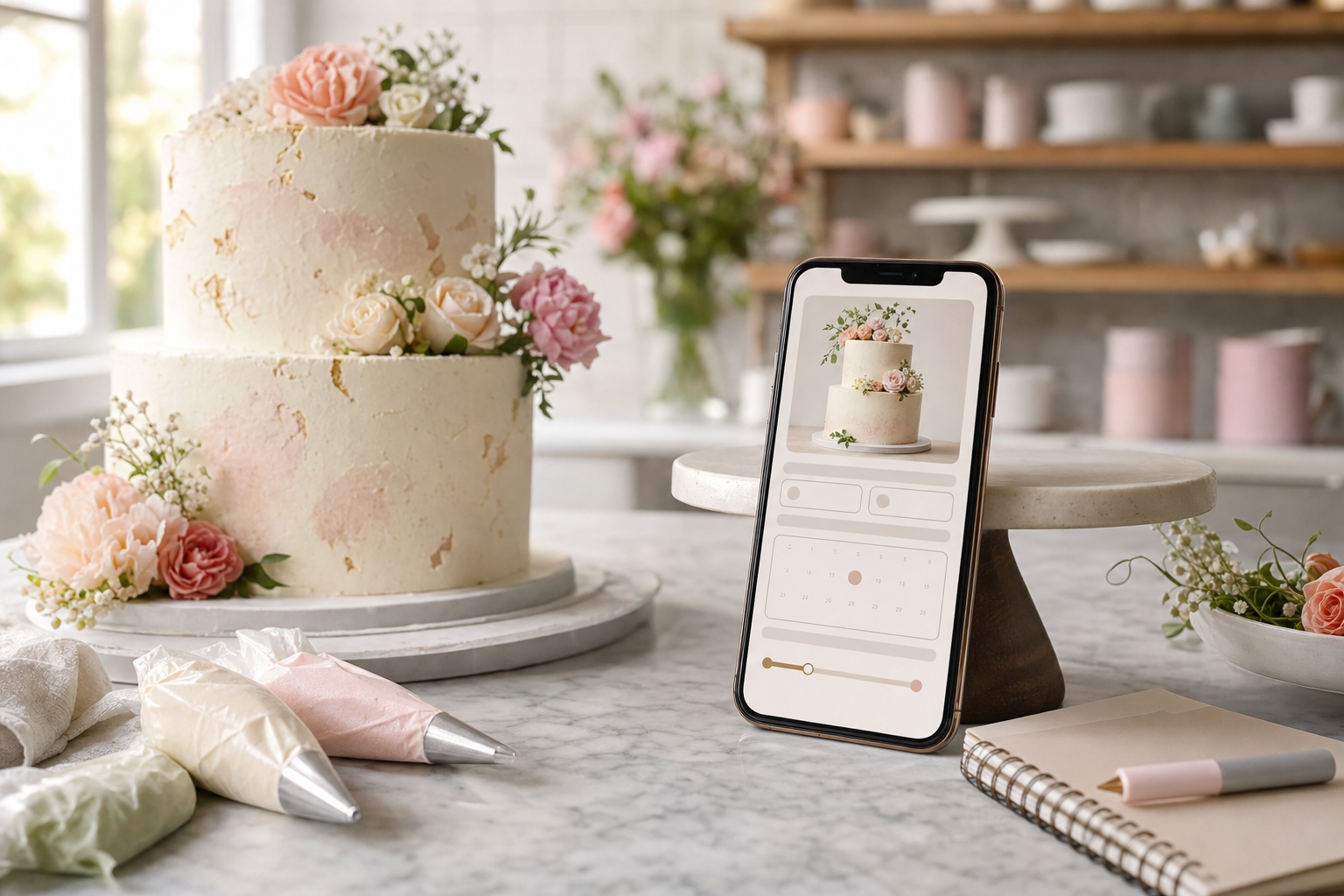
The fix is a pro prompt that builds the whole front door in one paste: Custom Cake Bakeries, Photo-Reference Complexity Quote & Deposit-Locked Capacity Calendar. A customer uploads their inspiration photo, picks a date and serving count, sees a price range in under a minute, and pays the deposit that locks the date. The bakery gets an inbox and a week-by-week capacity board. Grab it, paste it into Lovable, and you have a working tool the same afternoon.
Why the DM is the problem, not the customer
Instagram is where custom cake customers live. It's also the worst possible place to take an order. A DM has no intake form, no event date field, no deposit button and no record that survives the customer deleting the thread. Every order that starts there is one missed reply away from being lost, and every detail the baker needs has to be asked for one message at a time.
The numbers behind this are well documented by the people who coach bakers for a living. Owners typically spend 3 to 5 hours a week on inquiries, chasing details and quoting. Bakers who move to an order form report fewer no-shows and better-qualified inquiries, and they stop asking for the same information twice.
Then there's the second problem, which is less visible and more expensive: over-booking. A single home oven and one decorator tops out at roughly 6 to 8 custom cakes a weekend, with each mid-tier cake eating 3.5 to 5 hours of baking, cooling, decorating, boxing and cleanup. When orders live in a chat thread, the baker finds out she's at nine cakes on a six-cake weekend on the Wednesday before. Someone gets a refund and an apology, and someone else gets a cake made at 2am.
Both problems have the same root cause. The bakery's rules (prices, lead times, deposits, capacity) live in the owner's head instead of in the ordering process. This blueprint moves them into the process.
How the blueprint actually works
The master prompt describes a small web app with two sides and a set of rules that drive everything.
On the customer side, the flow is four screens. Upload one to three inspiration photos. Enter the serving count (quick buttons for 12, 24, 40, 60, 100, 150), pick buttercream or fondant or "match the photo", choose a flavour, add notes. Pick the event date, occasion, and pickup or delivery. Then a short loading state while the photo is assessed.
The assessment is the interesting bit. The app sends the photos to a vision model with a very specific brief: you are a senior cake decorator pricing this photo, return strict JSON with a complexity tier from 1 to 4, the finish you can see, the number of cake tiers, a list of decorative elements (drip, fresh flowers, sugar flowers, modelled figure, gold leaf, hand painting), a confidence score, and one plain sentence a customer could read.
The four tiers map directly onto how real bakeries already price. Tier 1 is smooth or rustic buttercream with basic piping. Tier 2 is themed: custom colours, drip, ombre, fresh florals, a printed topper. Tier 3 is sculpted fondant with modelled figures or carved shapes. Tier 4 is premium: hand-painting, handmade sugar flowers, gold leaf, isomalt, or any wedding cake of 3 tiers or more. The multipliers run 1.0, 1.3, 1.7 and 2.0, which sits inside the 1.2 to 2.0 complexity range the current cake pricing guides use.
Price is then arithmetic. The bakery's own per-serving base ($4 to $6 for buttercream, $6 to $10 for fondant are the going US ranges, and both are editable fields) times the tier multiplier times servings, plus $25 per extra tier for structure, plus delivery by distance band, plus a $125 on-site setup charge for assembled wedding cakes. The customer sees a range with a 15 percent spread rather than a single number, because the decorator confirms the exact figure once they've looked at the photo themselves.
Before that price screen ever renders, the app checks the week of the event against the bakery's cap. Default is 6 custom cakes per Monday-to-Sunday week, with a Tier 4 cake counting as 2 slots. If there's room, the customer sees a "Lock my date" button and pays the deposit through Stripe Checkout. If the week is full, they see that plainly, with the three nearest open weeks as tappable alternatives and a waitlist option that captures their details without payment.
The deposit is what makes this different from a contact form. Industry standard is 25 to 50 percent, non-refundable, because it reserves calendar space and often covers supplies already bought. The cake bakery blueprint defaults to 50 percent and makes the percentage a client-editable field, and a paid deposit is the only thing that consumes a capacity slot. Quotes that never convert don't block the calendar.
On the owner side there are five screens: an inbox with every request and its status, an order detail view with the photos large and the price calculation line by line, a 12-week capacity board, settings for every rule, and monthly reports. The reports include one number that matters more than the rest, which I'll come back to.
A worked example
Say Maya wants a cake for her daughter's 7th birthday. It's a Saturday three weeks out. She's saved a photo from Pinterest: a two-tier pastel buttercream cake with a pink drip, a cluster of macarons on top, and a printed unicorn topper.
She opens the link from the bakery's Instagram bio at 9:30pm, uploads the photo, taps 40 servings, picks "match the photo", vanilla, and adds "no nuts please". She picks the Saturday and chooses pickup.
The vision model returns tier 2, buttercream, 2 cake tiers, elements: drip, macarons, printed topper, confidence 0.91, reason: "Buttercream finish with a drip and placed decorations puts this in our Themed tier."
The maths: $5 per serving times 1.3 times 40 servings is $260. One extra tier adds $25. Pickup is free. Low end $285, high end $285 times 1.15, rounded to $330. Maya sees "from $285 to $330", the tier explanation in plain English, and a deposit of $143 (50 percent of the low end) with a balance due date 14 days before the party.
The capacity check runs. That week has four deposit-paid orders out of six. Maya sees the lock button, pays $143 through Stripe, and lands on a confirmation page with a permanent status link. The bakery owner gets an SMS: "New order locked for Sat 17 Oct: 40 servings, Tier 2, $285 to $330." Total elapsed time from the first tap: about four minutes. No DM was involved.
Two days later the decorator opens the order, looks at the photo properly, and confirms $310. That triggers Maya's "price confirmed, balance of $167 due by [date]" email with a pay link. Reminders go out 3 days before the due date and on the day. The day before the party she gets the pickup time and address. Two days after, a thank-you with the Google review link.
Now the variant that shows why the range and the review path exist. Suppose Maya's photo had been a screenshot of a video with a play button over it, and the model came back at confidence 0.52. The app still shows a quote, but widens the high end to 30 percent and flags the order NEEDS REVIEW in the inbox, so the decorator eyeballs it before anything is confirmed. And if she'd uploaded a photo of her dog by mistake, the model returns tier 0 and the app asks for a cake photo or shows a "describe it instead" text path. Nothing ever gets priced that the rules don't cover.
The capacity board is where owners lean in
Every demo of this tool goes the same way. The quote flow gets a nod. The capacity board gets the owner picking up the phone.
It's a 12-week grid. Each week shows slots used out of the cap as a bar, each order as a chip, Tier 4 orders as double-width. Full weeks go red. The owner can close a week for a holiday or raise the cap for one specific week when a second decorator is in. And the double-booking safeguard is real: if two customers try to pay for the last slot in the same week within seconds, the Stripe webhook re-checks capacity, refunds the loser automatically and emails both parties.
The number I mentioned earlier lives in the reports screen: quotes lost because the week was full. That's demand the bakery turned away. If a bakery lost 8 orders to full weeks last month, that's somewhere between $1,600 and $3,000 of work it could have taken by raising the cap or bringing in a part-time decorator on Fridays. Owners have never had that number before. It changes hiring decisions.
Who should build this, and what it's worth
The target is any custom cake business that already says "DM for pricing" in its bio. Independent cake studios, licensed home bakeries doing 4 or more custom orders a week, and bakery counters that do wedding and celebration work. The tell that they're ready is a policies highlight about deposits and lead times: they've already felt the pain of running orders out of a chat thread, they just haven't found a tool that fits.
Skip supermarket bakeries and franchises with head-office ordering. And check cottage food law before selling to a home baker in a state that restricts online sales or delivery.
On the money, the pro prompt's pricing section suggests:
- Setup fee of $1,800 to $3,000, covering the build, Stripe and SMS setup, the tier calibration session on the bakery's own cakes, and a two-week supervised pilot.
- Monthly retainer of $197 to $347, covering hosting, the OpenAI and Twilio usage, template edits, reporting and a quarterly pricing recalibration.
- A performance bonus of $25 per deposit-paid order above the bakery's previous monthly average. A studio going from 12 to 20 custom orders a month pays an extra $200 on orders that average $200 to $450 each. Everyone's happy.
- $150 per additional location for multi-shop clients sharing one dashboard.
Costs to run it are small. Each photo classification is one or two cents. Stripe takes 2.9 percent plus 30 cents per payment. Resend is free to 3,000 emails a month. Twilio SMS is under a cent each plus about a dollar a month for the number. A bakery doing 25 orders a month costs you under $15 in usage.
The calibration session is the part to take seriously. You sit with the owner, run 10 to 15 of their own finished cakes through the flow, and adjust multipliers in settings until at least 12 of 15 land in a range they'd have charged. That hour is where the owner stops seeing "AI pricing" and starts seeing their own pricing, automated. Expect 80 to 90 percent of real inquiries to land where the decorator would have put them after that, with the rest routed to the inbox for a hand quote.
Build time is a weekend if you follow the 12-step phase 1. The prompt is written to be run in a single paste with no clarifying questions, and it includes a build order that lets you test the pricing and capacity logic with a stubbed AI response before you've even added an API key.
Ship it as the bakery's own app
The last phase 2 step wraps the Lovable build as a native iOS and Android app plus a PWA through AppBuild.DIY, with push notifications and the camera plugin switched on. That matters more for cake bakeries than for most trades.
A customer who orders a birthday cake once will order another one in twelve months. If the bakery's app is on her phone, that second order comes through the app. If it isn't, it comes through whichever bakery Instagram happens to show her that week. And push lets the bakery tell every past customer "Christmas orders close on 10 December" in one tap, at a 60 to 90 percent open rate, instead of hoping a grid post reaches them. Order alerts hitting the owner's lock screen, and "your cake is ready" pings going out as push instead of SMS, are the bonus.
Why build this one now
Custom cakes are a high-ticket, high-emotion, photo-first purchase, and the ordering process at most bakeries is still a chat thread. The vision models got good enough this year to grade a cake photo reliably against a written rubric. Stripe Checkout takes deposits in a single redirect. Lovable turns a 15,000-character spec into a working app in an afternoon. The three pieces this tool needs all matured at the same time, and almost no bakery has put them together yet.
Go and search "custom cakes" plus your city on Instagram. Count how many bios say "DM to order". Each one is a demo waiting to happen, and the demo takes three minutes on a phone.
Get the Custom Cake Bakeries pro prompt now: the full master prompt, all 8 client fields, the 12-step build playbook, the 9-step sell-and-run playbook, required tools, pricing and a cold outreach script you can send tonight.