
The Quote Follow-Up Sequencer: Turning Ghosted Estimates Back Into Booked Jobs
The Quotes That Die of Neglect, Not Rejection
Somewhere between 60 and 75 percent of quotes a contractor sends never turn into a job. That number holds across roofing, HVAC, plumbing, remodeling, landscaping, painting, solar and pool construction, which tells you it isn't a pricing problem or a product problem. It's a follow-up problem. Most of that lost revenue doesn't come from a homeowner who compared three bids and picked a competitor. It comes from a homeowner who said "let me think about it," meant it honestly, got busy with their kid's soccer schedule and a work deadline, and simply never circled back. The contractor, meanwhile, is out on another job site measuring a different roof and has no system for reminding that first homeowner they exist.
This is the gap the Quote Follow-Up Sequencer is built to close, and it's worth sitting with why the gap exists before looking at how the tool closes it. A one-person or five-person trades business does not have a sales development rep. The owner or office manager sends the quote, maybe makes one follow-up call if they remember, and then the lead falls into a folder that nobody opens again. There's no CRM cadence, no drip sequence, no second or third touch, because building and running one by hand takes discipline that a business focused on actually doing the roofing or the plumbing rarely has spare capacity for. The prospect isn't rejecting the offer. Nobody ever asked them again.
The blueprint's own numbers make the size of the opportunity concrete: a disciplined follow-up sequence closes 15 to 30 percent of quotes that would otherwise have gone cold, which the sales page translates into $30,000 to $200,000 a year in recovered revenue for a business that's already sending a meaningful volume of quotes. That's not new demand generation. That's money already sitting on the table from people who already raised their hand and asked for a price. It is, in other words, the highest-margin kind of revenue a service business can recover, because the cost of acquiring the lead has already been paid.
The entire system, database schema, six-touch sequence, halt logic, reply classifier, is already built out step by step in the Quote Follow-Up Sequencer (Universal) blueprint. If you'd rather build this and sell it to real contractors than just read about it, that's where you start.
What You're Actually Building
Strip away the sales language and the Quote Follow-Up Sequencer is a small, purpose-built application: a database of quotes, a scheduling engine that fires messages on a timer, an LLM that writes the copy for each message in context, and a notification layer that pings the business owner when a human replies. Built in Base44 (or a comparable app builder like Lovable), it's small enough for a solo builder to ship in days, not weeks, which is exactly why it works as a productized service you sell to multiple local businesses rather than a custom build for one client. The full blueprint spells out the exact schema and prompt chain for each step, so you're not reverse-engineering the architecture from a blog post.
The trigger condition is simple and that simplicity is the point: a quote gets sent, and if 48 hours pass with no reply from the customer, the sequence engine wakes up and starts writing. There's no manual step where someone has to remember to kick it off. The system watches the clock so the business owner doesn't have to.
Three Doors a Quote Can Walk Through
A tool like this only works if getting a quote into the system is close to effortless, because a contractor who has to double-enter data will quietly stop using it within a month. The blueprint handles this with three separate entry paths, each aimed at a different kind of buyer.
The first is manual entry: the business owner or office manager types a new quote in directly when they close out an estimate, which is the baseline path every customer can use on day one regardless of what other software they run.
The second is an import from whatever job-management software the business already lives in: QuickBooks, ServiceTitan, or Jobber. Most established trades businesses already track estimates somewhere, and forcing them to abandon that system to adopt yours is a fast way to lose the sale. Pulling quotes in from tools they already trust removes that friction entirely and turns the sequencer into an add-on layer rather than a replacement system.
The third path is the most interesting one strategically, because it isn't really about data entry at all: quotes auto-import directly from any of the other visualizer tools in the same library when the two are bundled together. If a homeowner uses a roofing satellite quote tool, a backyard pool visualizer, or a kitchen re-render tool to generate an instant estimate, that estimate can flow straight into the follow-up sequencer without anyone touching a keyboard. This turns two separate products into one connected pipeline: the visualizer generates the quote and captures the lead at the moment of maximum interest, and the sequencer takes over the moment that interest goes quiet. Neither tool needs the other to function, but sold together they cover the entire arc from "here's your instant estimate" to "are you still interested," which is a stronger pitch than either one makes alone.
Six Touches, Thirty Days, One Job: Stay in the Room Without Becoming Annoying
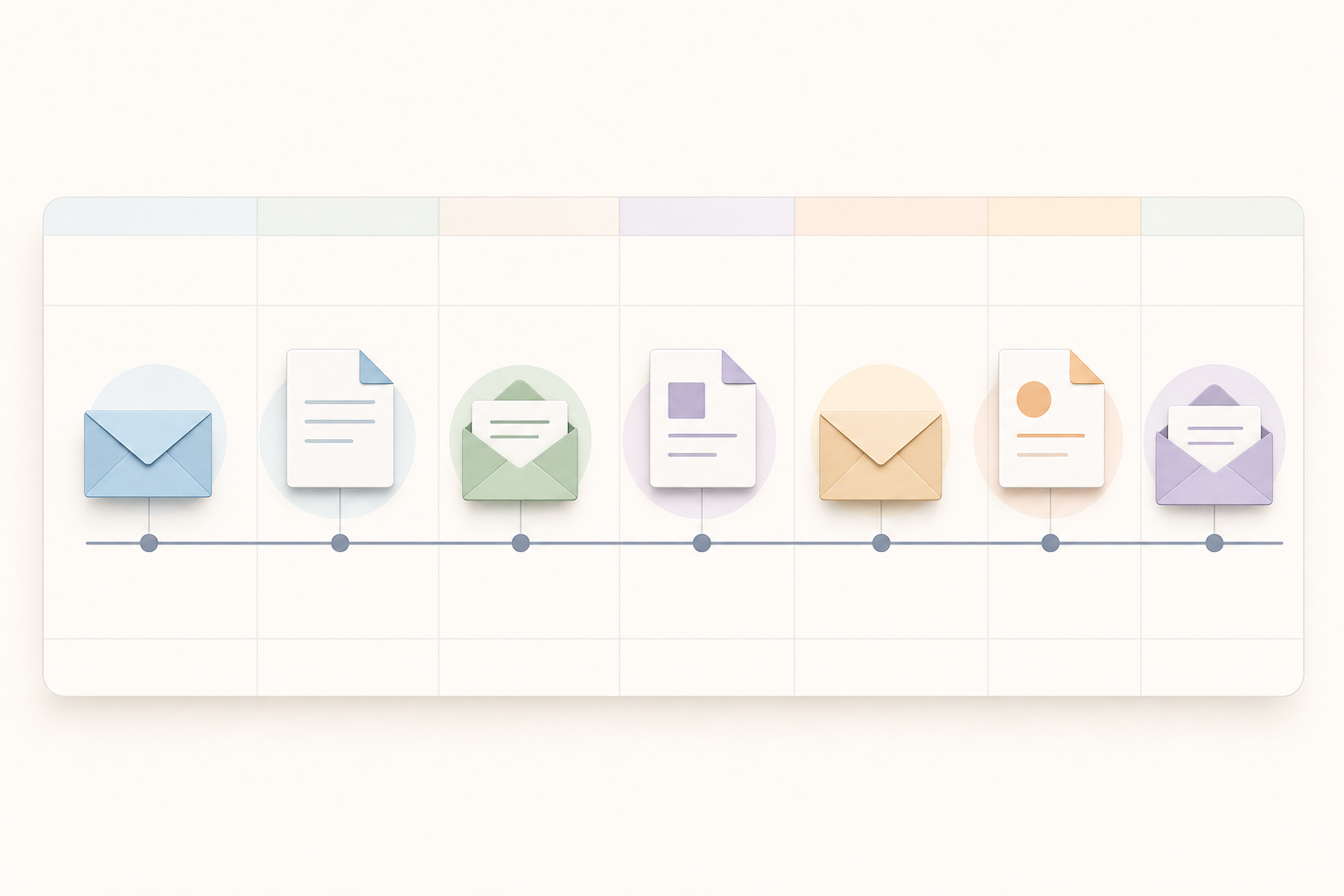
Once a quote sits unanswered past that 48-hour trigger, it enters a sequence of six scheduled messages spread across thirty days, and the reason it's six messages rather than one aggressive reminder is that each one is doing a different job. A single generic nudge reads as spam. A sequence that changes its angle every few days reads as a business that's genuinely still available to help, which is a completely different emotional signal to a homeowner sitting on a decision.
| Day | Touch | Job it's doing |
|---|---|---|
| 2 | Check-in | Low-pressure "still thinking about this?" nudge, assumes good intent rather than assuming they went cold |
| 5 | Value-add | Adds something useful, not salesy, like financing options or recent customer reviews, to give a reason to re-engage besides "buy now" |
| 10 | Social proof | Shows the customer they aren't the only one weighing this decision, using other jobs or testimonials to build confidence |
| 14 | Limited-time urgency | Introduces a real reason to decide soon, whether that's scheduling availability or a pricing window, without inventing false scarcity |
| 21 | Final close | A direct, no-frills attempt to get a yes or a clear no before the sequence winds down |
| 30 | Graceful exit | A polite closing message that leaves the door open for the future instead of just going silent, so the relationship doesn't end on an awkward note |
Look at the arc that creates: check in, add value, build confidence, add urgency, ask directly, then bow out with grace. It mirrors exactly what a good salesperson does on the phone over a month of calls, except it happens automatically, at scale, across every quote the business sends, whether that's five quotes a week or fifty. And because each message is written by an LLM with the specific quote's context (the customer's name, the job type, the amount, how long it's been since the quote went out) it doesn't read like a template. It reads like someone actually remembered them.
The Part That Actually Makes This Safe to Ship: Halting Instantly
Here's the piece of this build that separates a tool you can actually put in front of paying customers from a toy that will embarrass you the first week it's live. If a customer replies to touch two on day five, saying "yes, let's book it" or even just "not interested, thanks," the system has to stop sending the rest of the sequence immediately. Not by the next scheduled run. Not "eventually." Instantly, and with zero chance of a race condition where the customer's reply and the next scheduled message cross paths and both fire.
Picture the failure mode if this isn't built correctly: a homeowner replies at 9:03am to say they've already hired someone else, and at 9:05am the scheduler, unaware anything changed, fires off the day-10 social proof message anyway. Now the business looks like it isn't listening, which is worse than never following up at all, because it confirms the exact fear a lot of homeowners have about automated outreach: that nobody's actually paying attention on the other end.
The blueprint's answer to this is an atomic check built directly into the send path rather than a separate cleanup process. Before any scheduled message goes out, the system re-fetches the quote record fresh from the database and checks a single field: has this sequence been halted? If it has, the scheduled message gets marked as skipped and the send never happens, and critically, that check has to happen inside the same transaction as the send itself, not as a prior step that could go stale between the check and the action. That's the difference between "this system usually doesn't double-message people" and "this system cannot double-message people," and for a tool that's going to run unattended on someone else's customer list, that distinction is the whole ballgame. This is the one piece of the build you cannot cut corners on, because it's the one failure a business owner will actually notice and remember.
Reading the Reply: Booking, Question, Declined, Complaint
Halting the sequence solves half the problem. The other half is making sure a human being actually sees the reply and knows what to do with it, fast. The moment a customer responds to any message in the sequence, the system classifies the intent behind that reply into one of four buckets: a booking (they want to move forward), a question (they need more information before deciding), a decline (they've gone with someone else or decided not to proceed), or a complaint (something about the original quote or the outreach itself upset them). That classification gets pushed to the business owner as an SMS notification in real time, so a genuinely hot reply, someone ready to book a $14,000 job, doesn't sit in an inbox until Friday because the owner was on a roof all week.
This is what turns the tool from a passive reminder system into an active lead-routing layer. A generic autoresponder just sends messages on a timer and hopes someone notices when a reply lands. This system reads the reply, decides what kind of moment it is, and tells a real person exactly how urgently to react. A booking reply and a complaint reply both deserve a same-day response, but they need completely different tones, and the owner walking into that conversation already knowing which one they're dealing with is worth more than the follow-up messages themselves.
A $14,000 Roof That Almost Got Away
Take a concrete case to see how this actually plays out. A roofing contractor quotes a full tear-off and reroof for a homeowner at $14,200, sends the PDF over email on a Tuesday afternoon, and hears nothing back. The homeowner isn't stalling out of doubt. They got the quote, meant to talk it over with their spouse that weekend, and then a work trip came up and the whole thing slipped their mind entirely.
Forty-eight hours pass with no reply, and the sequence engine kicks off. Day 2's check-in goes out Thursday morning, something short and low-pressure, along the lines of confirming the quote is still on the table and asking if they had any questions after reviewing it. No response. That's normal, most people don't respond to the first nudge, which is exactly why the sequence doesn't stop there.
Day 5 lands on the following Sunday evening, right when the homeowner is finally sitting down after the work trip catching up on personal email. This is the value-add touch, and instead of just asking again, it mentions that the business offers 0% financing over 12 months for jobs over $10,000, and links to two recent five-star reviews from homeowners in the same zip code who had similar tear-off jobs done that summer. That combination does two things at once: it removes a real objection the homeowner hadn't voiced (can we actually afford this right now) and it reduces the perceived risk of hiring a contractor they haven't worked with before. The homeowner reads it, remembers they'd actually meant to reply days ago, and texts back: "Sorry for the delay! The financing option is helpful, can we get on a call this week to go over the exact start date?"
That reply hits the system within a second of being sent. The halt logic fires immediately, so the day-10 social proof message that was scheduled never goes out, there's no awkward overlap where a second automated message lands on top of a live conversation. The reply gets classified as a question, since the homeowner is asking for a call rather than confirming a booking outright, and the owner gets a text notification within moments: new reply on the $14,200 roofing quote, classified as a question, financing mentioned, wants to schedule a call. The owner, who's currently on a different job site with dusty hands and zero time to check email, reads that text on his phone in ten seconds and calls the homeowner back that evening. Job closes the following week.
Without the sequence, that $14,200 job is sitting in a "quoted" folder that nobody reopens, and the homeowner's genuine, honest intention to move forward quietly evaporates under the weight of a busy month. The value-add touch didn't manufacture interest that wasn't there. It just showed up at the moment the homeowner was finally free to act on interest that had been there the whole time.
Who Should Build This, and What It's Actually Worth
This is not a tool aimed at a solo contractor building it for their own business. The economics only make sense as a productized service sold to multiple trades businesses in the same category, and the blueprint's own pricing reflects that: a $1,500 setup fee per client plus a $397 monthly retainer. Running costs are low enough to leave real margin on that retainer: the Base44 builder plan runs about $50 a month, LLM calls for message generation run roughly $50 per 1,000 messages, and Twilio SMS runs about $1.15 a month per phone number plus a fraction of a cent per message sent. A business sending a modest volume of quotes each month is nowhere near burning through that $397 in raw infrastructure cost, which means most of the retainer is margin for whoever built and maintains the system. The blueprint's full pricing breakdown walks through that margin client by client, so you know exactly what to charge before you pitch the first contractor.
The buyer who should actually build and sell this is someone comfortable running a small AI app-builder like Base44 or Lovable, who can talk to a local contractor, plumber, or HVAC company owner in language they understand (recovered revenue, not "automation architecture"), and who's willing to own the ongoing relationship rather than just shipping code and disappearing. The setup fee covers the build and onboarding. The monthly retainer is what pays for updates, monitoring, and being the person the business owner calls when they want to tweak the sequence copy or add a new industry-specific value-add offer.
The cross-sell math is where this gets genuinely interesting as a business model rather than a one-off build. Because quotes can auto-import from any bundled visualizer tool in the same library, roofing satellite quote generators, pool backyard visualizers, kitchen re-render tools, a builder who's already sold a visualizer to a contractor has a natural, low-friction second sale sitting right there. The pitch isn't "buy a second, unrelated product." It's "the tool you already have generates quotes, and this one makes sure none of them die of neglect." That's an easier close than a cold pitch to a brand-new client, and it roughly doubles the revenue per relationship without doubling the sales effort. A builder running five or six of these bundled pairs across different contractor niches in one metro area is looking at several thousand dollars a month in retainer income from a build that, once templated, takes a fraction of the time to redeploy for the next client.
Why This Is Worth Building Now
The case for building this today comes down to one number from the blueprint itself: 60 to 75 percent of quotes never convert, and the overwhelming majority of that loss traces back to a follow-up gap rather than a genuine no. Every contractor, plumber, and remodeler sending quotes right now has that gap open in their business whether they've noticed it or not, and almost none of them have the time, staff, or systems to close it themselves. That's not a market that needs to be convinced the problem exists. It's a market that's living the problem every week and has simply never been shown a fix that doesn't require hiring a salesperson.
What makes this buildable right now, specifically, is that the hard part isn't the AI-generated message copy, any reasonably capable model can write a warm check-in email. The hard part is the reliability engineering underneath it: the atomic halt check that guarantees a customer never gets double-messaged after they've already replied. That's the piece that makes a business owner trust the system enough to actually hand it their customer list, and it's a solvable, well-defined engineering problem, not a research project. Get that part right, bundle it against a visualizer tool that's already feeding it warm leads, and you've got a system that turns a business's own unanswered quotes back into booked jobs on autopilot, which is about as close to free money as a productized AI tool gets.
Every piece of this build, the schema, the six-touch sequence, the atomic halt check, the reply classifier, the pricing model, is already worked out for you. All that's left is picking your first contractor. Grab the Quote Follow-Up Sequencer (Universal) blueprint here and start building today.