
The Rain Doesn't Lose You Customers, the Silence After It Does
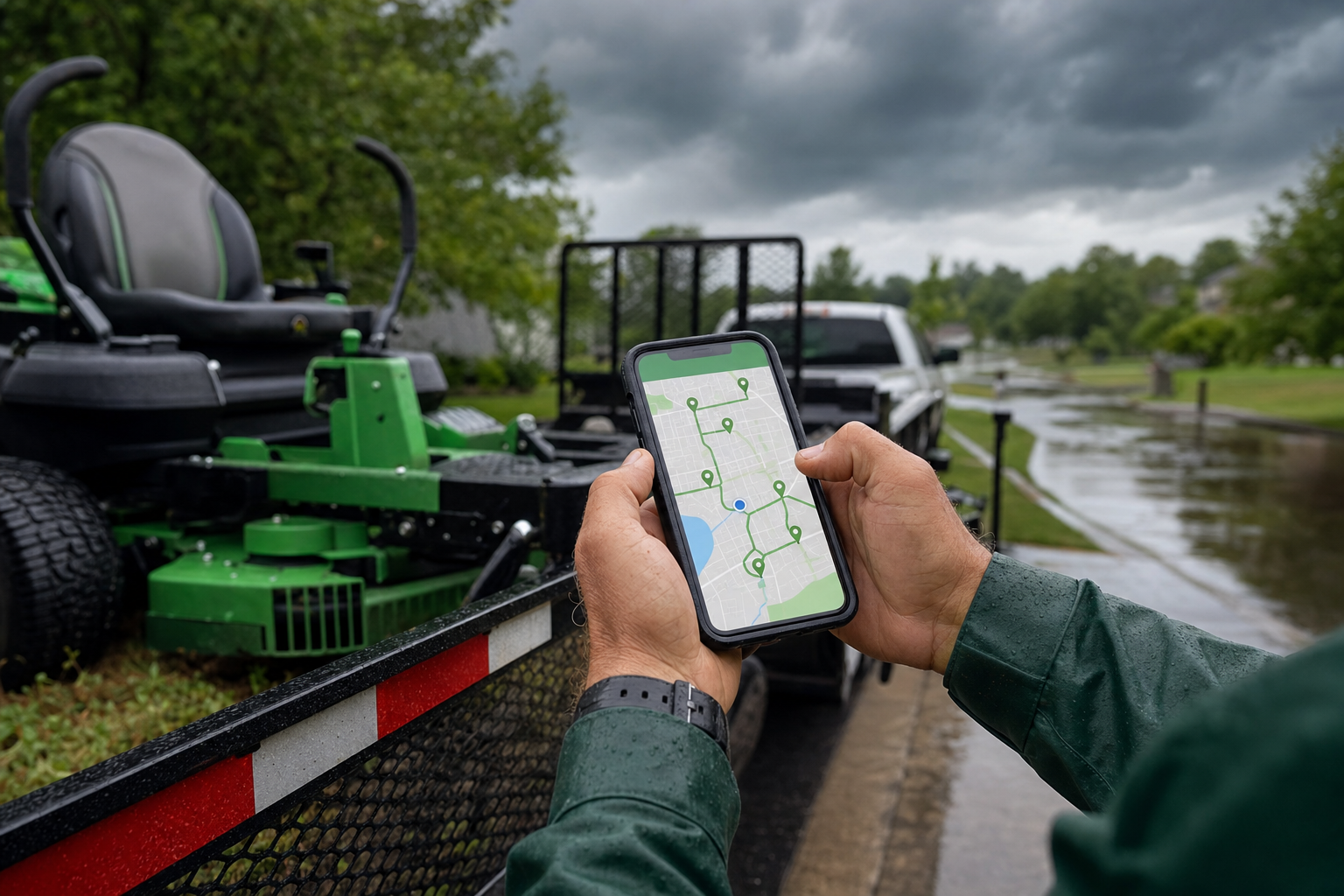
It rains on a Tuesday. A lawn care company with eleven routes scheduled that day has to figure out, fast, who's getting rescheduled and to when. The dispatcher starts calling customers one by one, some pick up, some don't, some get a voicemail that doesn't say when the new visit is, and by Thursday a handful of customers still don't know what happened to their Tuesday mow. A few of them cancel their plan entirely, not because of the rain, but because nobody told them anything.
Want to build the app that fixes this exact moment? The Recurring Route Optimizer & Weather Rescheduler checks the forecast automatically, reschedules customers before a visit is even missed, and keeps every technician's route optimized around whatever's actually happening that day.
The real problem isn't the weather
Lawn care and pest control run entirely on recurring visits, so weather disruption isn't rare, it's routine. What actually determines whether a rescheduled customer stays or cancels isn't the rain itself. It's whether they knew what was happening. Research into recurring-service churn backs this up directly: when cancellations spike after a rainy stretch, the cause traces back to a communication breakdown, not the weather event. A customer who understands the plan cancels far less than one left guessing whether anyone's coming.
That's a solvable problem, and it doesn't need a smarter forecast, it needs a system that acts on the forecast before the customer has to wonder. This build does exactly that: it checks the weather for each scheduled visit ahead of time, proposes a new date automatically if conditions cross a threshold the company sets, and texts the customer a clear plan instead of leaving them to find out the hard way.
How the blueprint actually works
The day before a scheduled visit, the customer gets a normal confirmation text with an arrival window. If the forecast for that specific date and address crosses the company's configured threshold, rain probability, wind speed, whatever they've set, the system skips the normal confirmation and sends a reschedule proposal instead: 2-3 real alternative dates pulled from the technician's actual available capacity, not a single generic "tomorrow" fallback. The customer taps a link to confirm one, no login, no app.
If they don't respond within a configured window, the system auto-confirms the next available slot on its own and sends a plain confirmation, so a visit never stalls indefinitely waiting on a reply that isn't coming. On the actual visit day, the customer gets a "technician's on the way" text once the tech marks the stop started, and an "all done" text afterward, with any service notes the technician logged.
On the technician side, the daily route view only shows stops that are actually confirmed for that day, weather-rescheduled visits are automatically excluded rather than cluttering the list as cancelled entries. Stops are ordered by a real route-optimization pass against the day's confirmed addresses, so a tech isn't zigzagging across town because the office built the route by hand at 7am. One-tap status updates keep the customer-facing texts firing without any extra admin work, all driven by the route optimizer logic running underneath.
The admin view is where this becomes a genuine retention tool, well beyond a scheduling convenience. Every pending reschedule shows up in a queue, so dispatch can see who's awaiting confirmation or got auto-confirmed without responding. More importantly, a churn-risk view flags any customer who's been rescheduled two or more times in a row. That's a signal most companies have never had visibility into before: not "who cancelled," which is too late to act on, but "who's quietly drifting toward cancelling," which is exactly early enough for a dispatcher to make a genuine call and save the account.
It's worth sitting with how small the actual trigger event is here. One rainy Tuesday. That's the whole starting point for a feature set that ends up touching scheduling, communication, route logistics, and retention all at once. Most operational problems in a service business look like that up close: a single recurring moment that happens dozens of times a month, handled slightly badly each time, quietly costing more in lost customers than anyone's tracking. This build is really just a bet that fixing that one moment well, consistently, pays for itself many times over across a year of rainy Tuesdays.
What actually gets built here, in plain terms
Strip away the automation and this is a straightforward idea: check the forecast before the visit, not after a missed one, and tell the customer the plan instead of leaving them guessing. Everything else, the route optimization, the churn-risk flags, the auto-confirm timeout, exists to make that one idea reliable at scale across hundreds of customers and multiple technicians rather than something a dispatcher could plausibly do by hand for a dozen accounts.
A worked example
Picture a company running 400 recurring lawn customers across six technicians. A storm system moves through on a Wednesday, affecting roughly 60 of that day's 70 scheduled visits. Instead of a dispatcher spending the whole morning on the phone, the system checks the forecast against every address at 6am, finds 58 addresses crossing the rain threshold, and sends each of those customers a reschedule proposal with dates pulled from their assigned technician's actual open capacity over the next week.
By 9am, 41 customers have confirmed a new date themselves. By the auto-confirm deadline that evening, the remaining 17 have been automatically slotted into the next available date and notified. Dispatch spends the day handling the 10 customers who called in with questions, not manually rebuilding 58 individual reschedules by phone. A week later, the churn-risk view flags three customers who've now been rescheduled twice in a row, dispatch calls each one personally, and two of the three simply needed reassurance their lawn wasn't being neglected, exactly the kind of save that never happens when reschedules are handled reactively and invisibly.
Who should build and sell this, and the real economics
The right buyer is a lawn care or pest control company running somewhere between a couple hundred and a few thousand active recurring customers, still handling weather disruption by phone. The clearest signal is a company that's noticed churn ticking up after rainy stretches, or a dispatcher who's visibly buried every time weather forces a reshuffle.
Setup runs $2,500 to $4,000, covering the build, weather-threshold configuration for the company's specific service types, and pilot route onboarding. The monthly retainer runs $397 to $597, covering hosting, weather and mapping API usage, SMS costs, and ongoing threshold tuning as real forecast edge cases surface. Given how directly this ties to retention, a performance-based structure is worth proposing: a lower base retainer around $297 a month plus a bonus tied to measured churn reduction against the company's own baseline. Even a small reduction in recurring-customer defection has an outsized effect on a subscription-style business's profit, which makes this an easy number for an owner to reason about once they've seen the pilot data.
Start with a single technician's route as a pilot, not the whole company. That validates the weather-threshold tuning and route optimization on real customers before rolling out further, and gives the owner a direct before-and-after comparison to point to.
Multi-technician companies are worth pricing differently than a single-route operation. Once the pilot route proves out, a modest per-technician add-on for each additional route makes rolling out to a six or eight technician team a straightforward expansion rather than a full renegotiation. Companies at that scale are also exactly the ones losing the most to manual reschedule chaos, since a dispatcher managing weather disruption across eight routes by phone is functionally impossible to do well, which makes the pitch land even harder the bigger the team gets.
What to actually expect when you build this
The route optimization and SMS pieces are the easy part. The weather-threshold logic deserves real testing time: check it against light drizzle, high wind with no rain, and marginal forecasts, beyond the obvious clear-versus-storm cases, since a poorly tuned threshold either reschedules too aggressively and annoys customers with unnecessary moves, or not aggressively enough and sends technicians out in genuinely bad conditions.
Build the reschedule-proposal logic to pull real available slots from technician capacity rather than defaulting to a fixed "tomorrow" option. That fallback breaks down fast once a company has more than a handful of reschedules landing on the same day. And spend real time walking the client through the churn-risk view specifically, most owners have never had a systematic way to see which customers are quietly drifting, and that visibility alone tends to change how a team handles those accounts.
Handling the "our customers already know we can't control the weather" objection
Some owners will push back that customers already understand weather delays, they don't need an app to explain rain. That's usually true for the fact itself. What customers don't tolerate as well is uncertainty about what happens next. There's a real difference between a customer who knows it's raining and a customer who knows it's raining, their visit has already moved to Thursday between 1 and 3pm, and they'll get a text when the technician's on the way. The first customer is left to wonder. The second one has a plan. Most companies are already good at the first part and quietly weak at the second, and the gap between those two experiences is exactly where recurring customers start drifting toward a competitor who seems more organized, even if the actual service quality is identical.
What makes the churn-risk view worth the build on its own
If nothing else about this build justified its price, the churn-risk view alone would come close. Most lawn care and pest control companies operate reactively on retention: they find out a customer's unhappy when the cancellation call comes in, at which point there's rarely anything left to offer that changes their mind. A view that surfaces "this customer has been rescheduled three times running and hasn't responded to the last two proposals" flips that pattern completely. It gives dispatch a list of accounts worth a personal call while there's still something to save, not a postmortem after the account is already gone. Building this well means resisting the urge to bury it as a minor tab in the admin dashboard. Put it front and center, since it's the single feature most likely to show up directly in the client's retained-revenue numbers a few months in.
The pest control angle specifically
Pest control adds a wrinkle worth building for from the start: a company offering both lawn care and pest treatments on the same customer often needs different weather thresholds for each. A rain day that should pause a mow might not need to pause a perimeter pest treatment, and treating both services with the same threshold either over-reschedules the pest side or under-protects the lawn side. Building the threshold configuration per service type from day one, rather than bolting it on later, saves a painful rework once a bundled-service client signs up, which is common in this space since lawn care and pest control companies frequently cross-sell each other's services to the same customer base.
Why now
Weather disruption isn't going away, and phone-based rescheduling doesn't scale past a certain customer count no matter how good the dispatcher is. A company that automates this one specific moment, forecast check, early reschedule, clear communication, turns its worst operational day of the month into a non-event for most customers, and gets early warning on the accounts that are actually at risk instead of finding out when they cancel.
The full blueprint, including the complete master prompt, the weather and route-optimization logic, and the eleven-step build and eight-step launch phases, is live on Prompt-King now. If you know a lawn care or pest control company still rescheduling by phone, this is the build that turns their worst weather day into a paid engagement instead of a churn event.
Get the Recurring Route Optimizer & Weather Rescheduler blueprint now and have a pilot route ready to test this week.