
The Satellite Quote Blueprint That Kills the Dead-End Roofing Contact Form
The Contact Form Is Where Roofing Leads Go to Die
Every roofing company running Google or Meta ads is funding the same broken handoff. The ad does its job: it gets a homeowner with a leaking roof or a hail-damaged ridge line to click through. Then it dumps that person onto a contact form asking for their name, email, phone number, and a message describing their problem, with zero indication of what happens next or what it might cost. No price, no timeline, no reason to believe anyone will call back before dinner. The homeowner fills it in, closes the tab, and goes back to scrolling, because filling out a form isn't a commitment, it's a maybe.
What happens after that form submits is usually worse than the form itself. The lead sits in an inbox or a CRM queue until someone on the sales side gets a free hour, which in a lot of small roofing operations means a callback the next morning, or the morning after that. By then the homeowner has usually filled out two or three other contact forms on competitor sites, because a leaking roof creates urgency and urgency does not wait politely for a callback. Industry data on lead response time is blunt about this: contact a lead within five minutes and your odds of qualifying them are dramatically higher than if you wait thirty. Most roofing companies, especially the ones still running a form-and-callback funnel, are nowhere close to five minutes.
This is the gap the Roofing Satellite Quote Tool from Prompt-King.AI is built to close, and it closes it with a mechanism that is genuinely different from "faster follow-up," which is the answer every CRM vendor pitches. Instead of speeding up the human response, it removes the wait entirely for the part of the conversation that actually matters to the homeowner in the first sixty seconds: roughly how much is this going to cost. The tool answers that question before a salesperson ever picks up the phone, using nothing but a street address and a satellite photo.
Want the actual build instead of just the teardown? The Roofing Drone-Style Satellite Quote Tool blueprint on Prompt-King.AI hands you the master prompt, the full API stack, and the real numbers behind the pricing so you can have this running for a client before the week is out.
How the Address-to-Quote Flow Actually Works
The blueprint's public page lays out the mechanics plainly, and it's worth walking through what's actually happening at each step rather than treating it as a black box, because the sequence itself is the sales pitch to the roofing company.
A homeowner lands on the roofing company's site or ad landing page and types their property address into a single field. That address triggers a call to the Google Maps Platform, which returns a satellite image of the property along with address autocomplete so the input is clean before it ever reaches the analysis step. No app to download, no account to create, no fifteen-field intake form. One field.
That satellite image then goes to a vision model, either the AI builder's own built-in model or an external one through OpenAI or Anthropic, which the blueprint flags as optional since the built-in option already handles it. The model does the work a roofer would normally have to physically climb up to do on a first visit: it measures the roof's square footage, identifies the likely material (asphalt shingle, tile, metal, flat membrane), and assesses complexity, meaning how many pitch changes, dormers, chimneys, and valleys are cutting up the roofline. A steep roof cut into six planes with three dormers costs more to work on than a simple gable, and the vision pass is what lets the tool price that difference automatically instead of guessing.
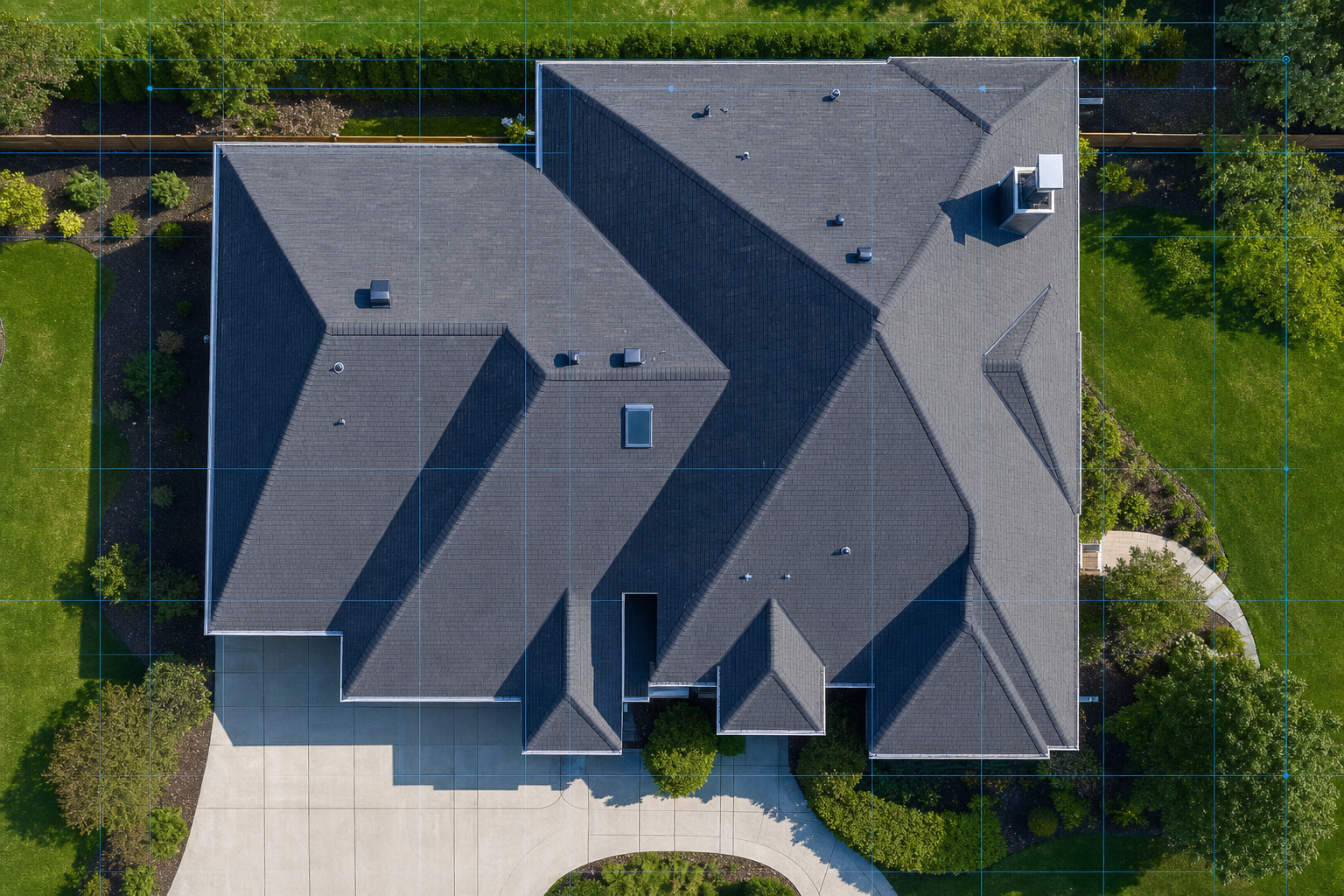
From there the app generates an instant quote and displays it directly on the marked-up satellite image, in three pricing tiers. This is the part that separates the tool from a generic "get a quote" form: the homeowner isn't handing over their information and waiting to find out if they can afford it. They see good/better/best pricing laid over an actual photo of their own roof, with the measurements and material call visible right there. It reads like the company already sent a drone over the house, even though nothing left the ground.
Once the homeowner has a number they're comfortable with, they don't get routed to "someone will call you." They book an inspection slot directly and put down a $50 refundable deposit through Stripe. That deposit is doing more strategic work than its size suggests. Fifty dollars is small enough that it doesn't function as a real financial commitment, but it's large enough to filter out the tire-kickers who were never going to book anything, and because it's refundable, the roofing company can advertise it as zero-risk without lying. A person who has typed in a credit card number to hold a slot behaves completely differently than a person who typed a phone number into a form. They show up.
Everything the homeowner does, from address entry to deposit, lands in an admin dashboard the roofing company runs themselves. No missed leads sitting in somebody's personal inbox. Twilio handles the operational glue on top of that: a confirmation text the moment the deposit clears, an alert to the sales team the instant a new lead books, and a reminder before the inspection so no-shows don't eat the slot. The whole thing is designed so that by the time a human salesperson gets involved, the lead has already self-qualified on budget, already committed money, and already has a specific appointment on the calendar. That's a fundamentally different phone call than "hi, I saw you filled out our form."
A Homeowner in Westfield, an Address, and a Sunday Night
Picture Karen, who owns a two-story colonial on a quarter-acre lot in Westfield, the kind of subdivision street with mature oaks and roofs that are all somewhere between eighteen and twenty-five years old. It's a Sunday night in late September. She noticed a soft spot near the chimney flashing during the last storm and finally got around to Googling "roof replacement cost near me" after her husband went to bed.
She clicks a Meta ad for a local roofing company, a short video of a crew installing shingles with a caption about instant online quotes. The landing page has one field: enter your address. She types it in, half expecting the next screen to ask for her email so someone can "reach out." Instead, eleven seconds later, a satellite image of her actual house loads on screen with a measurement overlay: 2,380 square feet of roof area, architectural asphalt shingle detected, moderate complexity flagged for the two dormers and the chimney she's worried about.
Below the image sit three tiers. Good is a standard 30-year architectural shingle replacement at $9,400. Better adds an upgraded synthetic underlayment and ridge vent system at $11,750. Best is a premium designer shingle with an extended warranty at $14,200, right in the middle of the $8,000 to $15,000 range this kind of job typically runs. Karen isn't shopping in the dark anymore. She now knows the low end covers her problem and the top end is for someone chasing curb appeal, and she can decide which one she is without talking to anyone.
She picks Better, because the chimney flashing issue makes the upgraded underlayment feel like the responsible choice, not the upsell. The booking calendar shows Tuesday and Thursday morning slots for the following week. She grabs Tuesday at 9 a.m., enters her card for the $50 refundable deposit, and gets a text thirty seconds later confirming the appointment and the deposit. The roofing company's sales rep gets his own alert at the same moment: a $11,750-range lead, pre-measured, pre-qualified, deposit down, appointment locked, showing up in two days instead of "whenever we get around to calling back the form submissions from the weekend." He calls Karen anyway, but the call is completely different in tone. He's not pitching a stranger cold. He's confirming details with someone who already picked her tier and already paid to hold her slot.
That's the entire value proposition in one Sunday night. Nobody waited. Nobody guessed. And the roofing company captured a warm, self-qualified, deposit-paid lead using nothing but an address field and a photo from space.
Who Should Actually Build and Sell This
This isn't a tool for hobbyists chasing a side project. The public page is direct about the target buyer: roofing companies already spending $1,000 or more a month on Google or Meta ads, who are currently sending every one of those expensive clicks into a basic contact form. That's a specific, findable business, and it's specific for a reason. A roofer already spending real money to generate traffic has already proven two things: they have marketing budget, and they have a broken conversion step downstream of that budget. You're not pitching someone on the idea of running ads. You're pitching a fix to a leak they're already paying to fill with water.
The operator who should build and sell this needs to be comfortable doing local sales outreach. Pasting the master prompt into an AI builder is the easy part of this job. The blueprint's own page sets expectations honestly here: paste the master prompt into the builder and it spends five to ten minutes producing something that's 80 to 90 percent correct on the first pass, with two or three follow-up messages needed to sort out small breakage like a satellite image not rendering on mobile or a Stripe button not showing the right deposit amount. That's a normal AI-builder Tuesday, not a serious engineering lift. The harder, more valuable skill is walking into a roofing company (or getting on a call with one) and making the case for why their current contact form is bleeding money, then closing a retainer.
Because that's genuinely where the advantage sits. A developer who can build this but can't sell it has a neat demo. An operator who can sell it, even a mediocre builder who follows the blueprint closely, has a business. This is a "local AI agency" play in the truest sense: one polished vertical tool, one clearly defined buyer, one specific and provable ROI story (dead contact form versus instant satellite quote), sold repeatedly across every roofing company in a metro area that's already running ads and already frustrated with their close rate.
The Real Numbers
The published pricing on the blueprint gives you the shape of the deal without pretending every roofing company negotiates identically:
- Setup fee: $1,500. This covers the build, the integration of Google Maps, Stripe, and Twilio, and getting the tool live on the roofer's site or as a standalone landing page for their ad traffic.
- Monthly retainer: $397/month. This is the ongoing fee for hosting, maintenance, and presumably tweaks as the roofer's needs change, positioned as a normal SaaS-style line item on their books rather than a one-off project cost that gets forgotten.
- Average deal value the tool is producing: $8,000 to $15,000 per job. This is the number that makes the retainer trivial by comparison. One converted roof job, at the low end of that range, is more than twenty times the monthly fee the operator is charging.
Run the actual cost side and the margin on the operator's end is close to embarrassing. Lovable itself is free to start and $20 a month on a paid plan. Google Maps Platform gives $200 a month in free credit, which the blueprint notes most roofing companies won't burn through until they're getting serious traffic. Stripe only charges when money moves, 2.9% plus 30 cents per transaction, so it costs nothing until a deposit is actually collected. Twilio starts with $15 of free trial credit and runs about eight-tenths of a cent per text after that. The optional vision model call through OpenAI or Anthropic runs about two-tenths of a cent per analysis if the operator skips the builder's free built-in model. Add it all up and a roofer generating a few hundred leads a month is looking at infrastructure costs in the tens of dollars, against a $397 retainer the operator is collecting. That spread is the entire business model, and every one of those cost lines comes straight out of the Roofing Satellite Quote Tool build, not a guess.
The blueprint's own numbers also make an obvious case for structuring part of the deal around performance rather than flat retainer alone, even though the public page keeps its detailed pricing playbook behind login. Think through the math from the roofing company's side: if this tool is closing jobs in the $8,000 to $15,000 range that would otherwise have died in a contact form, a roofer who's skeptical of a flat $397 monthly fee stops being skeptical the moment you offer to tie part of the fee to booked, deposit-paid appointments instead of just charging for uptime. It reframes the retainer from "a bill for software" to "a cut of pipeline we're generating that didn't exist before." For the operator, a bonus structure on top of the base retainer means the incentive to actually get the tool converting well (getting the pricing tiers dialed in, making sure the mobile experience doesn't drop leads) is aligned with the roofer's incentive to keep paying. Nobody's just holding a subscription hostage. Given how cheap the infrastructure is to run, an operator has enormous room to offer that kind of upside-sharing arrangement without touching their own margin.
Why This Is Worth Building Now
The strongest argument for building this today isn't abstract, it's sitting in the blueprint's own "what to expect" section: paste the master prompt in, and the AI builder gets 80 to 90 percent of a working satellite-quote tool right in a single five-to-ten-minute pass, with only a couple of follow-up fixes standing between that first draft and something you can put in front of a roofing company. That's not a six-week dev sprint. That's an afternoon, including the time it takes to find your first prospect.
And the prospect is easy to find, because the targeting criteria is baked into the pitch itself. Roofing companies spending $1,000-plus a month on ads and still routing leads to a plain contact form are not rare. They're the default. Most local trade businesses haven't touched their lead capture flow since whoever built their WordPress site in 2016, while their ad spend has only gone up as CPCs climb every year. That mismatch, rising acquisition cost against a stagnant, dead-end conversion step, is exactly the wedge a $1,500 setup and $397 monthly retainer walks through, backed by a demo that takes eleven seconds to run in front of a prospect: type in their own competitor's address, or better, the roofer's own house, and show them a live quote appear on a satellite photo before they've finished their coffee.
Nobody needs to be convinced that instant, specific, visual pricing beats "fill out this form and we'll be in touch." They need to see it happen once, on their own roof, and the case makes itself.
If that's the pitch you want to be making next week instead of next quarter, get the Satellite Quote Tool blueprint now. Master prompt, full API stack, real pricing playbook, ready to hand to a builder today.