
Voice-to-Estimate
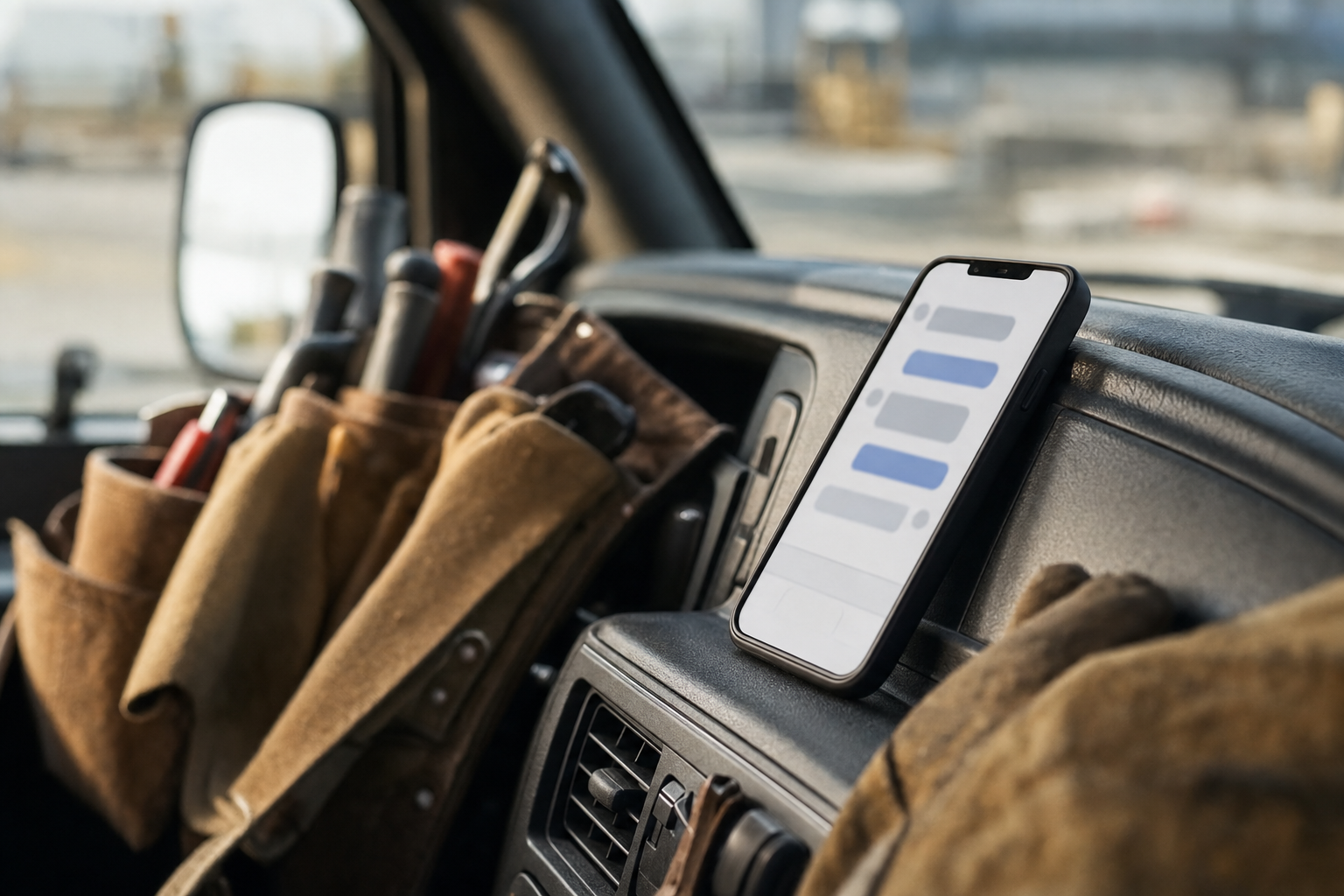
The job goes to whoever texts back first
It's 9:40pm on a Tuesday in July. A water heater dies in a house with three kids and one bathroom. The homeowner doesn't wait until morning. She pulls up Google, finds the top three plumbers with decent reviews, and calls all three in a row. Two go to voicemail. One picks up, and it isn't because that company is better, cheaper, or more qualified. It's because a human answered a phone at 9:40pm on a Tuesday.
The other two businesses lost that job before they even knew it existed. Somewhere in a call log there's a voicemail with a name, an address, and a description of the problem, sitting untouched until someone gets around to it the next morning, by which point the homeowner already has a plumber in her driveway. This is not a rare event. It's the default outcome for every after-hours call a service trade business doesn't answer live, and for most one-truck operators and small shops, that's most of the calls that come in outside business hours.
There's a second, quieter version of the same problem, and it hits the businesses that actually do win the job. A tech drives out, looks at the broken unit, talks to the homeowner, and knows within twenty minutes exactly what needs to happen and roughly what it costs. Then he drives home, and instead of being done for the day, he opens a laptop or a paper pad and spends two to three hours turning that twenty-minute diagnosis into a formal written estimate: line items, a total, professional language, something a customer can actually read and approve. For an owner running the truck and doing the books, that's two or three hours a night, five nights a week, on top of the actual labor. It's the kind of grind that quietly burns people out of businesses they otherwise love running.
Prompt-King.AI's Voice-to-Estimate (Universal) blueprint is built to close both gaps at once. It takes whatever voice input already exists (a customer's voicemail, a tech's site-visit notes, or a call transcript from an AI receptionist) and turns it into a customer-ready, ranged estimate inside minutes instead of days. The pitch line on the page says it plainly: it beats competitors who take two to three days to quote by getting a number back to the customer within ten minutes.
Want to actually build this for a client? The full Voice-to-Estimate (Universal) blueprint lays out every prompt, the pricing knowledge base structure, and the approval-gate logic step by step, ready to hand a client this week.
How the blueprint actually works
This is a Base44 build (the blueprint estimates roughly 20 to 30 minutes to construct), paired with OpenAI's Whisper and GPT-4o for transcription and estimate generation, and Twilio for the voicemail and SMS layer. Anthropic's Claude is listed as an optional swap for the estimate-generation step if a builder prefers it over GPT-4o. None of that is exotic. What makes the tool worth building is how the pieces are wired together, and specifically the discipline built into the prompt logic around three separate input paths, the actual prompts and structure of which live inside the Voice-to-Estimate blueprint.
Path A: the customer voicemail, the highest-value path
This is the after-hours scenario above, automated. A Twilio number answers the call, records the voicemail, and forwards the recording to a transcription endpoint. Whisper turns the audio into text. From there, an LLM step reads the transcript and pulls out the specifics: the customer's name, contact details, address, a description of the problem, any equipment mentioned, and how urgent it sounds. That structured data then gets checked against a vertical-specific pricing knowledge base built for the business, and the system generates a ranged estimate rather than a single number.
That range matters more than it might look like on first read. A single hard number sent to a customer before anyone has laid eyes on the equipment is a liability problem waiting to happen. A range like "$185 to $340 likely" does the actual job an estimate needs to do at this stage: it tells the customer roughly what to expect and gets them off the market before they call the next name on the list, without the business making a promise it can't keep. The blueprint's troubleshooting notes are explicit about this failure mode too. If the pricing knowledge base isn't loaded as proper system context, the model will happily invent numbers that have nothing to do with what the business actually charges. The fix baked into the prompt forces the model to select from the knowledge base's real entries or return a low-confidence flag and recommend an in-person diagnostic instead of guessing.
Path B: the contractor's own voice memo
Not every estimate starts with a stranger's voicemail. Often it's the tech, standing in someone's driveway after a site visit, who has the clearest read on the job. Path B lets that tech open the admin app and just talk: something like "Sarah Johnson, garbage disposal replacement, recommend Insinkerator Badger 5, plus new mounting hardware, ninety-minute job." That's the actual sample line used in the blueprint, and it's worth noticing how unstructured it is. Nobody talks in line items. The AI's job is to take that loose, spoken description and turn it into a complete estimate with real line items, a total range, and language a homeowner can read without needing it translated.
Path C: feeding off an AI Receptionist
If the same client is also running Prompt-King's AI Receptionist tool, this path skips voicemail entirely. Call transcripts flow straight into the estimate queue already structured, because the receptionist tool did that work on the call itself. This is where the blueprint stops being a standalone tool and starts being a piece of a bigger system, which matters a lot for how you sell it (more on that below).
The owner approval gate is the whole point
Every single estimate, regardless of which path it came from, stops at an approval queue before a customer ever sees it. The owner gets a push notification the moment a draft is ready, reviews it on their phone, and taps approve or edits it first. Only then does the SMS go out. The blueprint's build notes call this out directly as a legal and liability firewall, and treat any attempt to skip it as a critical bug rather than a minor default: the approval status field has to start as pending, the send function has to check for an approved state before it fires, and any auto-send-on-confidence setting has to default to off.
That's not caution for its own sake. The blueprint flags a specific real failure mode: the AI can sound completely confident while pricing a $200 capacitor when the actual problem is a $4,000 compressor. The knowledge base's built-in ambiguity flags catch some of that, but the people who wrote this prompt clearly don't trust the model to be the last line of defense. A person who knows the business has to look at every number before it leaves the building. That's not a limitation of the tool, it's the feature that makes it safe to run at all.
There's also a plainer, less dramatic reason the gate matters: Whisper isn't perfect. The blueprint puts a real number on this, stating that Whisper handles roughly 85 percent of voicemails cleanly, with the remaining 15 percent carrying transcription errors from background noise, mumbled speech, or bad cell coverage. Those errors surface in the approval queue where a human catches them in seconds, instead of turning into a wrong estimate sent to a real customer.
Walking through a real call
Say a homeowner's air conditioner dies at 8:15pm in August. She calls the HVAC company that installed it two years ago, gets a voicemail greeting, and leaves this: "Hey, this is Karen Ruiz, my AC just stopped blowing cold air, it's just running fan and it's ninety-one degrees in my kitchen. I've got a Trane unit, not sure how old it is, we got it when we bought the house. Can someone come look at it tomorrow? My number's the one I'm calling from."
Twilio records that and forwards it for transcription. Whisper turns it into text cleanly (this is a fairly clean recording, well within the 85 percent range). The extraction step pulls out what matters: name Karen Ruiz, symptom "runs but blows warm air, fan only," equipment "Trane, age unknown," urgency "same day or next day, extreme heat," and contact info from caller ID. That structured summary gets checked against the HVAC pricing knowledge base built for this specific client, which has entries for common no-cool scenarios: capacitor failure, refrigerant leak, compressor failure, thermostat malfunction, each with its own typical cost range and, critically, its own confidence level given how little diagnostic detail is available from a voicemail alone.
Because "runs but blows warm" without a technician on-site could mean a $150 capacitor swap or a $3,500 compressor replacement, the system doesn't gamble on picking one. It generates a ranged estimate that reflects genuine uncertainty, something like "$150 to $450 for likely capacitor or refrigerant issue, diagnostic visit required to confirm, technician can be on-site tomorrow between 9am and 12pm," flagged at lower confidence than a clearer case would carry. Within a few minutes of the voicemail landing, the owner's phone buzzes: "New estimate ready: Karen Ruiz, AC blowing warm air, Trane unit, estimate $150-$450 pending diagnostic. Tap to approve." He reads it on his phone while eating dinner, adjusts the low end slightly because he knows this particular Trane model tends to run into refrigerant issues, and taps approve. Karen gets a professional SMS back within ten minutes of leaving her voicemail, with a real price range and a next-day appointment window, while the other two companies she'd have called in the morning are still asleep. That's the entire ten-minute gap the blueprint is built around, made concrete.
Who should build this, and what it actually pays
The buyer profile on the blueprint page is specific for a reason: one-truck operators who do their own estimating, where the owner's time is the actual bottleneck in the business, and small shops doing $500,000 to $3 million a year that can't justify a $60,000-a-year estimator on payroll but still lose real money to slow response times. The vertical list reads like a checklist of trades where a twenty-minute site visit routinely turns into a multi-hour paperwork session afterward: HVAC, plumbing, electrical, roofing, appliance repair, garage door, landscaping, cleaning, and auto repair.
The published economics on the blueprint's page are straightforward: a $1,500 setup fee and a $497 monthly retainer. Set that against what it actually costs to run: Base44 hosting around $50 a month, Whisper and GPT-4o usage estimated at $5 to $15 a month for a typical volume of voicemails and memos, and Twilio at $1.15 a month per number plus roughly eight-tenths of a cent per SMS sent. Total running cost lands somewhere in the $60 to $80 a month range for most single-location clients, against a $497 retainer. The detailed pricing playbook and outreach script for this specific tool sit behind Prompt-King's account login rather than on the public page, so the exact upsell and negotiation guidance isn't something to guess at here. What is visible is the raw math: the setup fee alone covers the build time several times over, and the monthly retainer clears a wide margin over the actual API and infrastructure bill every single month it's running.
Here's the part that turns this from a decent standalone tool into the center of a real recurring revenue plan: the blueprint explicitly wires itself into two other tools in the same catalog. Path C exists specifically to pull structured call data from Prompt-King's AI Receptionist tool, and once an estimate gets approved and sent, it flows automatically into the Quote Follow-Up Sequencer tool if the client has that too, kicking off a 21-day follow-up cadence that keeps chasing the quote until it either closes or the client stops paying attention. The full loop the blueprint describes runs like this:
- Customer calls after hours
- Voicemail gets transcribed
- Estimate gets generated against the pricing knowledge base
- Owner approves from their phone
- Customer gets an SMS quote within ten minutes
- Follow-up sequence runs for 21 days if the quote doesn't close immediately
- Deal closes
That's three separate retainers built off one client relationship, each one solving a different failure point in the same sales funnel: nobody answers the phone, nobody follows up fast enough on the estimate, and the quote itself dies of neglect after it's sent. Voice-to-Estimate is the middle link, and it's arguably the easiest of the three to pitch on its own, because the pain it fixes (hours lost to writing estimates by hand, jobs lost to slow response) is something every owner in these trades has lived through personally, not an abstraction about missed calls they may not even be tracking.
Why this is worth building now
The number that makes the case here isn't the retainer, it's the claim the blueprint leads with: a business running this tool captures $20,000 to $100,000 a year in quotes that would otherwise have been lost to slow turnaround. That figure isn't about generating new leads. It's about stopping leads that already exist, that already called, that already left a name and a problem and a phone number, from walking to a competitor purely because nobody got back to them in time. Every trade business owner reading a pitch built around that number already knows exactly which voicemails from last month that describes, because they've listened to them.
The tools required to build this are cheap and already commoditized: Whisper transcription, GPT-4o for structured extraction, Twilio for the phone and SMS layer, Base44 to hold it together. None of that is the hard part. The hard part, and the part that actually justifies charging for this instead of it being a free template someone copies once and forgets, is the discipline in how the pieces are ordered: a pricing knowledge base the model has to draw from instead of inventing numbers, a confidence flag that tells the model when to admit it doesn't know enough, and an approval gate that never lets a machine-generated price reach a customer without a human signing off first. That's the difference between a demo that looks impressive in a sales call and a tool an owner will actually trust with their business's reputation at 9:40 on a Tuesday night.
If the $20,000 to $100,000 a year figure sounds like money your clients are already losing, get the Voice-to-Estimate (Universal) blueprint now and have it built before the next after-hours call goes to voicemail.