
Why Your Local Taxi Company Still Feels Stuck in 2010
A customer calls a local taxi company to book a ride. A dispatcher picks up, asks for the pickup address, checks a whiteboard or a radio channel to see which driver is nearby and free, calls that driver, relays the details, and hangs up hoping the message landed clearly. The customer waits, with no idea whether a car is actually coming, how far away it is, or when it'll show up. Meanwhile, the dispatcher can only handle one call at a time, which caps how many bookings the whole company can process during a busy hour, no matter how many drivers are actually available.
Want to build the app that replaces that whole process? The Taxi & Private Hire Fleet Dispatch, Tracking & Booking App gives an existing licensed fleet a self-service booking flow, automatic driver matching, and live tracking, the same experience customers already expect from a modern ride app, running on the company's own drivers instead of a marketplace.
Who this is actually for
This isn't a blueprint for launching a new ride-hailing marketplace, and it's worth being precise about that distinction upfront. Onboarding independent contractor drivers, running background checks, and carrying the right insurance for an open marketplace is a legal and regulatory undertaking that has nothing to do with software, and no master prompt can solve it. What this blueprint is built for is an existing, licensed taxi or private hire company, one that already has its own drivers, its own vehicles, and its own legal authority to operate, and just wants to replace phone-and-radio dispatch with something self-service and trackable. That's a much narrower, much more solvable problem, and it's the one this build actually targets.
How the blueprint actually works
The build is one application with three role-gated views sharing a single backend, not three separate apps that somehow have to stay in sync. A rider, a driver, and an admin all log into the same system and see a completely different interface depending on their role.
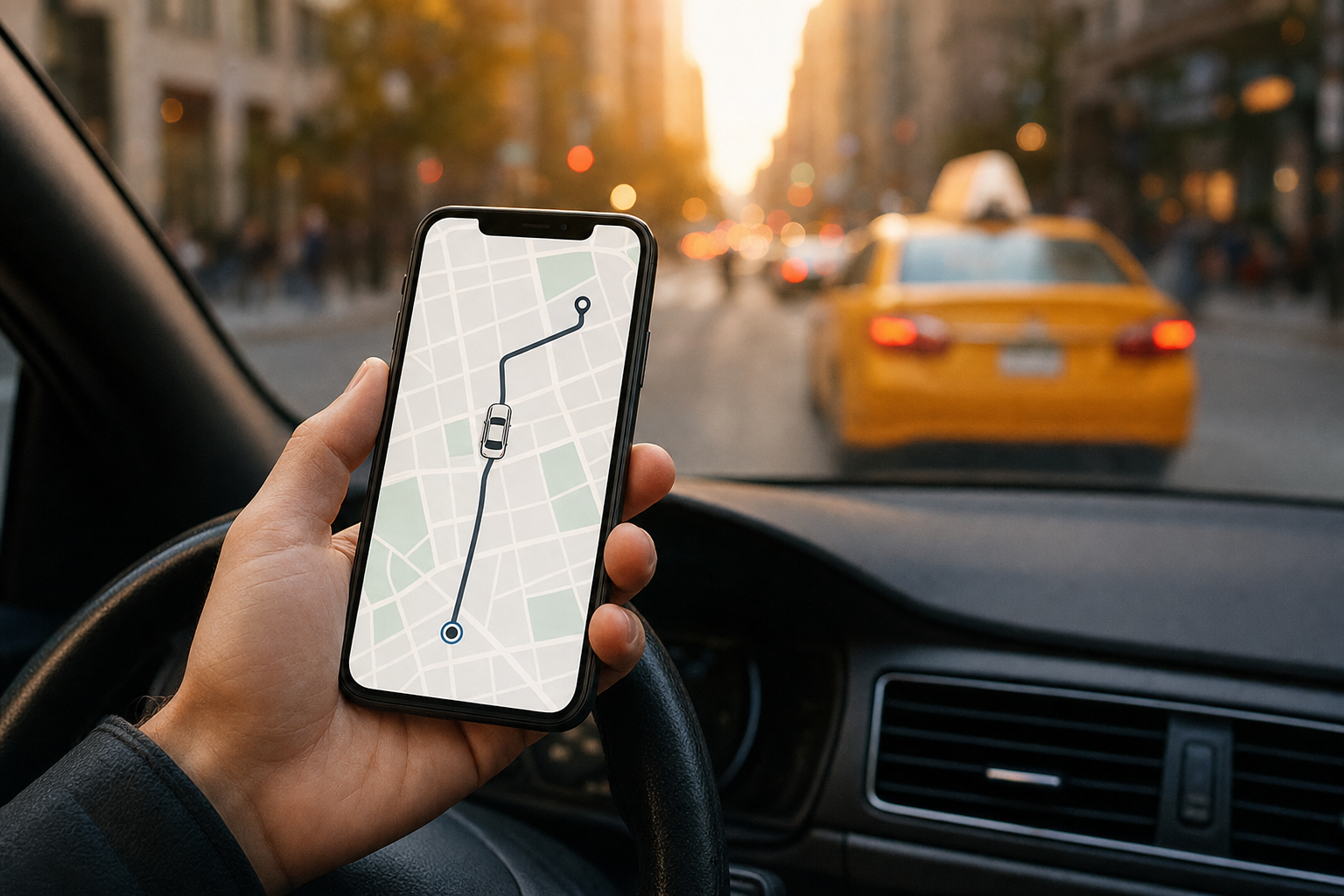
On the rider side, someone opens the app, enters a pickup and destination, and sees an upfront fare estimate before they confirm anything. Once they book, the system finds the nearest available driver automatically. If that driver doesn't respond within a short window, maybe fifteen or twenty seconds, the request cascades to the next-nearest driver rather than sitting stuck waiting on one person. Once matched, the rider watches their driver's position on a live map, gets clear updates as the trip progresses (driver arrived, trip started, trip completed), and is charged automatically through Stripe the moment the trip wraps up.
On the driver side, there's a simple online/offline toggle to start and end a shift. New requests arrive as an in-app alert with a backup SMS notification, so a driver isn't relying purely on the app catching their attention at the right moment. Once accepted, the app hands off to a deep link into Google Maps or Apple Maps for actual turn-by-turn navigation, since building custom in-app navigation would be a huge, unnecessary undertaking when drivers already know how to use the maps app on their phone. Trip status updates happen through simple one-tap buttons rather than anything requiring typing while driving.
The admin view is where the company actually runs the fleet: a live map showing every online driver and every active trip at once, the ability to manually reassign a trip if a driver has a problem mid-shift, roster management for adding or deactivating drivers, and analytics covering completed rides, average wait time, revenue, and driver-level performance. None of this requires the dispatcher to make a single phone call.
The location-tracking question, and how it actually gets solved
Here's the part of this build that needed the most careful thought, and it's worth walking through honestly rather than glossing over. A web application, which is what Lovable and Base44 produce, can reliably track a device's location while its app is open and active, but not while the screen is off or the app is fully backgrounded. That's not a bug, it's how browser-based geolocation works on both iOS and Android. For a taxi app, that matters most during the "driver waiting for the next request" period, when the app might not be the thing on screen.
The build handles this in two clean stages rather than pretending the limitation doesn't exist. Stage one is the Lovable build itself: foreground tracking, which is exactly what's needed during an active trip anyway, since a driver naturally keeps the app open for navigation and status updates the same way they'd keep any maps app open while driving. Stage two happens when the finished web app gets wrapped into a native app through AppBuild.DIY. Inside AppBuild.DIY's Native Capabilities panel is a Background Geolocation plugin, a real toggle that gives the wrapped native app genuine continuous location tracking, well beyond the moments the app happens to be open on screen. AppBuild.DIY handles the platform requirements that capability triggers as part of turning it on: Google Play wants a background-location declaration and a short demo video before approving an app that uses it, and Apple wants a clear purpose string explaining why the app needs always-on location. Both are standard, expected steps for a legitimate use case like driver dispatch, not obstacles specific to this build.
The practical result is that a driver waiting between trips doesn't actually need constant background GPS updating every second, they need a reliable alert the instant a new request comes in, which native push notifications (also enabled through the same AppBuild.DIY wrap) handle well. Once they accept a request and the trip is underway, tracking is live and accurate because the app is genuinely in active use at that point. The two pieces together, foreground tracking during trips plus reliable push for new requests plus background tracking once wrapped, cover the real behavior of how a taxi dispatch app actually gets used, rather than chasing a theoretical always-on tracking requirement that isn't the actual bottleneck.
A worked example
Picture a private hire company running fifteen vehicles in a mid-size town, currently dispatching entirely by phone. A regular customer opens the app instead of calling, enters her office as the pickup and a downtown restaurant as the destination, and sees a $9.40 fare estimate before confirming. The system checks which of the company's drivers are online and finds three within a few minutes of her location, offers the request to the nearest one first, and he accepts within about eight seconds.
She watches his car move across the map toward her office in real time, gets a notification when he arrives, and taps nothing else until the ride is done, since he handles status updates from his side with one-tap buttons and she just watches the trip progress on the map. At drop-off, her card on file is charged automatically, she rates the driver five stars, and the whole interaction never involved a phone call. Meanwhile, the dispatcher, who used to field this exact request personally, is free to handle the two edge cases that actually need a human today: a driver who called in with a vehicle problem, and a rider asking about a lost item from an earlier trip.
Who should build and sell this, and the real economics
The right buyer is an existing licensed taxi or private hire company, typically somewhere between five and fifty vehicles, still running dispatch by phone or radio. The strongest signal is a company that's visibly capped by how many bookings one dispatcher can physically process, or one that's quietly losing bookings to a competing modern ride app because customers can't see where their driver is.
This is by a meaningful margin the most complex build in the pro-prompt library, and pricing should reflect that honestly rather than matching the simpler tools. Setup runs $6,000 to $9,000, covering the three-role build, mapping, payment, and SMS integration, pilot configuration, and the AppBuild.DIY wrap for store submission. The monthly retainer runs $797 to $1,200, covering hosting, mapping API usage, SMS costs, AppBuild.DIY hosting, and ongoing tuning as real fleet usage surfaces edge cases the initial build didn't anticipate. Given the scale involved here, a performance-based structure is worth proposing directly: a lower base retainer around $497 a month plus a small percentage, one to two percent, of the fare revenue actually processed through the app. That ties your fee to how much of the fleet's real business is running through the system, which is a much easier number for an owner to reason about than a flat monthly charge unrelated to adoption.
The right way in is a small, controlled pilot: three to five drivers and a limited rider group, not the whole fleet and the public at once. That surfaces matching and tracking issues on a small scale before they matter at volume, and gives the owner real usage data before committing to a full rollout and the AppBuild.DIY wrap.
What to actually expect when you build this
Set expectations correctly from the start: this is realistically several days of focused build and testing time, not a single afternoon, and it should be priced and scoped that way from the first conversation with the client. The three-role architecture is the right structure for this problem, but the matching and cascading-offer logic needs real testing with multiple simulated drivers online at once rather than a single one, since bugs in how an unanswered request moves from one driver to the next only show up when there's actually a queue of candidates to cascade through.
Test the live map updates on real mobile devices, beyond a desktop browser preview. Both riders and drivers will use this exclusively on their phones, and browser geolocation behavior, along with how the UI actually feels on a small touchscreen while driving, is different enough from a desktop preview that skipping this step risks shipping something that looks fine in a demo and feels clumsy in the driver's seat.
Once the base build is solid and the AppBuild.DIY wrap is live, the most common follow-up requests worth anticipating are scheduled or advance bookings rather than only on-demand rides, a simple masked-call or in-app chat feature between rider and driver so phone numbers don't need to be shared directly, and time-of-day or demand-based pricing rules layered on top of the base fare structure. None of these are required for a working first version, but they're the natural next asks once a fleet owner sees the core system working well.
Handling the "we already know our regulars" objection
Some fleet owners will push back that they don't need an app, their drivers already know the regulars and the phone system works fine for them. That's often genuinely true for a company's most loyal, longest-standing customers, and this build isn't trying to replace that relationship. Where it earns its keep is everywhere outside that core group: a first-time customer who's never called this company before and has no relationship to lean on, someone booking from a hotel room at 11pm who doesn't know the local dispatch number, or a regular customer who'd genuinely prefer to just watch their car arrive on a map instead of waiting by the window wondering if the message even got through. The app isn't competing with a strong existing phone relationship, it's capturing the growing share of bookings that would otherwise go to a competitor's app entirely, simply because dialing a number to book a ride is starting to feel like an unnecessary extra step to a lot of people who've gotten used to not doing it.
Why now
Every year a taxi or private hire company keeps dispatching by phone, it looks a little more dated against the ride apps its customers already use for everything else. That gap isn't about service quality, plenty of these companies genuinely serve their customers well, it's about the booking and tracking experience itself. A self-service app that shows a real-time driver location and an upfront fare closes that gap directly, without asking the company to change who their drivers are or how their business is licensed. It's a software upgrade to a real, already-functioning business, which is exactly the kind of project that's straightforward to scope, price, and deliver.
The full blueprint, including the complete master prompt, the two-stage location-tracking approach, the eleven-step build phase, and the nine-step launch and AppBuild.DIY wrap phase, is live on Prompt-King now. If you know a taxi or private hire company still dispatching by phone, this is the build that turns their booking process into a paid engagement.
Get the Taxi & Private Hire Fleet Dispatch app blueprint now and have a pilot-ready build in progress this week.