
Dog groomers lose the matting argument at pickup. The fix is 3 photos at booking.
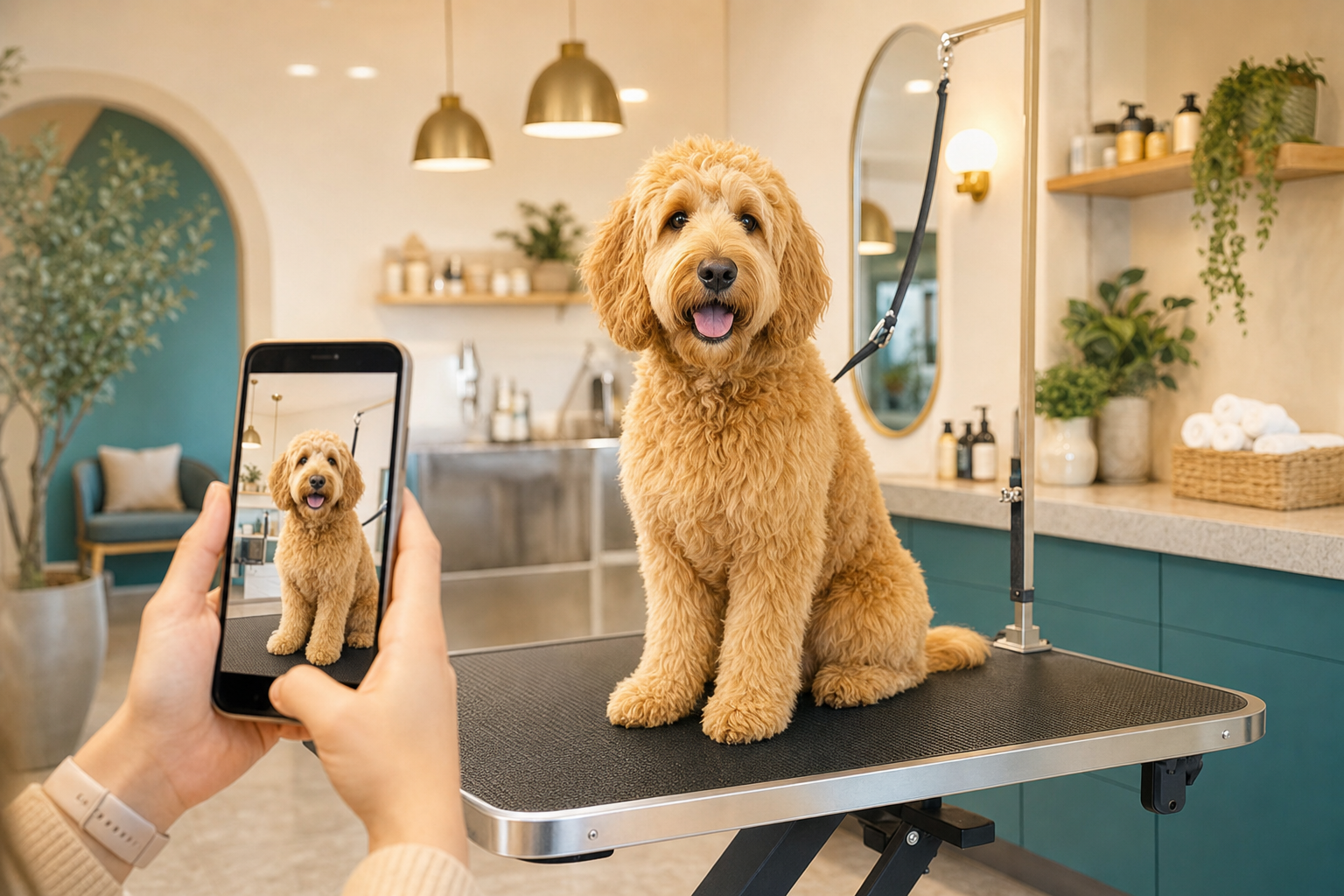
Here's the scene every groomer knows. An owner drops off a goldendoodle at 9am, says "just a tidy-up," and leaves. The groomer finds pelted mats behind the ears and under the legs, does the humane thing, and shaves the coat short. At 1pm the owner picks up a dog they don't recognise and a bill that's $40 higher than they expected.
That conversation goes badly almost every time. The owner feels ambushed. The groomer feels accused of something they warned about in a policy nobody read. And the salon eats a 1-star review that says "they shaved my dog without asking and charged me extra for it."
The maddening part is that the groomer did nothing wrong. Dematting a pelted coat hurts the dog, and every dematting fee schedule in the industry ($15-$50 is the going range, some salons charge by the minute) exists because mats take real time to deal with. The problem is purely where the conversation happens. At pickup, it's a dispute. At booking, it's just a price.
The full blueprint is live now: Pet Grooming Salons, AI Coat Check Photo Quote & Right-Length Booking Tool. One master prompt builds the whole system in Lovable, and the listing includes the build playbook, the client-ready pricing, and a cold outreach script you can send today.
What matting actually costs a salon
Start with the base numbers. A full groom in the US runs $45-$120 depending on size and coat, with the typical ticket landing around $75. Doodles and double-coated breeds sit at the top: $95-$160 and up, because a curly wool coat takes 2-4 hours on the table.
Matting stacks a surcharge onto that base price, and it's the single most disputed line item in grooming. Most salons charge $15-$50 extra or bill the added time by the minute. Nearly all of them disclose this somewhere: a line in the Instagram bio, a laminated sign at the desk, a paragraph on a policies page. And nearly all of them still have the argument at pickup, because disclosure a customer never read is disclosure that didn't happen.
Then there's the scheduling cost, which is sneakier. A groom is a 2-4 hour appointment, and a matted dog booked into a 90-minute slot wrecks the rest of the day. Every dog after it waits, the groomer skips lunch, and the 4pm client gets a call asking to reschedule. The salon didn't lose one appointment to that mat. It degraded four.
And underneath all of it sits the retention math, which is where grooming gets genuinely interesting as a business. A dog on a 6-week cycle comes in 8 or 9 times a year. At $75 a visit that's $340-$600 per dog per year, and a doodle client on a $100 groom every 6 weeks is worth $850+ annually. Industry benchmarks put a loyal grooming client's lifetime value around $3,500. Meanwhile acquiring a new client costs $75-$150 in marketing. The whole game is keeping dogs on cycle, and a client who drifts from 6 weeks to 10 weeks costs the salon 3 grooms a year without ever "leaving."
How the blueprint works
The coat check booking tool is one web app with two faces: a booking flow the dog owner uses on their phone, and a dashboard the salon lives in all day.
The owner side starts with 3 guided photos. Full body from the side, a close-up of the worst area (the app tells them where to look: behind the ears, the armpits, the hindquarters, which is where mats hide), and the face. An AI vision model grades the matting on a 0-3 scale, names the problem areas, and sanity-checks that the photos roughly match the declared breed and size.
Then comes the screen that kills the pickup argument: an honest quote. The app takes the salon's own price matrix (not generic numbers, the salon's actual prices by size and coat type), adds the estimated dematting time at the salon's own rate, and shows a range. A grade-2 doodle sees something like "$95-$125 depending on what we find on the table," with the breakdown right there. The final price still gets confirmed face to face at drop-off, but now that's a 10-second formality instead of an ambush 4 hours later.
Grade 3, severe or pelted matting, triggers a different path. Before the app offers a single appointment slot, the owner sees a consent screen explaining in kind, plain language that severe mats sit tight against the skin, that brushing them out hurts the dog, and that the humane option is usually a short shave and a fresh start. They tick a box acknowledging a shave-down may be needed. That checkbox, stored on the booking, is the difference between "they shaved my dog without asking" and "we talked about this before you booked."
Two more things happen before payment. The owner uploads a photo of the rabies certificate (a tag on the collar doesn't count as proof, and the app says so), and the vision model reads the expiry date off the certificate and blocks the booking if it's lapsed. Then the slot picker only offers appointments long enough for the estimated job: the grade-2 doodle gets a 3-hour block, a smooth-coat beagle bath gets 90 minutes. A $25 deposit through Stripe seals it, applied to the final bill, forfeited on a no-show.
The salon side is a dashboard with a today view (every dog's photos, grade, quote and vaccine status visible before the dog arrives), a one-tap override if the groomer disagrees with the AI grade (the owner gets an automatic text if the price range moves), and the piece that pays for everything: a rebook engine. Five weeks after each completed groom, the client gets a text with a one-tap rebooking link. Every converted nudge is a $75-$120 ticket that would otherwise have drifted toward week 10.
A booking, start to finish
Here's the flow with real numbers. Sarah in Austin has Buddy, a 55lb goldendoodle, and her salon's booking link is in their Instagram bio.
She taps it on Tuesday night. Enters Buddy's details: goldendoodle, large, curly coat. Takes the 3 photos on her sofa. The model comes back in a few seconds: grade 2, moderate matting behind the ears and in the armpits, common in doodles, nothing scary. The quote screen shows the salon's large curly-coat full groom at $95, plus an estimated 35 minutes of dematting at the salon's $1-per-minute rate. Range shown: $95-$130.
Sarah winces, but she's wincing on Tuesday night on her sofa, with full information and the option to walk away. She doesn't walk away, because the number is explained and nobody's ambushed her. She uploads Buddy's rabies certificate (the app reads the March 2027 expiry off the photo), picks Thursday at 10am from slots that are all 3 hours long because that's what a grade-2 doodle takes, and pays the $25 deposit.
Thursday morning the groomer has already seen Buddy's photos and knows exactly what's coming. At drop-off she confirms $118 with Sarah in person, no surprises on either side. Wednesday beforehand, Sarah got a reminder text, which is a big part of why she showed up at all: deposits plus reminders are how salons cut the no-shows that burn 2-4 hour slots.
Five weeks later, Sarah's phone buzzes: "Time flies! Buddy's about due for his next groom. Tap to grab a slot." She books in under a minute because the app already knows Buddy. That one text is the difference between 8 grooms a year and 5, which on Buddy alone is worth about $350 a year to the salon.
Who builds this, and what the money looks like
This is a blueprint for people selling AI-built tools to local businesses: agency owners, freelancers, and anyone working through the AI app-builder playbook. You don't write code. The master prompt in the pro prompt listing is a single paste into Lovable that scaffolds the whole thing: database, auth, the owner flow, the dashboard, the Stripe deposit, the Twilio texts and the rebook cron. The listing's Phase 1 playbook walks the build in 10 steps, and Phase 2 covers the sell: what to collect from the client, the SMS compliance registration, a 2-week supervised pilot, and team training.
The pricing that works: $2,000-$3,500 setup and a $297-$497 monthly retainer, plus a performance kicker of $5 per completed rebook the nudge engine generates. A typical single-location salon converts 30-60 nudges a month, so the bonus adds $150-$300 while only costing the salon money when it makes them money. Multi-location salons add $197 a month per site.
The retainer defends itself with the salon's own dashboard numbers. Thirty converted rebooks at a $75 average ticket is $2,250 of recovered revenue a month against a $397 retainer. Add the no-shows that deposits prevented (each one a saved 2-4 hour slot) and the pickup arguments that never happened, and the monthly report writes its own renewal case. The target customer makes this easy to find, too: search any suburb for dog groomers, read the 1-star reviews, and shortlist every salon with a "surprise charge" or "shaved without asking" complaint. Those reviews are a lead list.
Grooming is also unusually good retainer territory because the revenue is recurring by nature. Pets need grooming every 4-8 weeks whether the economy is up or down, retention in the industry runs 60-80%, and a 5% retention improvement moves profit by 25-95%. You're selling a system that compounds.
Why this works now
Two years ago the coat-grading step was the blocker. Vision models either weren't good enough to tell a tangle from a pelt, or cost too much to run on every booking. Both problems are gone: an assessment on 3 photos costs about a cent, and current models handle "find the matting on this doodle" well enough that the dashboard's override log becomes a tuning tool rather than a crutch.
Meanwhile the salons haven't moved. Most independents still book by phone and Instagram DM, which means every booking interrupts a groomer mid-dog, and every quote is a guess made without seeing the coat. The first salon in a neighbourhood whose booking link says "know your price before you book" has a real, visible edge over every competitor still saying "call for pricing."
And the wedge is sharp because it leads with pain. The whole pitch is one question to a salon owner: "When a dog comes in matted, does the owner find out the price before they book, or at pickup?" Every owner knows the honest answer, and every owner has a story about the review it cost them.
The upsell hiding in the last step
The blueprint's sell-and-run playbook ends with wrapping the finished web app into a real iOS and Android app, and that step deserves its own paragraph because it's where the retainer grows. The rebook nudge is the money feature, and the nudge works harder as a push notification than as a text. Push lands on the lock screen with 60-90% open rates within minutes, it costs the salon nothing per message (SMS runs about $0.0079 each, which adds up across reminders, confirmations and nudges every single month), and it comes from the salon's own app icon sitting on the client's home screen.
That icon matters more than it sounds. A grooming client books 8 or 9 times a year for the life of the dog. Give them an app with their groomer's name on it and rebooking stops competing with every other tab in their browser. For the salon it's also a status move: the only groomer in the neighbourhood with their own App Store listing reads as a different class of business, and that perception supports the premium pricing a good groomer should be charging anyway.
Pitch the wrap as the premium tier of the same system. The web version proves the numbers in the pilot, and the app version is the renewal-proofing upgrade a month or two in, once the dashboard report has already made the case for you.
The economics on the owner's side close the loop. A grooming client is worth $340-$850 a year and $3,500 over the pet's life, and it costs $75-$150 to acquire a new one. Any tool that keeps existing clients on cycle beats any ad budget the salon could spend. That's the sentence that sells the retainer.
Get the complete blueprint here: Pet Grooming Salons, AI Coat Check Photo Quote & Right-Length Booking Tool. It includes the full 12,000-character master prompt, the 7 client-editable fields, the 10-step build playbook, the 7-step sell-and-run playbook including the app store wrap, the tool stack with real pricing, and a cold outreach script written to be sent as-is. Build it once this week, demo it on the fluffiest dog photo you can find, and you've got a product every grooming salon in your city has already wished existed.