
Subway Surfers Made $2 Billion. Here's the Local Version You Can Sell to a Town Centre.
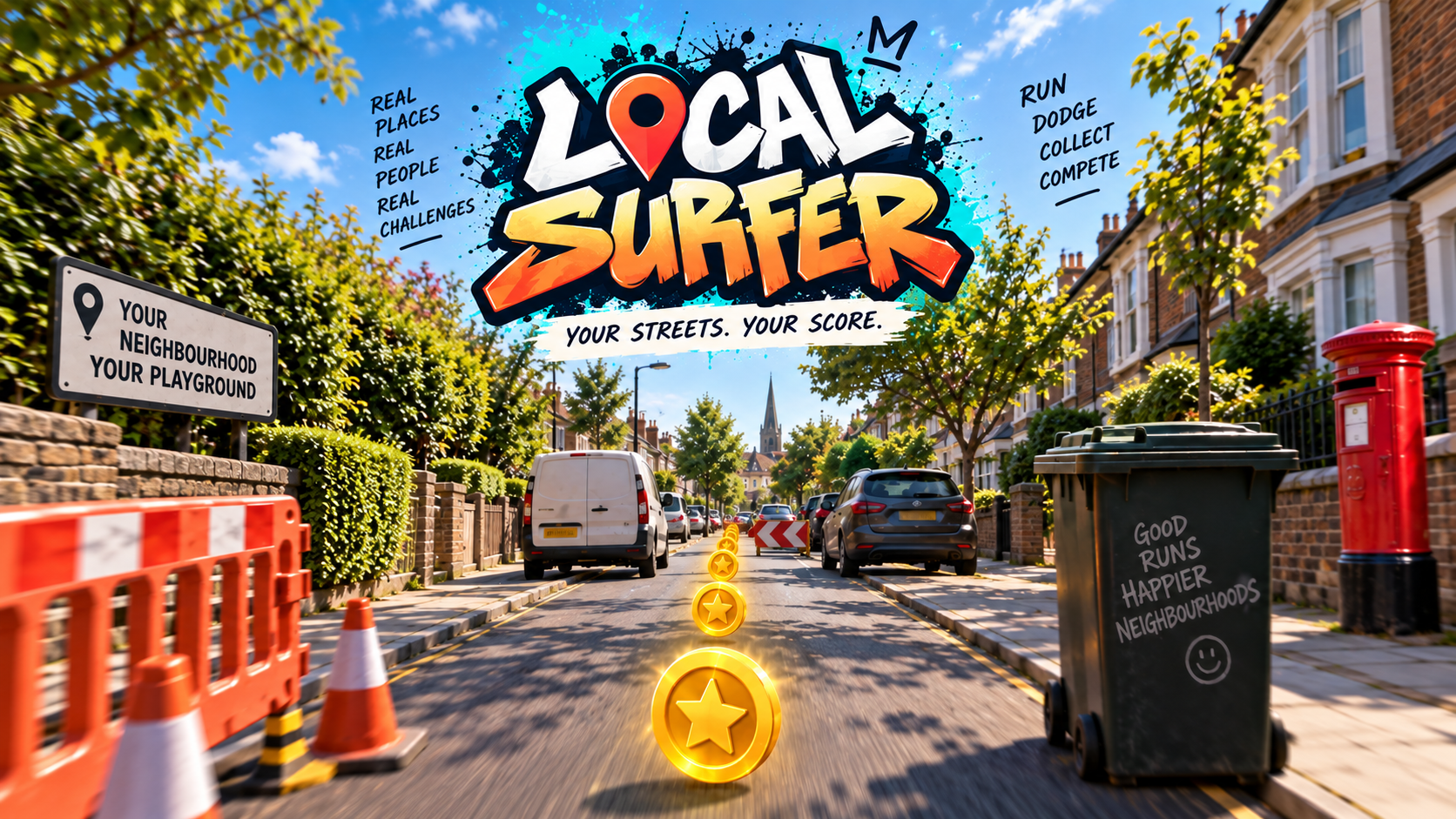
Subway Surfers has made over $2 billion since 2012. One endless runner, one dead-simple loop: dodge, jump, grab coins, don't get caught. That number's been rattling around my head for a while.
So one evening I sat down with Claude Code and asked it to build me a local version. Not a subway, my own street, pulled straight from Google Street View. Type a postcode, get a real road, run down it, dodge the bins and the parked vans, chase a leaderboard. Claude Code built the whole thing in one sitting. I called it Local Surfer.
The full build story, GitHub repo included, is over on the AppInstitute blog if you want the blow-by-blow. What belongs here is what happened after: I stopped thinking of it as a toy and started thinking of it as a product.
A game is a marketing tool if the right person's holding it
A hyperlocal arcade game is a strange thing to build for yourself. It's a genuinely useful thing to sell to a town centre.
Business Improvement Districts, shopping centre marketing teams, tourism boards, university student unions, they all spend real money trying to get people to actually show up somewhere and stick around. Footfall and dwell-time campaigns routinely run $15,000-$40,000 a year for exactly that outcome, usually through banners, events, and paid social that people scroll past.
A branded game where the track is their actual high street, with a public leaderboard and a real prize, is a different pitch entirely. People share their score. People come back to beat it. And because it's dynamically local, generated fresh from whatever postcode gets typed in, the same build works for a seaside town, a university campus, or a shopping quarter without touching the underlying code.
What's actually in the blueprint
I turned the whole thing into a proper pro prompt: Hyperlocal Arcade Game Builder. It's not locked to one game type either. Pick from three classic arcade styles when you fill in the placeholders:
- Endless runner / obstacle dodge, the Subway Surfers shape, lane-swipe and jump
- Scrolling platformer, jump across gaps and onto real street furniture
- Coin collector scavenger hunt, 60 seconds, pure high score chase
Six placeholders configure it for any client: business name, location name, game style, brand color, an optional sponsor credit, and the leaderboard prize. The master prompt handles the rest: real Street View imagery pulled dynamically per postcode (not one fixed location baked into the build), a Supabase leaderboard with proper data model and row-level security, a branding layer, and a share flow that's built to get passed around.
Phase one is the build, twelve steps from setting up the Google Maps API key through to a working GitHub Pages deploy. Phase two is running it as a client service: soft launch, monthly reporting, invoicing, and the AppBuild.DIY wrap as the final step, push notifications and a real App Store listing, so "you've been beaten" actually reaches someone's lock screen instead of dying as an unread email.
Who this is for
If you're already selling AI-built tools to local businesses, this slots straight into that offer. It's a genuinely different category from the usual quote-tool and receptionist builds too, most local businesses have never been pitched a game before, which makes it an easy meeting to book.
Grab the full blueprint here: Hyperlocal Arcade Game Builder. Setup runs $2,500-$4,000, retainer $297-$497 a month, and the whole first build is demoable the same day you paste the prompt in.