
Launch readiness framework: scorecard and AI prompts

Most launches don't fail on launch day. They fail at the review a week before, when someone says "support should be fine" and nobody asks for proof. A launch readiness framework fixes that. It turns a long checklist into one decision: go, go with conditions, or no-go, with evidence behind every answer.
This guide gives you a seven-area framework, a free launch readiness scorecard template, four copy-paste AI prompts that fill it in and test it, and a worked example from a staged feature launch. Use it for a new product, a big feature or a pricing change.
What is launch readiness?
Launch readiness is the point where every team that touches a release can show evidence that its part is done, the risks left are known and owned, and you can switch the launch off if it goes wrong. A launch readiness checklist lists the tasks. A launch readiness framework decides whether the tasks add up to a safe launch.
You need both. Write the task list first with the launch readiness checklist prompt, which turns a feature spec into tasks grouped by team. Then use the framework below a week before launch to make the call.
The 7-area launch readiness framework
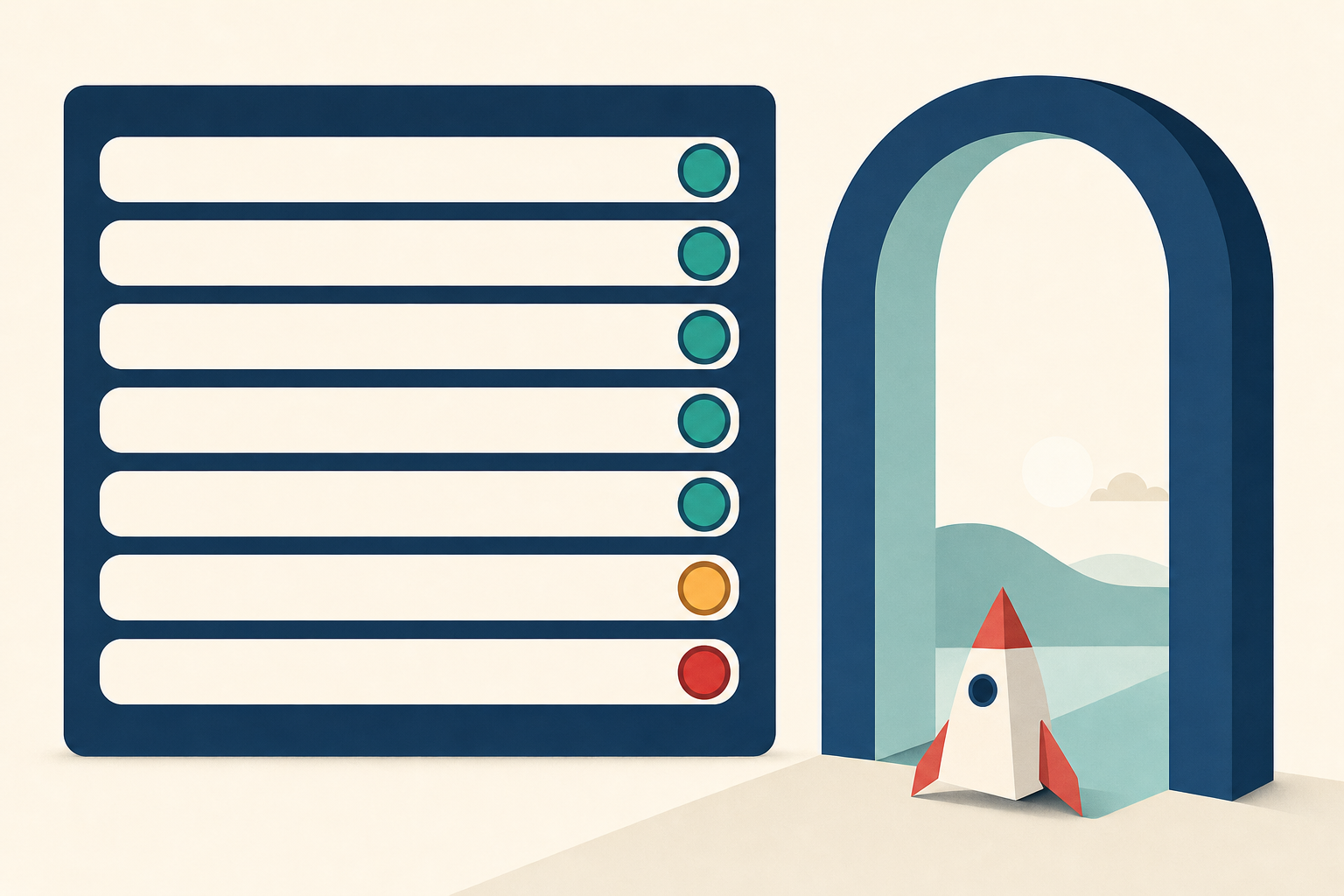
Rate each area GREEN, AMBER or RED. The first three are must-pass: a red in any of them means no-go, whatever the rest looks like.
| Area | The question that matters | Evidence that counts |
|---|---|---|
| 1. Product quality (must-pass) | Do the critical paths work on the build we will ship? | Test run on the release build, open bug list by severity |
| 2. Operations and rollback (must-pass) | Can we switch it off in minutes, and who is watching? | A tested flag or revert, on-call rota, live alerts |
| 3. Security, legal and privacy (must-pass) | Have we changed what data we hold or what we promise? | Review sign-off, updated terms or privacy notice |
| 4. Support | Can support answer the first ten questions without engineering? | Published help article, training done, known issues list |
| 5. Sales and marketing | Do customers hear about it at the right time, in the right words? | Approved release notes, announcement date, billing set up |
| 6. Data and measurement | Will we know within 30 days if it worked? | Agreed target, events firing in production, a dashboard |
| 7. People and ownership | Does every open item have one owner who is around on launch day? | RACI, escalation path, launch-week availability |
The gate. GO means no reds and every amber has an owner, a date and a fallback. GO WITH CONDITIONS means ambers only, and you launch to a small group first. NO-GO means a red in a must-pass area or more ambers than your team agreed in advance (three is a sensible limit).
Free launch readiness scorecard template
Copy this into your launch doc. Fill in the header now and the ratings at your review, about five working days before launch.
LAUNCH READINESS SCORECARD

Launch: [feature or product name]
Launch date: [date]   Rollout: [full / staged %, region, plan]
Decision owner: [one name]   Review date: [L-5 days is a good default]

Rating key
GREEN = done, with evidence anyone can check
AMBER = gap with an owner, a date before launch and a fallback
RED = gap with no fix before launch date

For each area: rating, evidence (link or fact), gap, owner, due date

1. PRODUCT QUALITY (must-pass)
   Critical paths tested end to end? Open bugs by severity? Regression run on the release build?
2. OPERATIONS AND ROLLBACK (must-pass)
   Can we switch it off or roll back in minutes? Who is on call on launch day? Monitoring and alerts live?
3. SECURITY, LEGAL AND PRIVACY (must-pass)
   Data handling reviewed? Terms, privacy notice and consent updated where needed? Any regulated claims checked?
4. SUPPORT
   Help docs published? Support team trained and given a script? Known issues list shared?
5. SALES AND MARKETING
   Announcement, release notes and sales talking points ready? Pricing and plans set up in billing?
6. DATA AND MEASUREMENT
   Success metric and target agreed? Tracking events firing in production? Dashboard built?
7. PEOPLE AND OWNERSHIP
   Every task has one owner? Escalation path known? Key people available on launch day and the day after?

GATE
GO: no reds anywhere, every amber has an owner, a date and a fallback
GO WITH CONDITIONS: ambers only, launch staged to a small group first
NO-GO: any red in a must-pass area, or more than [3] ambers overall

DECISION RECORD
Decision: [go / go with conditions / no-go]   Decided by: [name]   Date: [date]
Conditions and who checks them: [list]
Rollback trigger: [metric and threshold that means we switch it off]
Next review: [date]
Still need the task list for each team? Paste your feature spec into the launch readiness checklist prompt. It groups tasks by team with owners, due dates and a done-when line, then feeds straight into this scorecard.
4 AI prompts for launch readiness
These work in ChatGPT, Claude or Gemini. Run them in order. Paste real notes from your teams: the prompts are built to call out vague answers.
Prompt 1: Build the scorecard from your team notes
You are a launch manager who has run go/no-go reviews for software products. Build a launch readiness scorecard from my notes.

Launch: [feature or product, one line]
Launch date and rollout: [date, full or staged, who gets it first]
Teams involved: [engineering, support, marketing, sales, legal, ops]
Status notes from each team: [paste updates, ticket lists, Slack messages, meeting notes]

Use these seven areas: product quality, operations and rollback, security/legal/privacy, support, sales and marketing, data and measurement, people and ownership. The first three are must-pass.

For each area:
1. Give a rating: GREEN (done, with evidence), AMBER (gap with an owner and a date before launch) or RED (gap with no fix before the launch date).
2. Quote the evidence from my notes that supports the rating.
3. Where my notes say "should be fine", "in progress" or give no evidence, rate it AMBER at best and say what proof would turn it GREEN.
4. List the gap, a suggested owner role and a due date relative to launch (for example L-3).

Finish with the gate result (GO, GO WITH CONDITIONS or NO-GO) and the three questions the decision owner should ask before signing off.
Prompt 2: Challenge every green before you trust it
Teams rate their own work kindly. This prompt plays the person in the room who asks for proof.
Act as a sceptical engineering director at a go/no-go meeting. Here is our launch readiness scorecard: [paste scorecard]

Challenge every GREEN rating:
1. What could make this rating wrong? Name the specific failure.
2. What evidence would you ask to see before you believed it?
3. Is any GREEN resting on a single person, a manual step or a test run on a different build?

Then:
- List the two risks most likely to hurt real users in the first 48 hours.
- Say which AMBER items should block launch and which can ship behind a staged rollout.
- Rewrite any rating you disagree with, with one sentence explaining why.
Prompt 3: Run the go/no-go meeting and write the decision record
You are the chair of a 30-minute launch go/no-go meeting. Using the scorecard below, write:

1. A meeting agenda with timings: open reds first, then must-pass ambers, then the rest.
2. For each open item, the one question that settles it in the room.
3. A decision record I can paste into our launch doc: decision, who decided, conditions, who checks each condition and by when, the rollback trigger (metric and threshold) and the next review date.
4. A five-line update for people who were absent, leading with the decision and what it means for their team.

Scorecard: [paste the scorecard after the challenge round]
Decision owner: [name and role]
Prompt 4: Write the day-one watch and rollback plan
Our launch goes live on [date] to [who gets it first]. Write a day-one watch plan and rollback plan.

What is launching: [one line]
How we can switch it off: [feature flag / revert / config change / manual]
What we will watch: [error rate, sign-ups, payments, support tickets, page speed]
Normal levels before launch: [paste current numbers]

Give me:
1. A table of tripwires: metric, normal level, alert level, rollback level, who watches it and how often in the first 48 hours.
2. The rollback steps in order, with the person who runs each and how long each takes.
3. The message to customers and to the support team if we roll back.
4. The checkpoints at 2 hours, 24 hours, 7 days and 30 days, and what decision we make at each.
Worked example: a staged feature launch
Here is the scorecard a small booking-app team produced with Prompt 1 and Prompt 3. One red turned a likely no-go into a go with conditions, because the meeting found a half-day fix and gave it an owner.
Worked example: "Group bookings" for a salon booking app

Launch: customers can book up to 6 people into one slot
Date: Tuesday 1 December, staged rollout to 10% of salons first
Decision owner: head of product

Scorecard (review held at L-5)
1. Product quality: AMBER
   Evidence: critical paths tested on staging; 2 open medium bugs (deposit shown twice on receipts)
   Gap: regression not yet run on the release build. Owner: QA lead, due L-2
2. Operations and rollback: GREEN
   Evidence: feature flag per salon, tested off and on in 40 seconds; on-call rota published
3. Security, legal and privacy: GREEN
   Evidence: no new personal data fields; cancellation terms updated for group deposits
4. Support: AMBER
   Evidence: help article drafted, support training booked for L-1
   Fallback: if training slips, limit rollout to salons with a named account manager
5. Sales and marketing: GREEN
   Evidence: release notes and salon email approved; announcement held until the 100% rollout
6. Data and measurement: RED
   Evidence: "group_booking_created" event fires on web but returns nothing from the iOS app
   Gap: no fix promised before 1 Dec. Without it we cannot measure the target (8% of bookings are groups by day 30)
7. People and ownership: GREEN
   Evidence: RACI signed off; engineering lead and support manager both working launch week

Gate result before the meeting: NO-GO (one red)
In the meeting: the iOS fix was scoped at half a day and assigned to the mobile lead for L-2.
Decision: GO WITH CONDITIONS
Conditions: iOS event verified in production by L-1 (checked by data analyst); regression run passes on release build (QA lead)
Rollback trigger: booking errors above 2% or deposit complaints above 5 in 24 hours
Next review: L+1, then L+7 before moving to 100%
Notice what made this work: every green has a fact behind it, the red named exactly what was missing, and the rollback trigger is a number anyone can check at 9am on launch day.
Launch readiness workflow, from L-14 to L+30
- L-14: Turn the spec into team tasks with the launch readiness checklist prompt, and agree who owns what with the RACI matrix prompt for a project launch.
- L-10: Run a pre-mortem before launch and log what it finds with the project risk register prompt.
- L-7: Collect status notes from every team and build the first scorecard with Prompt 1.
- L-5: Run Prompt 2 to challenge the greens, then hold the go/no-go meeting using Prompt 3.
- L-3: Run the release build through the regression test checklist prompt and write customer-facing notes with the release notes prompt.
- L-1: Write the day-one watch and rollback plan with Prompt 4. Brief support. Confirm the rollback switch works.
- L+1 to L+7: Watch the tripwires. Send a short update with the stakeholder status update prompt.
- L+30: Review the launch against the target. If anything went wrong, use the post-incident review prompt and feed the lessons into next time's scorecard.
More prompts for a smoother launch
- Product launch strategy prompt: plan pre-launch, launch day and follow-up for the go-to-market side.
- Beta release notes prompt: get useful feedback from your first 10% before the full rollout.
- Tripwires prompt: set early warning signs for the launch plan itself.
- Project risk update prompt: tell leadership about the ambers in a way they will read.
- RACI breakdown prompt: sort out ownership when the launch team has grown messy.
Which page do you need?
If you have a spec and need the to-do list for every team, use the launch readiness checklist prompt. If you need to decide whether you are ready to ship, use this framework and the four prompts above. If you want to find what could go wrong before you even plan the tasks, start with the premortem prompts guide. For testing the release build itself, see the regression testing checklist template.
Launch readiness mistakes to avoid
- Ratings without evidence. "On track" is an opinion. Ask for a link, a test result or a number.
- No rollback plan. If nobody has switched the feature off in a test, you can't count on doing it under pressure.
- One giant checklist as the decision. Two hundred ticked boxes can hide one red that matters. Score the seven areas and decide on those.
- Measuring after launch. If tracking isn't live on day one, you lose the data you need for the 30-day review.
- A committee as decision owner. Name one person who signs off. Everyone else gives evidence.
Run your launch readiness review this week
Copy the scorecard into your launch doc, collect notes from each team and run Prompt 1. Challenge the result with Prompt 2 before the meeting, decide with Prompt 3, and write the watch plan with Prompt 4 the day before you ship.
For more prompts like these, with the method behind them, get the free Prompt King Handbook. It shows you how to get better results from ChatGPT, Claude and Gemini for launches, plans, reports and the rest of your business.