
Nearly 3 in 10 US homes can't take an EV charger as-is. Electricians find out after the truck roll.
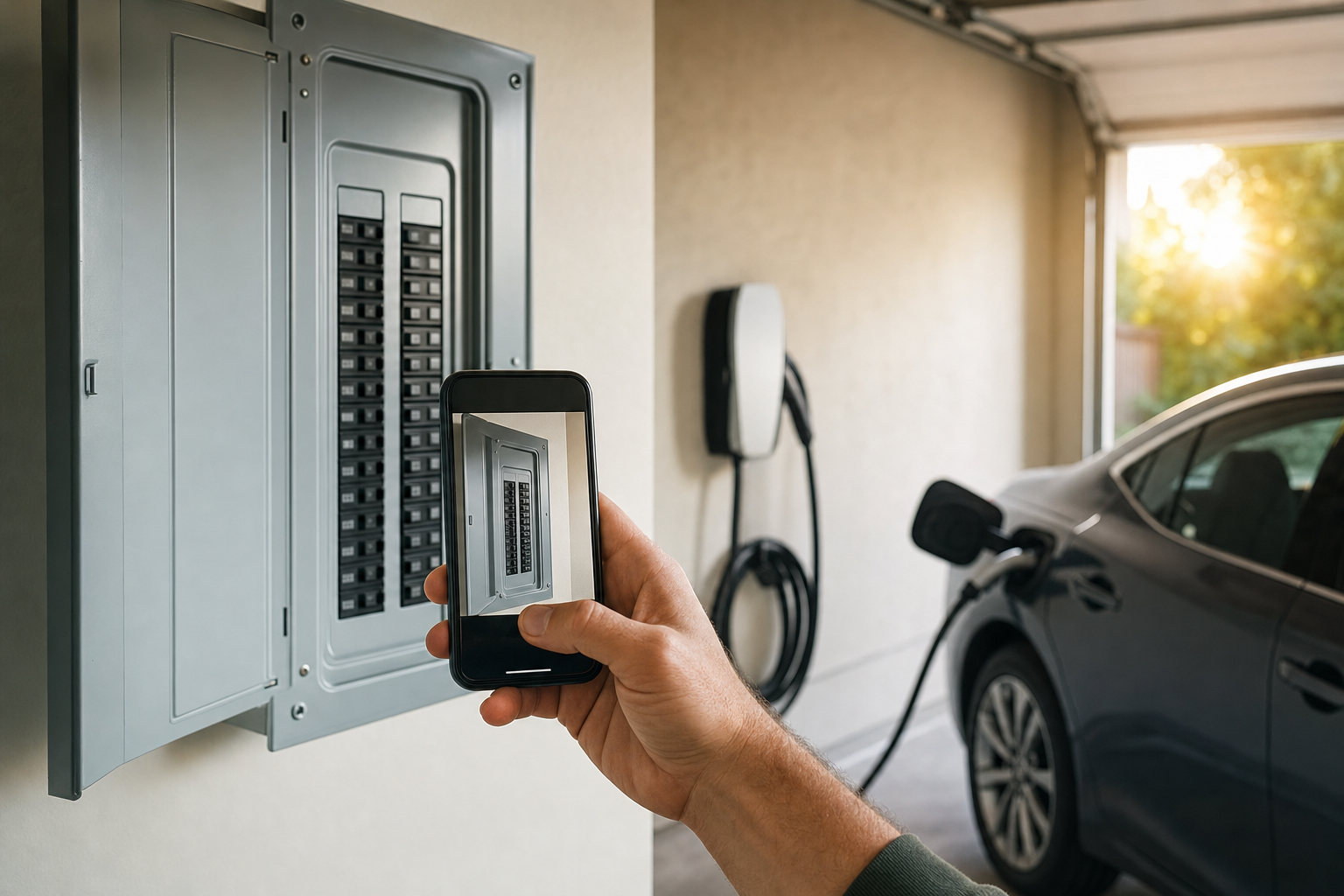
A homeowner rings an electrician and asks what it costs to put a charger in the garage. The honest answer is somewhere between $700 and $5,000, and which end depends almost entirely on a grey metal box the electrician has not seen yet.
So the electrician drives out. Forty minutes each way, a look at the panel, a look at where the car parks, a number on the back of a card. Maybe one in four of those visits turns into a job. The rest were free consulting delivered at van-diesel prices.
The frustrating part is that the information needed to answer the question is sitting on the homeowner's wall, and the homeowner is holding a camera.
The new blueprint: Electrical Contractors, EV Charger Panel Photo Feasibility & Instant Quote Tool. A full AI app-builder master prompt that turns four phone photos of a breaker panel into a preliminary load check, one of four install paths, and a priced band in about 90 seconds. Build it in a day, sell it to electrical contractors for $2,500 to $4,500 plus a monthly retainer.
The number that makes this worth building
A survey of electrical panel capacities across US single-family homes found about 62% of homes on 200A service and roughly 29.5% on 100A or less. That second figure is the whole business case. Close to 3 in 10 houses are going to struggle to take a 48A charger on top of what they already run, and nobody involved knows that until somebody opens a panel door.
Put real prices against it. A standard Level 2 install in 2026 lands between $1,000 and $2,500 all-in, with most jobs clustering around $1,200 to $1,800. The charger unit is $400 to $700 of that, labour and materials $800 to $1,800, permit $50 to $300. Then, if the house needs panel or service work, add another $1,500 to $4,500.
So the same enquiry is either a $1,400 job or a $4,800 job, and the difference is invisible over the phone. Homeowners who were braced for $1,400 do not sign the $4,800 version on the spot. They go quiet, ring two more electricians, and the first one eats the drive time.
What the lead maths looks like from the contractor's side
Electrician leads in 2026 run $15 to $120 depending on channel. Angi sits at $35 to $80 for electrical specifically, and benchmark data across thousands of home service search campaigns puts electrical cost per lead near $58. Contractors who own their own pipeline average around $42.
Per lead, that sounds survivable. Per booked job, it does not. Shared leads go to several pros at once, so at a 10 to 20 percent win rate a $60 lead works out at $300 to $600 for every job actually won. On a $1,400 install with materials in it, that is a thin day.
Anything that lifts the win rate on leads already paid for is worth more to a contractor than anything that produces more leads. Being the one electrician who gave a real answer in 90 seconds, with the arithmetic shown, while the other two were still checking their diary, is exactly that kind of lift.
What a photo of a breaker panel actually tells you
Quite a lot, as it turns out, and all of it from outside the box.
The main breaker at the top carries its rating printed on the handle. 100, 125, 150, 200. That one number sets the ceiling for everything that follows.
The rows of breakers tell you what is already drawing. A 50A double-pole is almost always an electric range. A 30A double-pole is a dryer or a water heater. A 30A to 60A double-pole with a disconnect outside is the air conditioning. A 50A pair feeding nothing you can account for is usually a pool or a hot tub. The labels are frequently wrong, and the breaker ratings rarely are.
The empty slots tell you whether there is physical room for a new two-pole breaker, which is a separate question from whether the service has electrical headroom. Plenty of houses have one and not the other.
And the brand on the panel tells you whether this is a normal conversation or a different one. Federal Pacific Stab-Lok, Zinsco, Challenger and Pushmatic panels all have known failure histories, and an electrician who spots one is no longer quoting a charger install. Scorch marks, rust streaks and moisture staining say the same thing in a different language.
Every one of those reads off a decent photograph. The master prompt in this blueprint specifies the vision model's output as strict JSON, with a confidence score on the main breaker reading and an explicit instruction to return "unknown" rather than guess at a painted-over label. That last rule matters more than it sounds. A confident wrong reading of a 100A panel as 200A produces a quote that falls apart on site and a contractor who stops trusting the tool.
The arithmetic that decides the job
There are two legitimate ways to work out whether an existing house can take the extra load, and they give very different answers.
The first builds the load up from the house itself. Square footage at 3VA per square foot for general lighting and receptacles, 1,500VA each for the two small appliance circuits and the laundry circuit, then nameplate-style allowances for the range, the dryer, the water heater, the air conditioning, the pool. Apply the standard demand factors, 100% of the first 8kVA and 40% of the rest, add the charger at full value because it runs continuously, and compare against the main breaker rating.
This method assumes a fairly pessimistic house. It is the one most online calculators use, and it is why so many homeowners get told they need a service upgrade.
The second method uses what the house has actually done. Take the highest demand the utility recorded over the previous 12 months, multiply by 1.25, add the new charger load, and compare that against the service rating. Because real houses never run the range, the dryer, the water heater and the AC flat out at the same moment, this routinely produces a figure 40 to 50 percent below the calculated method.
Same house, same panel, two answers. One says service upgrade, the other says go ahead.
The practical consequence is that asking a homeowner to upload one utility bill is the question that moves the answer most in the whole intake. The build asks for it at step 6, explains in one plain line why it helps, and falls back without complaint when the upload turns out to be unreadable.
Four paths, and the one most quotes never mention
Every submission comes out classified into exactly one of four buckets.
Direct install. The service has headroom and the panel has a free pair of slots. Run the circuit, mount the charger, pull the permit. This is the $1,200 to $1,900 job everybody hopes for.
Space solution. The service is fine but the panel is physically full. Tandem breakers, a quad, or a small subpanel frees what is needed for another $150 to $1,500 depending on which route the panel allows. Worth flagging on site, because not every panel permits tandems and the label that says so is often not visible in a photo.
Load management. The panel has room but the service does not have headroom on either calculation. An energy management system of the kind the electrical code permits for EV charging watches the whole-house draw and throttles or pauses the charger when the house gets busy. The device and fitting run $450 to $900. The homeowner keeps their 100A service, the car still charges overnight, and the job comes in thousands below an upgrade.
Service or panel upgrade. 100A service with no headroom and load management ruled out, a hazard panel, visible damage, or an undersized service entrance. This is the $2,000 to $4,500 job, with a utility disconnect to schedule and a longer permit route.
The third path is the interesting one commercially. Most quoting goes straight from "your service is too small" to "you need an upgrade", because the upgrade is the familiar answer and it happens to be the bigger ticket. A contractor who can show a homeowner a $700 device that solves the same problem wins trust that outlasts that one job. And the homeowners who genuinely do need the upgrade take the news better when they have been shown the cheaper option was looked at first.
There is a fourth lever sitting underneath all of this that almost nobody surfaces. Dropping the charger from 48A to 32A output frees 16A of headroom on the spot, and 32A at 240V still puts roughly 30 miles of range back per hour of charging. For a driver doing 40 miles a day, that is a complete non-issue. The build offers it as a priced option rather than treating 48A as a given.
What this looks like for one actual homeowner
Take Dana, 1978 ranch house, 1,850 square feet, just put a deposit on an EV. Gas range, gas dryer, but an electric water heater and central air. She finds the contractor's page through a QR sticker on a van parked down her street.
She photographs the panel with the door open and the inner cover left alone, gets a close-up of the main breaker, walks outside for the meter, and takes one shot of where she parks. Six questions about her appliances and the year the house was built. One utility bill upload.
The vision model reads a 100A main, 20 of 24 spaces filled, a 30A double-pole labelled WH, a 40A double-pole feeding the AC, no spare 240V capacity flagged, panel brand ordinary, condition fine, confidence 0.91.
The calculated method puts her existing load at roughly 59A. Add a 48A charger and she is at 107A on a 100A service. Fails.
Her utility's recorded 12-month peak came in at 11.8kW. Times 1.25 is 14.75kW, about 61A, plus the 48A charger puts her at 109A. Also fails, which happens, and the honest version of this tool says so rather than reaching for whichever method reads friendlier.
So she lands on load management. The result page shows her the arithmetic in words, not symbols: your service is already carrying about 59 amps of calculated load, a 48 amp charger needs 48, and that does not fit under 100. Here is what does. A load-shed device at $700, the circuit and run at $1,350 for the 30 feet from the panel to the garage wall, $125 permit, total band $2,050 to $2,400. Her utility is still running a $500 charger rebate, shown as a separate line rather than netted off, because she claims that afterwards.
Two days earlier she had a verbal quote from another electrician: $3,200 for a 200A service upgrade, plus the install on top. He was not wrong about her service being tight. He just went to the familiar answer.
Dana books a 45-minute verification visit from the result page and puts $149 on the card. The contractor's phone buzzes with the submission, photos attached, before she has closed the tab.
The economics for whoever builds this
The full blueprint prices the engagement at $2,500 to $4,500 setup and $397 to $697 a month. Here is what sits behind those numbers.
The setup fee covers the build, which is a focused day's work, plus the parts that take longer than people expect: loading the contractor's real price book instead of the seeded placeholder numbers, entering permit fees and utility names for every ZIP they serve, and calibrating the classification against 20 of their past jobs. That calibration step is the one to protect. Run their old panel photos through, compare the app's path call against what the electrician actually found on site, and tune until it matches their judgement on 18 of 20. Skip it and the tool gets abandoned in week three.
The retainer covers hosting, the vision model calls at roughly $0.02 to $0.05 per submission, SMS and email, keeping the permit and rebate tables current, and a monthly report. The report is what makes the retainer feel earned, and the number on it that nobody else can give them is the path mix: what share of their EV enquiries are really service upgrade jobs. Most contractors have never measured it. Seeing it come back at 30 or 40 percent changes what they advertise.
Then the performance bonus, which is where this gets interesting for the builder. $150 per booked service upgrade, or 3% of invoiced job value on any Path 4 conversion, verified monthly against the contractor's own invoicing. A shop converting four upgrades a month off the tool pays an extra $600 and is pleased to. Pushing for that structure rather than a flat retainer puts you on the same side of the table as the client, and it prices your work against the outcome instead of against hosting costs.
Running costs are small enough to ignore at this volume. A hundred submissions a month is about $5 of vision calls, $1 of SMS, and whatever tier of Supabase the photo storage pushes you into.
Why this is a better build now than it was a year ago
The federal 30C credit, worth the lesser of 30% or $1,000 on a home charger install, no longer applies to property placed in service after 30 June 2026. The One Big Beautiful Bill Act pulled the termination date forward from the end of 2032.
That has a specific effect on this market. A $1,400 install was effectively a $400 install for a lot of households, and now it is a $1,400 install. Price sensitivity on these jobs went up sharply in the second half of 2026, and the remaining money is scattered across state programmes, utility rebates and manufacturer offers that vary by ZIP code and change without notice.
Which is exactly the kind of thing a tool keeps track of and a busy electrician does not. The build keeps a rebate table matched on utility name, with a last-checked date, and the blueprint offers rebate monitoring as a separate $150/month add-on in states with active utility programmes. That add-on got more saleable the day the federal credit ended.
Asking the public to photograph live equipment
This is the part a careless build gets wrong, so it is worth spelling out. The app asks members of the public to photograph live electrical equipment.
The blueprint handles that with four hard rules baked into the master prompt rather than bolted on afterwards. The capture screen tells the homeowner to open the outer door only and leave the inner metal cover alone. If a submitted photo appears to show an exposed deadfront with busbars visible, the app suppresses the price entirely, flags the submission and tells the homeowner to close the panel. Every price carries a preliminary estimate label on screen, in the PDF and in the SMS. And the wording never crosses from "this looks like" into "your panel complies", because the app is not the authority having jurisdiction and should not sound like it.
Those rules also happen to be good sales material. A contractor putting their licence number on a public tool wants to see that somebody thought about this before they did.
Who should build it
Target licensed residential electrical contractors with 2 to 15 electricians, in metro areas with real EV density. Three ways to find them: filter Google Maps results for electricians whose site already mentions EV charging, work through the certified installer directories the charger manufacturers publish, and look at who is already paying for leads on the platforms.
Skip the solo operators with no office support, because nobody is there to work the dashboard, and skip the commercial-only shops, because their quoting is a completely different problem.
The opening line that works is the path mix question: do you know what share of your EV charger enquiries are actually panel upgrade jobs? Almost none of them do, and the ones who get curious about the answer are the ones who buy.
Ready to build it? Get the full EV Charger Panel Photo Feasibility & Instant Quote blueprint here. You get the complete 24,000-character master prompt, the 8 client-editable fields, a 12-step build playbook, a 10-step sell-and-run playbook covering A2P registration and the supervised pilot, the required tools with real pricing, and a cold outreach script you can send today.