
Electrical Contractors, EV Charger Panel Photo Feasibility & Instant Quote Tool
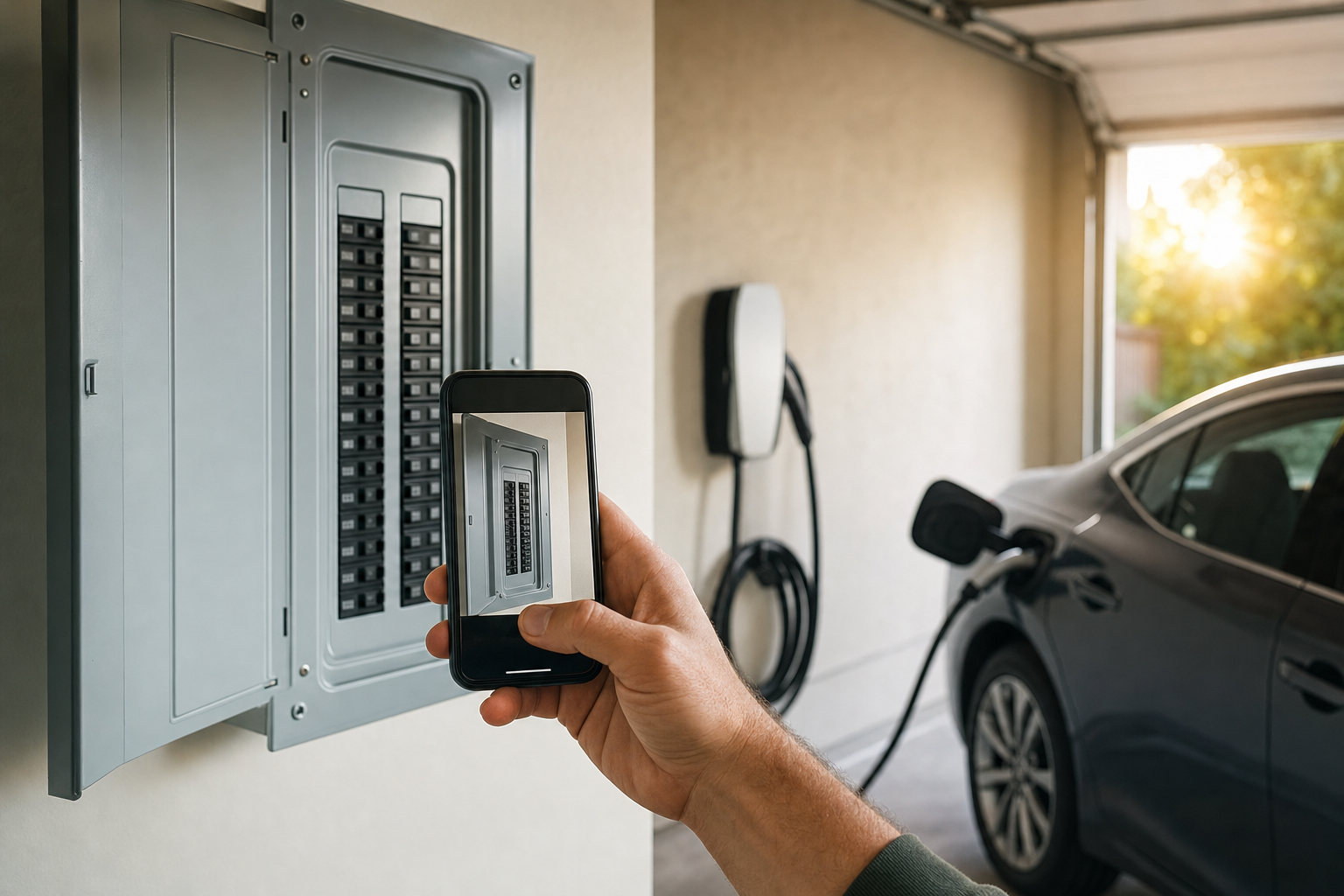
Homeowners photograph their own breaker panel and parking spot, and the app reads the main breaker rating, counts spare capacity, runs a preliminary NEC-style load check and returns one of four install paths with a priced band in about 90 seconds. The electrician gets pre-qualified jobs with photos attached, and finds the service upgrade work hiding behind the charger enquiry.
This blueprint is free. Copy the master prompt below, build it with your own time, and the only outlay is a few low-cost tool subscriptions. Use it inside your own business, or sell it to clients. The numbers further down are what you can charge, not what you pay.
Nearly 3 in 10 US homes can't take an EV charger as-is. Electricians find out after the truck roll.
Read the articleWho you sell it to
Licensed residential electrical contractors with 2 to 15 electricians, in metro areas with real EV density. The ones who buy this are already taking EV charger calls and already losing half a day a week driving out to quote jobs that die on price. You find them three ways.
Search Google Maps for electricians in your area and filter for the ones whose website mentions EV charging, since they are already chasing the work. Check the certified installer directories that the charger manufacturers publish, because those contractors have already invested in the category. And look at who is paying for EV charger leads on the platforms, which runs $35 to $80 a lead for electrical and $300 to $600 per booked job at a typical shared-lead win rate.
A contractor spending $2,000 a month on leads and converting one in five is the easiest version of this conversation. The ones to avoid are solo operators with no office support, since nobody is there to work the dashboard, and commercial-only shops, because their quoting is a different problem entirely.
If you sell it, here is the money picture:
The first tile is the value of your client's own jobs, which is the reason they will pay you. The other two tiles are what you charge them.
How it works
A homeowner hits the contractor's page from a van QR code, a Google Business Profile button or a missed-call text. The wizard asks where they are, what they drive, and then walks them through four photos: the panel with the door open and the inner cover left alone, a close-up of the main breaker, the meter outside, and the spot where they park. Six quick questions cover the other electric appliances, the year the house was built and how far the panel sits from the parking spot.
The vision model reads the panel. It pulls the manufacturer, the main breaker rating, how many spaces are filled and free, which large 240V loads are already in there, and whether this is one of the hazard panel brands that changes the whole conversation. It flags its own confidence rather than guessing.
Then the load maths runs twice. The standard existing-dwelling method builds the load up from square footage and appliances and applies the usual demand factors. The recorded-demand method, which only runs if the homeowner uploaded a utility bill, takes their actual 12-month peak and adds 25%.
That second method lands 40 to 50 percent lower in most houses, which is why the wizard asks for the bill and explains why in one line.
The result is one of four paths. Direct install when there is headroom and a free space. A space solution when the service is fine but the panel is physically full.
Load management when the service is tight, where a device permitted under the EV charging rules throttles the charger when the house is busy and saves the homeowner thousands against an upgrade. Or a full service upgrade, which is the $3,000-plus job sitting behind roughly a third of these enquiries.
The homeowner sees the path, the reasoning in plain words with the actual arithmetic, an itemised price band, their local permit fee and any utility rebate still running. Then they book a site visit or the install itself, with a deposit. The contractor sees a dashboard queue with the photos, the reading and an editable quote, plus a path mix metric that tells them what share of their market is really upgrade work.
What to expect
The build takes a focused day, call it 4 to 6 hours including loading the real price book and testing with actual panel photos. Pricing calibration is the part people underestimate, and it is the part that decides whether the contractor keeps using it.
Expect the vision model to read main breaker ratings well and panel space counts reasonably well, with the weak spots being painted-over labels, split-bus panels with no single main, and tandem breakers where the panel label is not visible. The build handles all three by routing to a site visit rather than guessing, and you should leave it that way. Roughly one submission in six will come back low confidence, which is a feature.
On results, the honest framing is speed and qualification rather than magic. Contractors quoting in 48 hours start quoting in 90 seconds, and the homeowner who was going to ring three electricians often stops after the one that gave them a real answer first. The bigger win is the path mix report.
Most contractors have never measured what share of their EV enquiries are service upgrade jobs, and seeing it at 30 or 40 percent changes how they market.
The caveats are real and you should say them out loud in the sales conversation. Every output is a preliminary estimate and the electrician still verifies on site, which means this shortens the sales cycle rather than removing the visit. Homes with existing solar get routed to a site visit by design, because the busbar rules change the answer.
And A2P 10DLC registration takes 1 to 3 weeks before SMS delivers reliably, so plan the launch around email first.
One timing note worth knowing. The federal 30C credit, worth up to $1,000 on a home charger install, ended for property placed in service after 30 June 2026. Homeowners are more price-sensitive on these jobs than they were a year ago, and a contractor who can show the cheaper load-management path instead of defaulting to a service upgrade has a genuine advantage right now.
Master prompt
You are an expert full-stack builder. Build a production-ready tool that… (the complete master prompt, custom input fields, build phases, pricing guidance and sales script are part of this blueprint.)
Build phases
Required tools
Lovable
The AI app builder that runs the master prompt and produces the whole application.
Free tier to try it, paid plans from about $25/month for the message volume a build like this needs
Sign upSupabase
Database, authentication and photo storage. Every panel photo, submission and quote lives here.
Free tier covers a pilot, Pro is $25/month once photo storage grows
Sign upOpenAI API
The vision model that reads the panel photos, identifies the main breaker rating, counts spaces and spots hazard panels.
Pay as you go, roughly $0.02 to $0.05 per submission across the 4 photos
Sign upResend
Sends the quote email with the PDF, booking confirmations, reminders and the follow-up sequences.
Free up to 3,000 emails/month, then $20/month
Sign upTwilio
Sends the quote link, booking confirmation and 24-hour appointment reminder by SMS.
About $0.0079 per SMS in the US plus roughly $1.15/month for the number
Sign upStripe
Takes the booking deposit at the point the homeowner schedules a site visit or install.
2.9% + 30 cents per transaction, no monthly fee
Sign upAppBuild.DIY (Vibes)
Wraps the finished build as a real iOS and Android app plus a polished PWA, with native push notifications. For this build, enable Push Notifications and the Photos/Camera plugin so homeowners capture panel photos through the native camera rather than a browser file picker, which materially improves image quality in a dim garage.
Free for up to 10 users, Pro $49/month, Unlimited $99/month
Sign up