
SEO content brief generator: build your own with AI prompts for SEO briefs
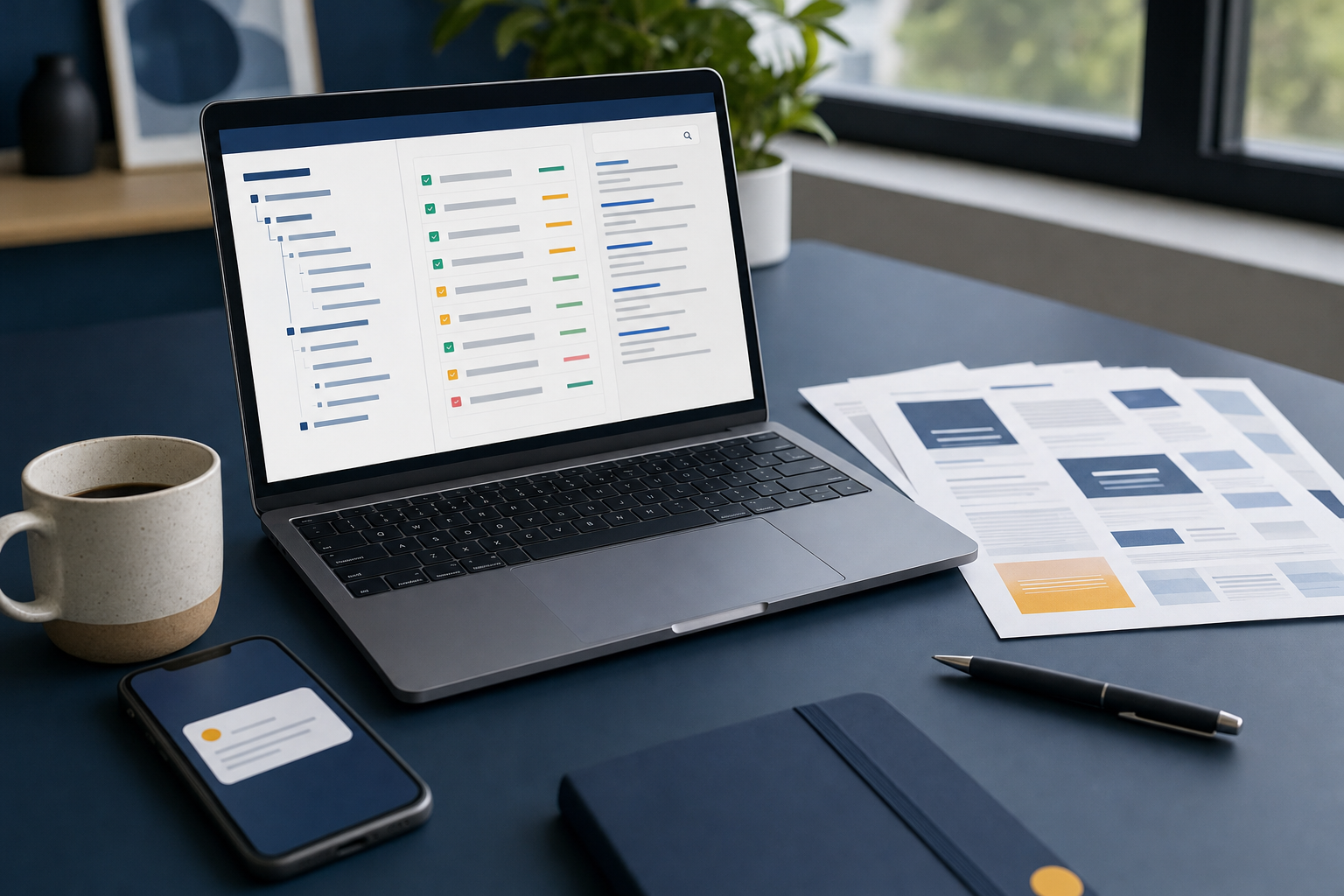
Ask any content strategist how long a proper SEO brief takes and you'll get a sigh before you get a number. Pull the SERP. Open 10 competitor tabs. Copy their headings into a doc. Skim People Also Ask. Guess at internal links. Then, 3 weeks later, discover the client already had a page chasing the exact same keyword.
Published estimates put a manual brief anywhere from 45 minutes to 4 hours, depending on depth. At 40 briefs a month, that's a part-time job spent copying and pasting.
So here's the plan: build your own SEO content brief generator, branded as your agency's tool, that turns a keyword into a writer-ready brief in about 2 minutes for a few cents in API fees. And I'll show you the AI prompts for SEO briefs that sit underneath it.
Want the whole build, ready to paste? The SEO Agencies, AI SEO Content Brief Generator pro prompt includes the full 22,000-character Lovable master prompt, an 11-step build guide, an 8-step sell-and-run playbook, tool costs, pricing and a cold email you can send today. Get the blueprint here.
Why briefs are where agency margin goes to die
A brief is the cheapest place to get an article right and the most expensive place to get it wrong. A weak brief means a writer guesses at intent, misses the subtopics Google clearly expects, and hands in 2,000 words that need a full rewrite.
And the work itself is repetitive. Every brief follows the same steps: look at what ranks, work out what those pages have in common, find the gaps, decide on an outline, add links. That's exactly the kind of work software should do, with a human checking the result.
The existing tools help, but they come with trade-offs. Surfer's Essential plan is $99/mo (or $79/mo billed yearly) for 30 Content Editor credits, and Scale is $219/mo for 100. Frase starts at $49/mo. Clearscope's Essentials plan is $129/mo. MarketMuse doesn't publish a price and routes you to a demo.
All of them are someone else's brand on your deliverable. Most charge per seat or per credit. And none of them know your client's sitemap well enough to say "hold on, you already have a page for this."
What a good SEO content brief actually contains
Before building anything, it helps to agree on the output. Here's what the generator produces, in the order a writer reads it:
- Search intent, classified as informational, commercial, transactional or navigational, with a plain-English reason.
- Title options and a meta description, length-checked, plus a URL slug that doesn't clash with existing client pages.
- A word count range based on the 25th to 75th percentile of the pages that rank for the same content type.
- A full H2/H3 outline, with what each section covers and which People Also Ask questions it answers.
- Must-cover topics (things 3+ competitors cover) and gaps (questions none of them answer well).
- An AI Overview and AI search citation section, covered properly below.
- FAQs drawn from People Also Ask and related searches.
- E-E-A-T notes: who should write or review it, what first-hand proof to add, which claims need a source.
- Internal links in both directions, and a cannibalisation check against the client's own site.
- Brand voice notes pulled from the client's style guide.
That last group is where a homegrown tool beats the off-the-shelf ones. Your tool knows the client.
How the generator works under the hood
It's a Lovable app with Lovable Cloud handling the database, logins and background functions. 4 outside services do the heavy lifting.
Step 1: pull the live SERP
DataForSEO's Google Organic Live Advanced endpoint returns the top 10 results, People Also Ask (including expanded answers), related searches, the featured snippet and the AI Overview, along with the sources that AI Overview cites. Live mode costs about $0.002 per call, and the minimum deposit is $50. That's roughly 25,000 briefs of SERP data for fifty bucks.
Step 2: read the competitors
Firecrawl scrapes the main content of the top-ranking pages and returns clean markdown. The app counts words, pulls the H1 to H3 heading tree and records the page type (guide, listicle, product page, tool, forum thread). Firecrawl's Hobby plan is $16/mo for 3,000 credits, and each page is 1 credit, so 8 pages per brief gets you around 375 briefs a month.
Pages that block scraping get skipped and logged. Reddit, Quora and YouTube results are recorded but not scraped, because they matter more as a signal ("Google wants lived experience here") than as content to copy.
Step 3: find the patterns and the gaps
An OpenAI model reads each page and pulls out the entities and subtopics. Then the app counts: anything in 3 or more competitor pages is table stakes, anything useful in 1 or 2 is an edge, and any PAA question or AI Overview claim that no competitor covers well is a gap. GPT-5 mini runs about $0.25 per million input tokens and $2 per million output, so this whole analysis costs pennies.
Step 4: check the client's own site
This is the bit agencies love in demos. The app syncs the client's sitemap (or maps the site with Firecrawl if there isn't one), stores the title, H1 and a one-line topic for each page, and then scores every page against the target keyword.
If an existing page already targets the term, or already ranks in the top 10, the brief says so in red and recommends updating that page instead. It also suggests 3 to 8 internal links out of the new article, and 2 to 5 existing pages that should link in once it's live, each with a suggested sentence.
Step 5: write the brief
A stronger model gets everything above plus the client's brand voice summary, audience notes, banned words and spelling preference, and returns structured JSON. The app renders it as an editable brief, saves version 1, and pings the strategist. Each regenerate or edit becomes a new version, so nothing gets lost when 2 people work on the same brief.
The full master prompt for this content brief generator spells out every table, screen and edge case, so Lovable builds it in one pass without asking you questions.
The AI prompts for SEO briefs behind it
If you searched for "AI prompts for SEO briefs", you probably want something you can paste into ChatGPT or Claude right now. Fair enough. Here's a cut-down version of the brief-writing prompt the app uses at step 5. Feed it real SERP data and it does a solid job on its own.
You are a senior SEO content strategist writing a brief for a freelance writer.

Target keyword: [keyword]
Secondary keywords: [list]
Audience: [who the reader is, what they already know, what they want]
Brand voice: [3-5 lines describing tone, plus words to avoid]

Here is today's Google data:
- Top 10 results with titles, URLs, word counts and H2/H3 headings: [paste]
- People Also Ask questions: [paste]
- AI Overview text and the sources it cites: [paste, or "none shown"]

Produce:
1. Search intent (informational / commercial / transactional / navigational), with a 2-sentence reason.
2. 3 title options under 60 characters and a meta description under 155.
3. A word count range based on the competitors of the same page type.
4. A full H2/H3 outline. Under each heading, 1-2 sentences on what to cover and which PAA question it answers.
5. Must-cover topics that 3+ competitors include.
6. Gaps: questions or angles none of the top 10 answer well.
7. A 40-60 word direct answer to the main question, to sit under the first H2.
8. 5-8 FAQs.
9. E-E-A-T notes: first-hand proof to add and claims that need a cited source.

Don't invent statistics. If a number is needed, say what kind of source the writer should find.
That prompt gets you maybe 70% of the way. The other 30% is the plumbing: fetching the SERP automatically, scraping competitors, checking the client's sitemap, storing briefs per client and sharing them with writers. That plumbing is what the pro prompt builds.
Writing so AI Overviews and AI search quote you
More of your clients' traffic now gets decided by whether Google's AI Overview, ChatGPT, Gemini or Perplexity quotes their page. So every brief from this tool includes a section on getting cited.
It starts with facts from the SERP: is there an AI Overview for this keyword today, and which sites does it cite? If a competitor's page is being quoted, the writer can see which claim earned it.
Then it gives specific instructions. Put a 40 to 60 word direct answer right under the first H2. Define key terms in one clean sentence. Use original numbers with the source named in the same sentence. Use tables or numbered steps where the topic suits them. Write some H2s as questions that mirror People Also Ask wording. Add an FAQ block with FAQPage schema, a named author with credentials and a "last updated" date.
Finally it lists the 3 to 5 exact claims the page should state in quotable form. Writers love this part, because it turns a vague goal ("rank in AI answers") into sentences they can actually write.
A worked example: one brief, start to finish
Say you run Northline Content Co., a 6-person agency with a UK physiotherapy client, Harbour Physio. Their content lead wants an article on "sciatica exercises".
Your strategist opens the app, picks Harbour Physio, types the keyword, adds "sciatica stretches" and "exercises for sciatic nerve pain" as secondaries and hits Generate.
About 90 seconds later the brief is ready. Intent comes back informational with high confidence: the top 10 is mostly NHS-style guides and clinic blog posts, with one Reddit thread. Because the client is flagged as a health business, the E-E-A-T section sits near the top in red: a chartered physiotherapist must review the piece, every exercise needs a "stop if" warning, and there's a references section and a disclaimer.
Word count target: 1,600 to 2,200, based on the guides that rank. The outline opens with a short "Which exercises help sciatica?" answer, then moves through 6 named exercises with H3s, a "when to see a physio" section and FAQs pulled from People Also Ask, like "Is walking good for sciatica?"
Then the cannibalisation panel lights up amber. Harbour Physio already has a page called "Lower back pain treatment" that mentions sciatica in 2 paragraphs. The recommendation: safe to publish, but differentiate the angle (home exercises vs in-clinic treatment) and link between them. It suggests the anchor "physio treatment for lower back pain" in the "when to see a physio" section, and a sentence to add to the old page linking back.
The strategist spends 10 minutes tweaking the outline, approves it, and sends the writer a private link branded with Northline's logo. The writer opens it on their phone, ticks off checklist items as they go, and leaves a comment asking whether to include video. The strategist gets a push notification and replies from the train.
Total API cost for that brief: under 10 cents.
Who should build this, and the economics
There are 2 obvious buyers.
The first is SEO and content agencies producing 20+ articles a month across several clients. They already write briefs, usually in a Google Docs template, and they'd love a branded tool to show clients. The second is in-house content teams at SaaS, e-commerce and multi-location businesses that publish weekly.
And there's a third option: build it for your own agency first. Run 50 real briefs through it, measure the time saved, and you've got the case study that sells it to every other agency.
Here's the pricing the blueprint recommends if you're building it for someone else:
- Setup: $2,500 to $4,500 one-time, covering the build, branding, custom domain, loading up to 10 clients and a 2-week supervised pilot.
- Monthly retainer: $297 to $597/mo for hosting, the Lovable plan, prompt tuning, quarterly updates and a monthly usage report.
- Volume tier: $797/mo for agencies running 150+ briefs a month or 25+ clients.
- Performance option: $10 per brief above 100 in a month.
Your running costs are small. Lovable Pro is $25/mo. API usage at 100 briefs a month typically lands around $20 to $60 total across DataForSEO, Firecrawl and OpenAI, and the blueprint recommends the agency owns those accounts directly so usage bills to them. Resend is free up to 3,000 emails a month.
Now the agency's side of the maths. If a brief takes their strategist 2 hours by hand and 15 minutes with the tool, 40 briefs a month frees up 70 hours. At a freelance strategist rate of $75 to $200/hour (the published 2026 range), that's $5,250 to $14,000 of time a month. Even at the bottom of that range, a $397 retainer is an easy yes.
The brief generator blueprint also includes a ready-to-send cold email that opens with exactly this time maths, plus a demo plan: run 2 briefs on the prospect's own site before the call, including one that exposes a real cannibalisation problem.
What you'll build, step by step
The build guide has 11 steps and most people get through it in an afternoon:
- Start a Lovable Pro project with Lovable Cloud switched on.
- Open a DataForSEO account, deposit $50 and add the login and password as secrets.
- Set up Firecrawl and add the API key.
- Create an OpenAI API key with a monthly spending cap.
- Verify a sending domain in Resend for share-link emails.
- Fill in 7 fields (agency name, website, contact email, brand colour, default Google location, language, competitor pages per brief) and copy the master prompt.
- Paste it into Lovable and let it build.
- Run a real brief and compare the SERP data against an incognito Google search.
- Test the PDF export, the writer share link and the edge cases (local keywords, forum-heavy SERPs).
- Brand it and connect a custom domain like briefs.youragency.com.
- Prep the demo.
The sell-and-run phase covers collecting client assets, moving API keys to the agency's own accounts, loading sitemaps, a 2-week side-by-side pilot, training, monthly reports and invoicing.
The last step wraps the app with AppBuild.DIY so it ships as a real iOS and Android app plus a PWA. Push notifications are the reason that's worth doing here: strategists hear about a finished brief or a writer's comment the moment it happens, and writers get new assignments on their lock screen instead of buried in email. A branded app in the App Store also makes a 6-person agency look a lot bigger to its clients.
Things to watch
Be honest with buyers about what this does. It produces faster, more consistent briefs grounded in live data. It doesn't guarantee rankings, which still depend on the writing, links and the site's authority.
Plan on a human reviewing every brief for 10 to 15 minutes. The research will be right; client judgement still needs a person.
Watch API credit. The app stops a brief before the next paid call if a provider runs dry, and the monthly usage report flags low balances, but someone has to own topping up.
And for health, finance and legal clients, switch on the YMYL flag. It moves E-E-A-T requirements to the top and insists on a qualified reviewer, which is what those clients need anyway.
Why build it now
Brief tools have been around for years, but 2 things have changed. SERP and scraping APIs got cheap enough that a brief costs cents to research. And tools like Lovable mean a non-developer can build a branded, multi-client app from one well-written prompt.
Meanwhile, AI Overviews and AI search have added a whole new section every brief needs. Agencies that can show clients "here's how we're writing to get cited" have a fresh reason to win and keep retainers.
You can keep renting someone else's brief tool per seat. Or you can own the engine, put your logo on it and sell it to the agencies down the road.
Ready to build your own SEO content brief generator? Grab the SEO Agencies, AI SEO Content Brief Generator pro prompt: the complete Lovable master prompt, the 11-step build guide, tool costs, pricing tiers and a cold email that's ready to send. Get it on Prompt-King now.