
She Drew Her Fence Line on Her Phone at 9pm. The Price Was on Screen Before Anyone Drove Out.
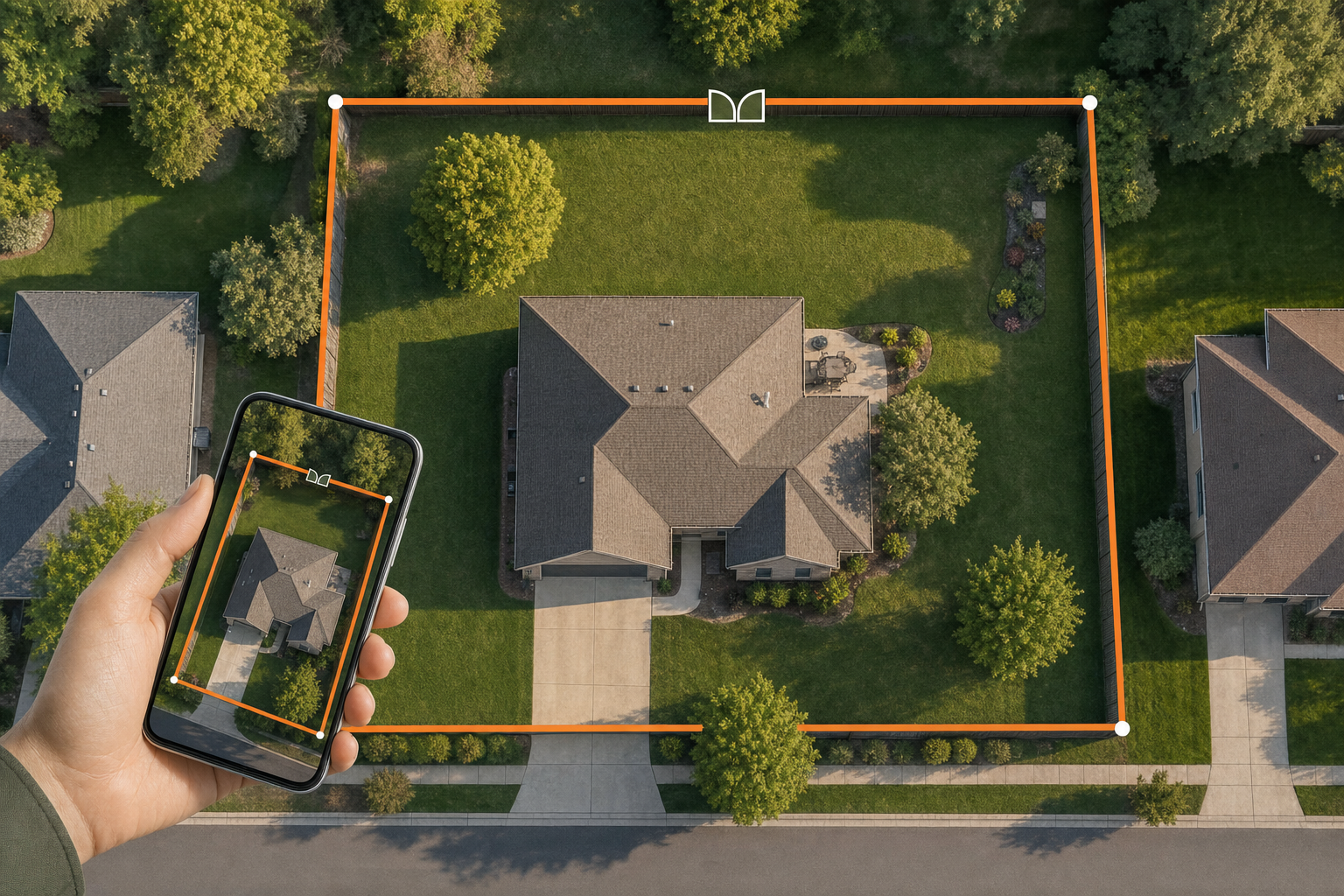
Dana wanted a fence. Her new dog had found the gap in the hedge twice in one week, and the third time she stopped waiting.
So she did what every homeowner does. She filled in three "request a free estimate" forms on a Tuesday night. Two companies called back on Thursday to ask when someone could come and measure. One came out the following Monday and emailed a number on Wednesday. Eight days from the first form to the first price.
Angi's 2026 data puts the average fence job at $3,277. Homeowners in that price range collect 2 or 3 quotes, and the pattern every fence marketer will tell you about is the same: they sign with whoever puts a clear number in front of them first. Speed wins more of these jobs than price does.
Which means the whole estimate process most fence companies run, the callback, the windshield time, the tape measure, the spreadsheet, the email 2 days later, is a machine for arriving second.
The Fence Contractors, Draw-Your-Fence-Line Satellite Instant Quote & Visit Booker pro prompt builds the tool that flips the order. The homeowner draws their fence on a satellite map of their own yard, gets a real price range in about 3 minutes, and books the measurement visit while they're still on the site. The complete Lovable master prompt, the 8 client fields, the 11-step build playbook, the 8-step sell-and-run playbook, tool list, pricing and a cold outreach script are all in the blueprint.
What a fence estimate costs the contractor before anyone wins anything
Start with the lead. A fence company buying from Angi or HomeAdvisor pays $15 to $85 per lead, and over $100 is common in big metros. That lead gets sold to 3 to 6 contractors at the same time. Close rates on shared leads run 5 to 10% on new installs. Work the maths through and the cost per booked job lands somewhere between $667 and $1,400, plus a membership fee of around $300 a year whether anything closes or not.
Then the estimate itself. The traditional flow is a 90-minute round trip: drive out, walk the line with a wheel, talk through the gates, drive back, price it in a spreadsheet, send the email. For an owner running 2 crews and bidding 12 jobs a week, that's most of a working week spent producing numbers for people who are also getting numbers from 2 other companies.
And the close rate follows the speed. One fence estimating vendor puts it plainly: the gap between a 30% close rate and a 55% close rate in this trade comes down to how fast and how clearly you quote. A lead answered in 5 minutes is 21 times more likely to qualify than one answered in 30. The fence company that answers with a real number in 3 minutes is playing a different sport from the one that calls back on Thursday.
So the goal is obvious. Put a credible price in front of the homeowner while they're still thinking about it, and make the site visit a confirmation step rather than the first step.
How the tool works
The mechanism is a satellite map and a line the homeowner draws themselves. That's the whole trick, and it's why the numbers come out right.
The homeowner types their address. The app geocodes it and drops them onto a satellite view of their property at zoom level 20, so the parcel fills the phone screen. Then they tap the corners. Each tap adds a point to a bright orange polyline, and a floating pill shows the running total in linear feet, worked out from the real geodesic distance between the points (the Google Maps geometry library does this in one call, metres converted to feet). They can undo, drag a corner, or start a second run for a yard where two sides don't meet.
Gates come next. They tap anywhere on the line to drop a gate icon and pick walk gate or double drive gate. Then a yes/no on whether there's an old fence to pull out, and roughly how much of it. Then material: chain link, wood privacy, vinyl, or aluminum, each card showing "from $X per foot" pulled from the contractor's own settings. Then height, and for wood and vinyl, a style.
Contact details sit right before the price, with a pre-checked SMS consent box, so the lead exists before the number appears.
Then the quote screen. Three columns, Good, Better and Best, built from the homeowner's chosen material. Good is exactly what they picked. Better is the same material with one upgrade (board-on-board for wood, heavier-gauge for vinyl, black vinyl-coated for chain link). Best is the next material tier up. Every column shows a price range rather than a single figure, the estimate plus or minus 8% by default, both ends rounded to the nearest $25, with the label "Estimated range. We lock the exact number at your free measurement visit." Under each column sit the line items: fence, gates, removal, and a plain "what's not included" note covering permits ($50 to $200 depending on the city), HOA approval, and a survey if the boundary's disputed. There's one more line the blueprint insists on: "We call 811 before we dig. It's free, it's required by law, and we handle it."
Two buttons. Book my free measurement visit, which pulls 90-minute windows from the estimator's live calendar for the next 14 days. And Lock this price for 30 days, a $100 refundable deposit through Stripe Checkout, refunded if they don't go ahead and credited to the invoice if they do.
Behind all that, a few things happen at once. The homeowner gets an SMS with the range and a link back to their quote. The office gets an SMS and an email with the lead and a link to the map snapshot. And the satellite snapshot with the orange line on it goes to an AI vision model with a system prompt written for an estimator: flag mature trees within 3 feet of the line, slopes, driveways the line crosses, a pool inside the enclosure (which triggers pool-code gate rules), a line that appears to run through a neighbour's structure, and access problems for a truck or auger. The flags show up as coloured chips on the lead. If the AI call fails, the quote still shows. The homeowner never waits on it.
The admin side is what makes it a business tool rather than a widget. A leads list with status, estimator and estimate value. A lead detail page with the map, every input, the three-column quote exactly as the homeowner saw it, the AI flags, the message history, and a final-quote form the estimator fills after the visit. A calendar with drag-to-reschedule. A pricing settings screen where the owner edits per-foot rates, height and style multipliers, gate prices, removal rate, minimum job and deposit amount, with every change applying to new quotes only. And a reports page that tracks leads, bookings, deposits, win rate, and one number that matters more than the rest: how far the drawn footage drifts from the measured footage.
The master prompt in the blueprint specifies all of this in one paste, including the data model with row-level security, the exact quote maths, the SMS opt-out handling, and 8 edge cases (slopes, corner lots, duplicate submissions, a road-centreline geocode, and so on). It runs to about 18,000 characters, which is what it takes to get Lovable to build the whole thing without asking questions.
A worked example: Dana's back yard
Say Dana lands on the tool at 9pm. She types her address, sees her roof and her lawn from above, and taps 4 corners around the back yard. The pill reads 120 linear feet. She drops one walk gate by the side of the house. There's no old fence to remove, just the hedge with the gap in it. She picks wood privacy, 6 ft, dog-ear (the plain style). She types her name and mobile.
The contractor's settings say $38 per linear foot installed for 6 ft wood privacy, $325 for a walk gate, and an 8% range. So the maths runs like this.
- Good (dog-ear cedar, 6 ft): 120 ft x $38 = $4,560, plus the $325 gate, gives $4,885. Range shown: $4,500 to $5,275.
- Better (board-on-board, 1.15 multiplier): $5,244 fence plus $325 gate gives $5,569. Range: $5,125 to $6,025.
- Best (vinyl privacy at $45 per foot): $5,400 fence plus $325 gate gives $5,725. Range: $5,275 to $6,175.
She sees all three at 9:04pm. The AI flags come back 15 seconds later with one medium-severity note: a mature tree sits within 3 feet of the back-left corner, and the homeowner note reads "Looks like there's a tree close to one corner, so we may shift a post a foot or two." Her phone buzzes with the SMS. She books Saturday at 10am and pays the $100 to lock the Good price, because the dog is the priority and the neighbours can look at dog-ear.
At 9:05pm the owner's phone buzzes too. He opens the lead in bed, looks at the orange line on the satellite map, sees the tree flag, and knows what he's walking into on Saturday before he's left the house.
Saturday morning the estimator's wheel says 123 ft, the tree means one post moves 18 inches, and the final quote comes in at $4,999. Inside the Good range. Dana signs on the estimator's phone at 10:35am. The $100 comes off the invoice. Total time from first tap to signed job: 4 days, and 3 of those were her waiting for Saturday.
The two companies whose forms she filled in on Tuesday night are still going to call her on Thursday.
Who should build this, and what the money looks like
This is a blueprint for someone selling built tools to local businesses, whether that's a one-person agency, a freelancer who's got the hang of Lovable, or a marketing consultant who wants a product to sell rather than hours.
The client is a residential fence contractor with 1 to 4 crews, quoting 8 to 20 jobs a week, in suburbs where lots need 100 to 300 feet of fence. The blueprint tells you how to find them: search "fence company" on Google Maps in any suburb, shortlist the ones with 30+ reviews whose website still says "request a free estimate" with no pricing on it. The warmest prospects are the ones already paying Angi or HomeAdvisor, because they already know the problem is speed and they can already feel the cost per booked job.
The pricing the blueprint recommends:
- Setup fee: $2,500 to $4,000, one-time. That covers the build, loading the client's real per-foot rates and testing them against 3 recent jobs until the tool's range contains the invoiced price, wiring Google Maps, Twilio, Stripe and Resend, A2P 10DLC registration, training, and a 2-week calibration pilot.
- Monthly retainer: $397 to $597. Hosting, map and SMS usage, the AI flags, rate updates when lumber or vinyl prices move, and a monthly report.
- Performance bonus: $100 per job marked Won above the client's pre-launch monthly average, agreed in writing before launch and billed from the dashboard's own Won count.
- Multi-branch: $797 to $997 a month for up to 3 service areas with separate rate sheets and calendars.
Here's why a contractor says yes to those numbers. Take the owner bidding 12 jobs a week and closing 4, a 33% rate. If faster, clearer quoting moves him to closing 5, that's one extra job a week. At the national average of $3,277 a job, one extra job a week is roughly $14,000 a month in extra revenue. Against a $500 retainer. The setup fee pays back on the first extra job.
Then there's the lead-cost side. The tool works on the people who already found the contractor. A company spending $1,500 a month on shared leads and converting 6% of them gets the same leads converting at a higher rate, because the response time dropped from days to seconds and the homeowner got a number before she'd finished filling in the second company's form.
For the person building it, the running costs are small. Lovable Pro is $25 a month. Google Maps Platform's free monthly allowance covers a typical fence company's traffic. The OpenAI vision call is a cent or three per lead. Twilio SMS is under a cent each plus $1.15 a month for the number. Stripe takes 2.9% plus 30 cents on the $100 deposits. Resend is free up to 3,000 emails a month. Ten clients on a $500 retainer is $5,000 a month recurring on maybe $150 of tool costs across all of them, before setup fees. The pro prompt page lists every tool with its pricing and gives each one a numbered setup step in the build phase, so nothing gets listed that the playbook never tells you how to connect.
What to expect, and where it breaks
On a flat suburban lot, a line drawn on satellite imagery usually comes within a few percent of the wheel. The 8% range is there to absorb the rest: slopes (the drawn distance is horizontal, and a slope can add up to 5%), roots and rock, and homeowners who draw a foot inside the property line. The blueprint's pilot step has the estimator write measured footage into every final quote for 2 weeks, so the owner can tighten the range to 6% where drift is small or widen it to 10% in hilly areas with big trees.
Satellite imagery ages. A back corner under tree canopy can be invisible from above. That's why the measurement visit stays in the flow and the price is a range until someone stands on the lot. The tool's job is to make sure the contractor's estimator is the first person standing on that lot, with a map, a footage figure and a list of things to look at.
SMS to homeowners in the US needs A2P 10DLC registration through Twilio, which takes 1 to 3 weeks and needs the client's EIN. Plan the launch date around it. Until it clears, the blueprint runs in test mode with every SMS going to the owner's own phone.
The final step in the sell-and-run playbook wraps the finished web app as a native iOS and Android app through AppBuild.DIY, and for this trade it earns its place. The estimator gets a push notification the moment a homeowner finishes drawing a line, which is how you hit the 5-minute response window from a truck. Homeowners get push reminders for the visit and a heads-up before their 30-day price lock runs out, on the lock screen at 60 to 90% open rates rather than in an SMS thread they may have muted. Camera and photo access lets the estimator attach site photos to the lead during the visit. And for a local contractor, an App Store listing with the company name on it does more for credibility than a bookmarked URL.
Why build this one now
Every piece of this was expensive or awkward 3 years ago. Satellite tiles and a drawing library are now a single Google Maps API key. A vision model that can look at an aerial photo and say "tree near the corner, pool inside the line" costs pennies per call. Lovable turns an 18,000-character specification into a working app with a database and auth in an afternoon. The national instant-quote fence players have trained homeowners to expect a number on screen, and the local contractor with 40 five-star reviews and a "request a free estimate" form is losing to that expectation every week without knowing it.
Fence season peaks in spring. A contractor who launches this in the autumn goes into the busy months with 6 months of calibration data, a tuned rate sheet, and an estimator who opens each morning with a list of leads that already have a map, a footage figure and a booked slot.
Get the Fence Contractors, Draw-Your-Fence-Line Satellite Instant Quote & Visit Booker pro prompt now. Fill in the 8 fields with your client's name, service area, alert contacts and per-foot rates, paste the master prompt into Lovable, and follow the 19 numbered steps from first build to the AppBuild.DIY wrap. Your first fence client's estimator could be getting map-and-footage leads on his phone before the end of next week.