
The 15 Foot Castle Met a 32 Inch Gate at 9am on a Saturday
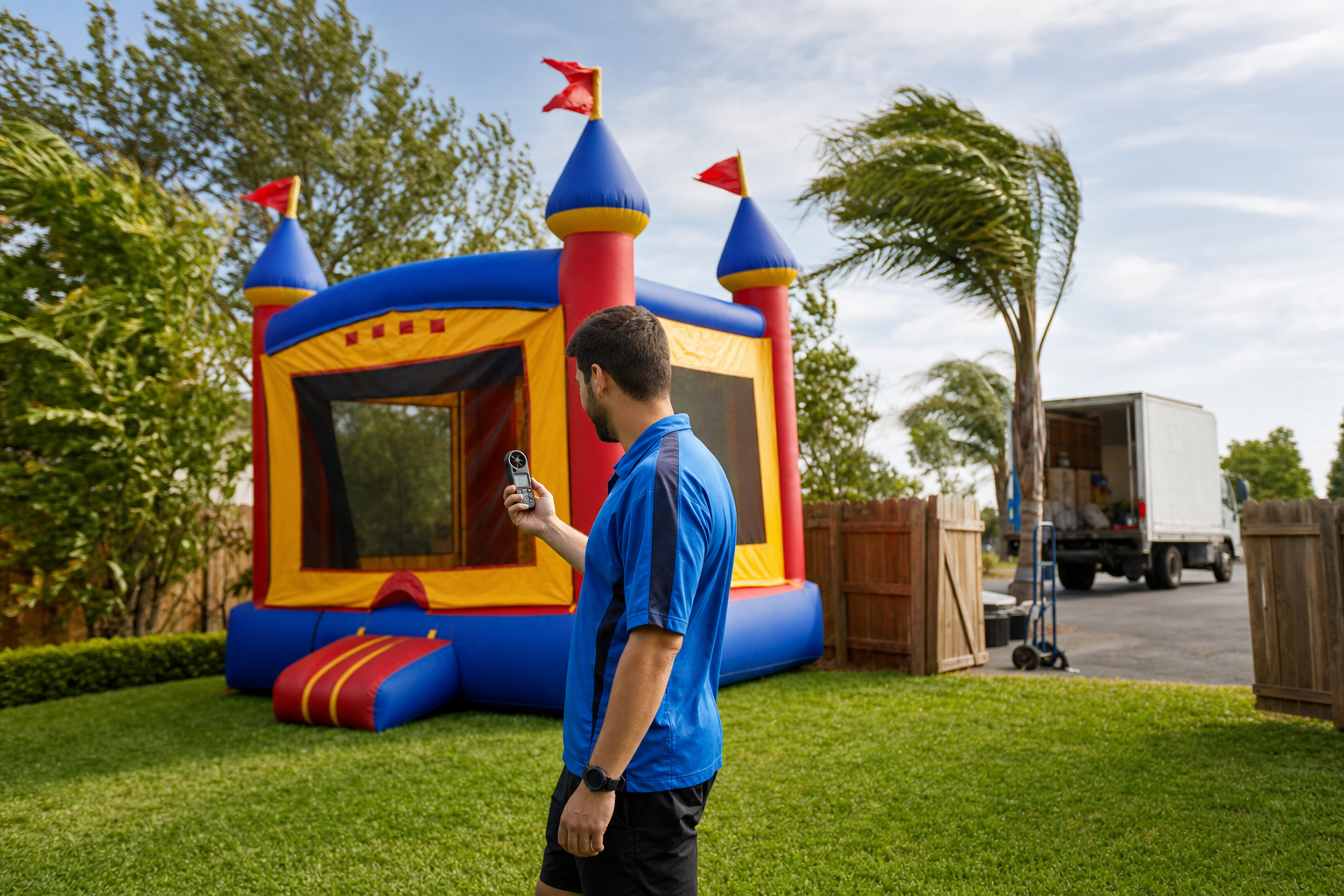
It's 9:04 on a Saturday morning. Two crew members are standing in a side passage in a suburb outside Dallas with a 15 by 15 castle rolled up on a dolly. The roll is 40 inches wide. The gate is 32.
The mum booked on the phone on Tuesday. She was asked if she had "a decent sized yard". She said yes, because she does. The gate never came up.
So the crew drive back to the warehouse for the 13 by 13, lose an hour, and the next drop on the sheet is late. And next weekend the forecast says gusts of 28 mph, and the owner spends Friday night and Saturday morning on the phone with 14 parents arguing about deposits.
That's the whole business problem for a bounce house company, in two scenes. The pro prompt in this post fixes both of them.
Get the full blueprint: Party & Inflatable Rental Companies, Yard Fit Check, Live Inventory & Wind-Safe Booking Tool. The 17,000 character master prompt, 11 build steps, 9 launch steps, the tool list and the pricing to charge for it.
Why party rental is a good niche to build for
Bounce house rental looks like a simple business. Buy some inflatables, buy a truck, put up a Facebook page. And a lot of the companies doing it are exactly that: an owner, a part-time crew of 2 to 6 people on weekends, 10 to 60 units in a warehouse or a big garage, and 1 to 4 trucks.
The money is decent. A standard bounce house goes for $150 to $250 for the day in most US markets, a combo with a slide for $200 to $400, and a water slide for $250 to $500. Add delivery, a generator, a table and chair package and a cotton candy machine and a typical birthday order lands between $250 and $600. School fun days, church festivals and corporate picnics run into the thousands.
But almost all of that revenue lands on about 100 days a year. Saturdays and Sundays from spring to early autumn, plus school holidays. When a company only has around 100 selling days, every lost booking on one of them hurts, and every wasted truck trip on one of them hurts more.
The owners know this. That's why their Facebook comments are full of "is the unicorn castle free on the 14th?" and their FAQ pages have a weather policy longer than the rental agreement.
Where the bookings leak
There are three leaks, and they're all about information arriving too late.
The 9pm inquiry. Parents plan parties after the kids are in bed. If the company's site says "call or text to check availability", the parent sends a message to three companies and books whoever answers first with a price and a payment link. The owner who replies at 8am with a lovely friendly message has already lost.
The yard that doesn't fit. Every inflatable needs its footprint plus roughly 3 feet of clear space on every side, so a 15 by 15 castle needs a flat patch of 21 by 21 feet. It needs to come through a gate on a dolly. It needs power within the blower cord's reach, usually about 50 feet. It can't go on gravel, and on concrete it needs sandbags instead of stakes. It can't go under power lines. On the phone, almost none of this gets asked properly, and the crew finds out on the day.
The windy weekend. The industry standard for inflatables, ASTM F2374, sets the stop point at 15 mph of sustained wind unless the manufacturer allows more, and gusts over 25 mph mean deflate. Thunderstorms mean get everyone off immediately. So a gusty Saturday is a safety call, and a responsible owner has to cancel. What turns that into a nightmare is that it happens by phone, one parent at a time, the morning of the party, with every conversation turning into a debate about whether the deposit is coming back.
How the blueprint works
The wind-safe booking tool blueprint builds a mobile-first booking site with three moving parts, and they share one database, so each part knows what the others know.
Part 1: the yard fit check
Before a parent sees a single price, they answer 6 questions about where the inflatable will go. How long and wide is the flat area (with a tip: one adult stride is roughly 2.5 feet, so pace it out). What's the surface. How wide is the narrowest gate or path between the street and the spot, in inches. Any stairs. How far is the nearest outlet. Any wires or branches overhead.
Then the app runs every unit in the inventory through a set of plain rules. Footprint plus clearance must fit the space in either direction. The gate has to be at least the unit's rolled-up width plus 4 inches. Gravel rules out every inflatable. Concrete or turf adds a $10 sandbag charge per unit. No outlet in reach means the unit is only bookable with a $75 generator. A few steps adds $25, a long flight sends the booking to the owner for a human look.
The bit I like most is what happens to the units that don't fit. They stay on screen, greyed out, with the reason written in normal language: "Needs 21 x 21 ft. Your space is 18 x 30 ft." Or "Won't fit through a 32 inch gate. Needs 44 inches." Parents trust a site that tells them why, and it stops the "why can't I book the big one?" phone call before it starts.
There's also an optional photo. If the parent snaps the setup spot, an OpenAI vision call looks for power lines, overhanging branches and slope. It never blocks the booking. It adds a red SITE CHECK flag on the crew's delivery sheet so they know which house to look at carefully before they unroll anything.
Part 2: live inventory and delivery pricing
Most castles are quantity 1. Once the unicorn castle is booked for the 14th, it's gone for the 14th, and the app shows the 3 nearest dates it's free. Tables and chairs work on counts. And the app tracks the thing most booking forms forget: trucks. Two trucks doing 6 drops each means 12 drops a day, and drop 13 doesn't exist no matter how many castles are sitting in the warehouse.
Delivery is priced from the real Google Maps driving distance from the warehouse. Free within the radius the owner sets (10 miles is common), then a per mile charge (often around $2), and anything past the maximum distance becomes a "call me" lead instead of an online booking. Every fee is its own line on the quote. The parent sees $189 castle, $10 sandbags, $16 delivery, before they pay a cent.
The deposit (50 percent by default, which is the most common setup in this trade) goes through Stripe Checkout with the card saved. The balance gets charged automatically at 8am on the party day, but only if the party is going ahead. That one rule does a lot of work on weather weekends.
Part 3: the weather check
48 hours before every delivery, the app pulls the OpenWeather hourly forecast for the exact coordinates of that booking, for the exact party hours. It looks at sustained wind, gusts, rain probability and thunderstorms against the owner's limits (15 mph, 25 mph, 60 percent, any storm).
If anything breaches, the booking goes to WEATHER WATCH. The owner gets a text. The parent gets a text with a link to a page that says, in plain English, what the forecast shows ("Gusts up to 28 mph between 2pm and 4pm") and gives three choices: keep the date and let the crew decide on the morning, move to another open date for free, or take a credit for everything paid, valid for 12 months.
It checks again at 24 hours. If the forecast clears, the parent gets a "good news" text and the booking goes back to confirmed. At 6am on the day, anything still breaching sits on the owner's weather board with two buttons: Call it off, or Go ahead. Calling it off frees the unit, turns the deposit into a credit (or a refund if the owner prefers that policy), sends the parent a calm explanation with the forecast numbers, and the balance never gets charged.
And if the forecast API fails, the check is marked UNKNOWN and a human gets a text. It never assumes the weather is fine because a call didn't come back. That's the kind of edge case the master prompt spells out so the builder doesn't guess.
A worked example: Jess, a Tuesday night, a 25th of April party
Here's one booking, start to finish.
Jess is planning her son's 6th birthday for Saturday the 25th. It's 9:40pm on a Tuesday. She finds Bounce Around Party Rentals on Google and taps "Book online".
She picks the 25th. She paces out her back lawn: about 9 strides by 10, so roughly 22 by 25 feet. Grass. The side gate is 46 inches (she measured it with the tape from the kitchen drawer, because the app asked). The outdoor outlet is about 25 feet from the spot. She ticks "not sure" on branches, because there's an oak at the back fence, and uploads a photo.
The results screen shows the 13 by 13 castle and the 15 by 15 castle in green. The 22 by 14 combo with a slide is grey: "Needs 28 x 20 ft. Your space is 22 x 25 ft." So close. The 30 foot water slide is grey too. The photo check notices branches near the back fence and adds a SITE CHECK flag for the crew, with a note to Jess asking her to set up the area away from the tree.
She picks the 15 by 15 castle at $189, adds a table and chair package for $65, and gets a quote. Her address is 14 miles from the warehouse, 4 past the free radius, so delivery is $8. Total $262. Deposit today: $131. Balance on the morning of the party.
She reads the rental agreement, ticks the box, pays with Apple Pay through Stripe, and goes to bed. The owner's phone buzzes with "New booking: 15x15 castle, table package, Sat 25 Apr, Frisco, $262". It's 9:46pm. The whole thing took 6 minutes.
On Thursday the 23rd at 10am, the 48 hour check runs. The forecast shows gusts of 27 mph between 1pm and 3pm on Saturday. Jess gets a text: the forecast, the link, the three options. She picks "keep my date", because her family's travelling in and she'd rather wait.
Friday morning, the 24 hour check shows sustained winds of 16 mph for one afternoon hour. Still over the 15 mph limit, so it stays on watch. Saturday at 6am, the forecast shows sustained 17 mph and gusts of 26 mph during party hours. The owner opens the weather board, sees 6 bookings in red, and presses Call it off on all 6 before his first coffee.
Jess gets a text at 6:05am explaining the cancellation, the numbers behind it, and her $131 credit for the next 12 months. Her card isn't charged the balance. The castle is freed. She rebooks for the 9th of May on Sunday afternoon, using the credit. The owner made zero phone calls.
Compare that to the version where she sent a Messenger message at 9:40pm and three companies replied the next day. Or the version where the crew showed up to a combo that didn't fit.
Who should build this, and the real economics
This is a build for someone who sells AI-built tools to local businesses: a freelancer, a small agency, a reseller with a few clients already. It's a Medium level build in Lovable. You don't need to write code, but you do need to set up 6 accounts carefully (Stripe, Twilio, Google Maps Platform, OpenWeather, OpenAI and Lovable itself), and you need an afternoon in the client's warehouse with a tape measure.
That warehouse afternoon is the part to take seriously. The fit check is only as good as each unit's real footprint and rolled-up width. Measure them with a tape. Supplier catalogues are often a few models out of date.
Here's the pricing laid out in the party rental pro prompt:
- Setup: $1,500 to $2,800 one-time, covering the build, all the account setup, loading the inventory, branding and a supervised pilot weekend.
- Monthly: $197 to $397, covering hosting, SMS, maps, weather and AI usage, inventory changes, a monthly report and support on weather weekends.
- Performance bonus: $8 per online booking above the company's previous monthly online average. A company going from 30 to 80 online bookings in May pays $400 extra that month.
- Multi-warehouse: $150 a month per extra territory, each with its own trucks, cap and radius.
- Off-season: drop to $97 a month from November to February for cold-climate companies.
Running costs for you are small. Lovable from $25 a month. Twilio around $1.15 a month for the number plus under a cent per text. OpenWeather's One Call 3.0 gives 1,000 calls a day free, which a 40-booking weekend doesn't come close to. Google Maps stays inside its free allowance for most single-town operators. The photo check is about a cent per photo. So on a $297 retainer, nearly all of it is margin once the build is done.
For the client, the maths is simpler still. One saved booking on a Saturday covers most of a month's retainer. One avoided wasted trip saves the crew an hour on the busiest day of the week. And a weather weekend handled by text instead of phone calls is worth a lot to an owner who's been through the other kind.
Plenty of these companies already pay for back-office rental software. That's fine, and the pitch shouldn't fight it. This tool is the customer-facing front door: it books the right unit for the right yard and runs the weather conversation, which is the bit those owners still do by hand.
Shipping it as a real app
The last step in the blueprint is wrapping the booking tool with AppBuild.DIY, so the client ends up with an iOS app, an Android app and an installable web app, with push notifications switched on. The camera and photos plugins open the yard photo straight from the phone, and foreground location lets a parent standing in the garden tap "use my location" instead of typing an address.
Why bother for a bounce house company? Because their customers come back. The same parents book every birthday, then the school fun day, then the church picnic. A push notification in February saying spring Saturdays are filling up gets read. A Google ad to win back a customer you already had is money spent twice.
Why build it now
Timing matters in this trade. The bookings for April to September start landing in February and March. If you pitch in October and build in the winter, the client goes into spring with the tool live, tested on a quiet weekend or two, and ready for the first windy Saturday in April.
And the pitch is easy to find a buyer for. Search "bounce house rental" on Google Maps in any suburb, open the websites, and look for "call or text to check availability". Then look at their Facebook comments. You'll find the 9pm inquiries sitting there. The sales script in the blueprint opens with exactly that.
Start with one company in one town. Measure their inventory, run a pilot weekend, film the weather board on a gusty Saturday, and use that video for the next ten pitches.
Ready to build it? Get the full party rental booking blueprint on Prompt-King: the master prompt, the 8 client fields, every build and launch step, the tool list, the pricing table and a cold outreach script you can send today.