
The House Color Visualizer
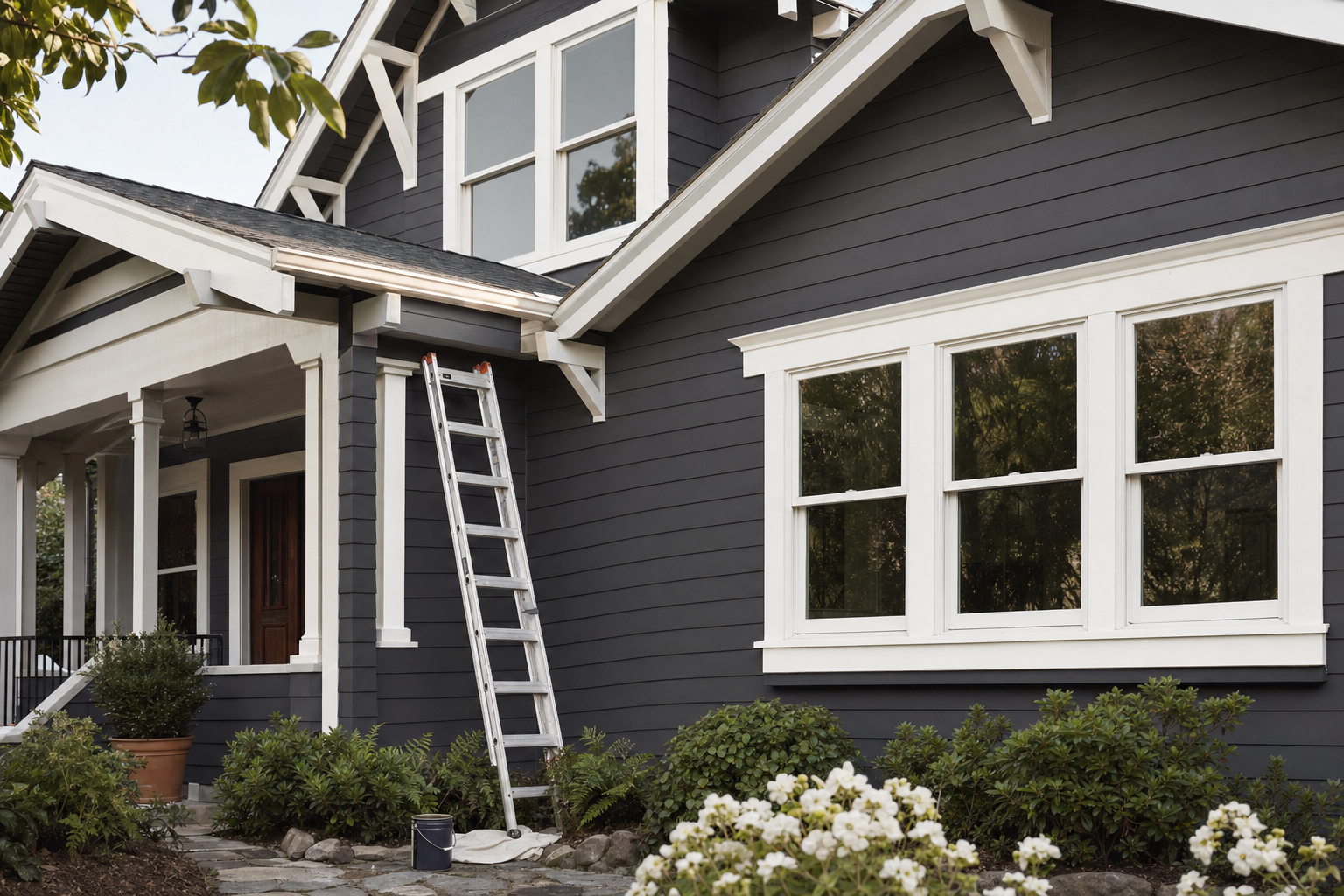
The Objection That Stalls Every Painting Estimate
Ask any exterior painting contractor what kills the most deals and you will not hear "price." You will hear some version of "I don't know what it's going to look like." A homeowner gets a quote, thanks the estimator, says they need to talk it over, and then the paper sits on the counter for three months while they try to imagine their own house in a color they have only seen in a paint chip the size of a matchbook. That gap between "here's a number" and "here's what it actually looks like on my house" is where deals go to die.
Prompt-King.AI's own framing of this blueprint says it plainly: color visualization is the single biggest objection in exterior painting. Homeowners can't picture their actual house in a different color, so they procrastinate. And the typical sales process makes that worse, not better, because it usually takes three separate touchpoints, an initial estimate visit, a follow-up call, and often a second visit with swatches, before anyone commits. Every one of those touchpoints is a chance for the homeowner to get busy, get a cheaper quote from someone else, or just quietly forget about it.
The tool at the center of this blueprint, listed on Prompt-King.AI as Painters (Exterior) – House Color Visualizer, is built to collapse that gap. Instead of a generic "get a free estimate" form that feeds a lead into a phone-tag queue, the homeowner types their own address, watches their own house get painted six different ways by AI, picks the one they like, and gets a number on the screen before they've closed the tab. No swatches, no second visit, no waiting on a callback. The blueprint is tagged Vision-Based, rated Easy to build, and marked Ready on the site, which in Prompt-King.AI's system means it has already been through a working build, not just sketched out.
Get the exact blueprint. Everything described in this post, the Street View fallback, the parallel rendering fix, the real paint code mapping, comes straight from the Painters (Exterior) House Color Visualizer on Prompt-King.AI. If you build for local contractors or sell software into that market, this is the fastest way to get a working version of the tool this post walks through.
How the Blueprint Actually Works, Address to Booked Job
Strip away the AI buzz and this is a fairly linear pipeline, and understanding each stage matters if you're the one building or selling it.
It starts with an address field with autocomplete, so the homeowner doesn't have to type a perfectly formatted string. Behind that field, the app calls Google's Street View Static API to pull an actual photo of the front of the house, along with a satellite view used to estimate the footprint. That combination matters because Street View alone tells you what the house looks like, but the satellite pass is what lets the system estimate square footage without anyone manually measuring anything. Nobody is walking the property with a tape measure before they get a number.
Not every address has usable Street View coverage. Some houses were photographed by Google's camera cars in 2024 or 2025 and look crisp. Others are stuck with grainy 2015 imagery, half the facade hidden behind a tree that's grown considerably since the photo was taken, or a car parked directly in front of the porch. Rather than pretend this problem doesn't exist, the blueprint builds in a fallback: when Street View comes back unusable or missing entirely, the homeowner is prompted to upload their own photo instead. That fallback isn't a nice-to-have bolted on after launch, it's treated as essential to the build from the start, because in real-world testing it comes up constantly.
Once there's a usable image, a vision model looks at it and does two jobs at once: it identifies the architectural style of the house (craftsman, colonial, farmhouse, ranch, and so on) and reads the existing exterior materials and colors. That style detection is what powers the next step, a curated library of color schemes tagged by which house styles they suit. Rather than showing every homeowner the same six generic combinations, the system pulls schemes that are actually compatible with a craftsman bungalow versus a colonial, and each scheme in that library carries real paint identifiers, specific Sherwin-Williams and Benjamin Moore codes, not just a color name like "sage green" that means something different to every paint counter in the country.
From there, six of those schemes get rendered onto the homeowner's actual house, in parallel, using image-to-image generation tuned to change only the painted surfaces. The roofline, windows, landscaping, sky, and every other part of the photo are supposed to stay exactly as they were, only the siding, trim, and accent colors change. The homeowner scrolls through the six results in a swipe-style interface, more Tinder than a paint chip aisle, picks a favorite, and immediately sees a quote calculated from the actual square footage the system estimated earlier, not a generic per-job flat rate. To book, they leave a $50 deposit through Stripe on the spot.
That's the whole loop: type an address, watch your own house repainted six ways, pick one, pay $50, done. No estimator visit required before the homeowner has already mentally committed to a color. Every stage of that loop, including the API calls and the exact prompts that make it hold together, is laid out step by step in the House Color Visualizer build.
Walking a Homeowner Through It
Picture a woman named Renata who owns a 1970s ranch-style house on a quarter acre in a suburb outside Columbus. Her house is currently a tired beige that was probably chosen by whoever built the subdivision, and she's been meaning to repaint for two summers running but never got past "I don't know what color." She clicks a Meta ad for a local painting company, lands on their site, and instead of a lead form, she sees a box asking for her address.
She types it in. Within a few seconds, her actual house appears on screen, not a stock photo of a similar ranch house, hers, with her driveway and her landscaping. Then the six renders load in, one after another, fast enough that she doesn't get bored waiting. The first is a classic warm palette, a soft greige body with white trim. The second goes darker and more current, a deep charcoal body with black trim and a red door for contrast. A third leans coastal, a muted blue-gray with crisp white. By the fourth and fifth she's starting to actually see herself in one of these, and the sixth is a bolder, more saturated option she'd never have picked from a swatch but looks genuinely good rendered on her own roofline.
She lingers on the charcoal one, swipes back to it twice, and picks it. Underneath the winning render, the app shows her the exact codes, the paint brand, the finish, and a quote built from the square footage the system pulled off the satellite image of her house rather than a generic "starting at" number. She's already looking at her own house in the color she wants, so the $50 deposit to lock in a date doesn't feel like a leap of faith, it feels like the obvious next click. Total time from landing on the page to booking a job: under five minutes, with zero phone calls and zero site visits.
That is the entire commercial argument for building this thing. A painting company that used to need a form fill, a callback, a scheduled estimate visit, and a follow-up close now has a homeowner who has already seen the outcome and already paid to secure it, before a single person on the sales team has said a word to her.
Why This Build Is Harder Than It Looks (and Why That's the Point)
Anyone can build a form that says "upload a photo, get a color suggestion." What makes this blueprint worth paying for is the list of failure modes it already accounts for, the stuff that separates a demo that works once from a tool that survives a real address book. Prompt-King.AI is upfront that this build runs 15 to 22 minutes for the initial pass and then another 5 to 8 follow-up messages to actually dial it in, and the specific problems it flags are worth understanding even if you never touch the code yourself.
The first is heading accuracy. Google Street View's camera doesn't always point at the front of the house you asked for, sometimes it captures the side, the neighbor's place, or a wall. The fix is to try multiple compass headings, zero, ninety, one-eighty, two-seventy degrees, and cross-check against Street View's Image Metadata API to figure out which heading actually shows a residence before committing to it.
The second is speed. Generating six photorealistic renders one after another would take minutes and homeowners would abandon the page. The renders have to fire in parallel against fal.ai rather than sequentially, so a job that would take ninety seconds run one at a time comes back in fifteen to twenty because all six requests are in flight simultaneously.
The third is the most important one for trust: keeping the house the house. Early image-to-image passes tend to drift, subtly reshaping a roofline or repainting a window that should have stayed put. The fix is turning up the image strength parameter and being explicit in the generation prompt that architecture, roof, chimney, foundation, windows, landscaping, and sky must remain untouched, only the painted surfaces change. Get this wrong and the homeowner notices immediately, because it's her house, she knows exactly what it's supposed to look like.
Fourth, color accuracy. Telling an image model "sage green" produces six different shades of sage green depending on its mood that day. Feeding it the actual hex value behind each Sherwin-Williams or Benjamin Moore code produces something a paint mixer can actually match on delivery day, which matters enormously once the painter shows up expecting the color the homeowner picked on screen to be the color in the can.
Fifth, the scheme library has to actually understand house styles, not just list six colors and call it done. Each scheme carries a tag for which architectural styles it suits, and if a detected style comes up short on matches, the fallback logic has to widen the net sensibly, letting a farmhouse style pull in craftsman and cottage schemes rather than showing a homeowner combinations that would look wrong on their house.
None of these are exotic problems. They're the ordinary, unglamorous debugging that separates a blueprint someone actually tested against real addresses from a slick-looking prompt nobody stress-tested past a single demo house.
Who Should Actually Build and Sell This
The target buyer here is specific, and that specificity is a feature, not a limitation. Prompt-King.AI describes it as exterior painting companies already running Google or Meta ads into a generic "free estimate" form and converting under 10% of those leads into booked jobs. That's a company spending real money to generate traffic and then leaking most of it at the form-to-job step. The sweet spot is a business completing somewhere between five and thirty exterior jobs a month, established enough to have ad spend and a sales process worth improving, small enough that a single-touchpoint close is a genuine competitive edge rather than a rounding error.
The commercial terms published on the listing are a $1,500 setup fee and a $397 monthly retainer, against an average deal value of $4,000 to $15,000 per house. Run that math and the argument sells itself to a contractor: if this tool closes even one extra job a month that would otherwise have sat on a countertop for three months while the homeowner shopped around, it has paid for the entire year of retainer several times over. The exact quote-tier structure, the deposit-booking logic, and the outreach script Prompt-King.AI uses to pitch this to painting companies all sit behind a free account on the site, along with the phase-by-phase build steps and the master prompt itself, so anyone serious about building and selling this should expect to create that account before touching code.
The running costs behind that retainer are genuinely low relative to what's being charged, which is where the margin lives. Building on an AI app builder like Lovable or Base44 runs from $50 a month. Google Maps Platform, which handles Street View, satellite imagery, autocomplete, and geocoding, comes with $200 of free monthly credit that covers thousands of address lookups before anyone pays a cent. fal.ai's image generation runs four to ten cents per render, and a $25 balance is enough to test extensively before ever taking this to a client. OpenAI's vision analysis for style detection runs about half a cent per house. Stripe takes its standard 2.9% plus 30 cents on the $50 deposit. Twilio, used for SMS confirmations and job reminders, comes with $15 of trial credit and costs roughly eight-tenths of a cent per message after that.
| Tool | Role | Typical cost |
|---|---|---|
| AI app builder (Lovable / Base44) | Hosts the app, backend functions, image generation calls | From $50/mo |
| Google Maps Platform | Street View, satellite imagery, autocomplete, geocoding | $200/mo free credit |
| fal.ai | Image-to-image rendering of the six color schemes | $0.04-$0.10 per render |
| OpenAI | Vision analysis of house style and existing materials | ~$0.005 per analysis |
| Stripe | $50 deposit collection | Free setup, 2.9% + 30c per transaction |
| Twilio | SMS confirmations and job reminders | $15 trial credit, ~$0.008 per SMS after |
Anyone weighing whether to build and sell this into a book of painting clients should also think seasonally, because exterior painting is a weather-dependent trade in most of the country. Demand for actual jobs clusters in spring through early fall in most climates, which means the strongest window to pitch this to a contractor is before that season ramps up, not in the middle of a slow January when nobody is scheduling anything outdoors. A $397 monthly retainer sold and installed in February, ahead of the spring rush, gives the contractor a full season to feel the lift in booked jobs before the first renewal conversation, which is a far easier sell than trying to convince someone to pay for new software in the dead of winter.
The person best positioned to sell this isn't necessarily a painter themselves, it's someone comfortable pitching local service businesses on a concrete, demonstrable tool rather than a vague promise of "more leads." Because the demo is the pitch, a prospective contractor can be handed their own competitor's address, or better, an address of a house they've already quoted and lost, and watch it get repainted in front of them in under twenty seconds. That's a far shorter sales cycle than most software pitches get.
Why This Is Worth Building Now
What makes this blueprint worth building today rather than filing away is that the hard part has already been solved by someone else and documented. The failure modes that would normally cost a solo builder days of trial and error, wrong Street View headings, slow sequential renders, image models that quietly reshape a roofline, color names that don't match real paint codes, are already named, diagnosed, and paired with the exact follow-up prompt needed to fix each one. That's the difference between a fifteen-minute build that actually works on the first ten addresses you throw at it and a fifteen-minute build that looks great on one cherry-picked demo house and falls apart the second a real homeowner's Street View photo has a delivery truck parked in front of the porch.
Exterior painting is also a business that has resisted software for longer than most home service trades. Painters still hand out paper swatches and business cards. A contractor who can show a homeowner their actual house, painted six real ways, with real paint codes attached, before that homeowner has left the landing page, is not offering a marginal improvement on the status quo, they're offering something most of their competitors down the street simply cannot do yet. That gap won't stay open forever. The contractors who install this before it becomes standard in the trade get the "I can't picture it" objection dead before their competitors even know it's the reason they're losing bids.
If you're building this, build from the real thing, not the summary. The Painters (Exterior) House Color Visualizer on Prompt-King.AI hands you the master prompt, the fallback logic for bad Street View coverage, the paint code library structure, and the retainer pitch to close painting companies with it. Grab it now while there's still a full season ahead to prove the lift before the first renewal conversation.