
The House Sitting at 40% on Tuesday Ran Dry on Sunday Night
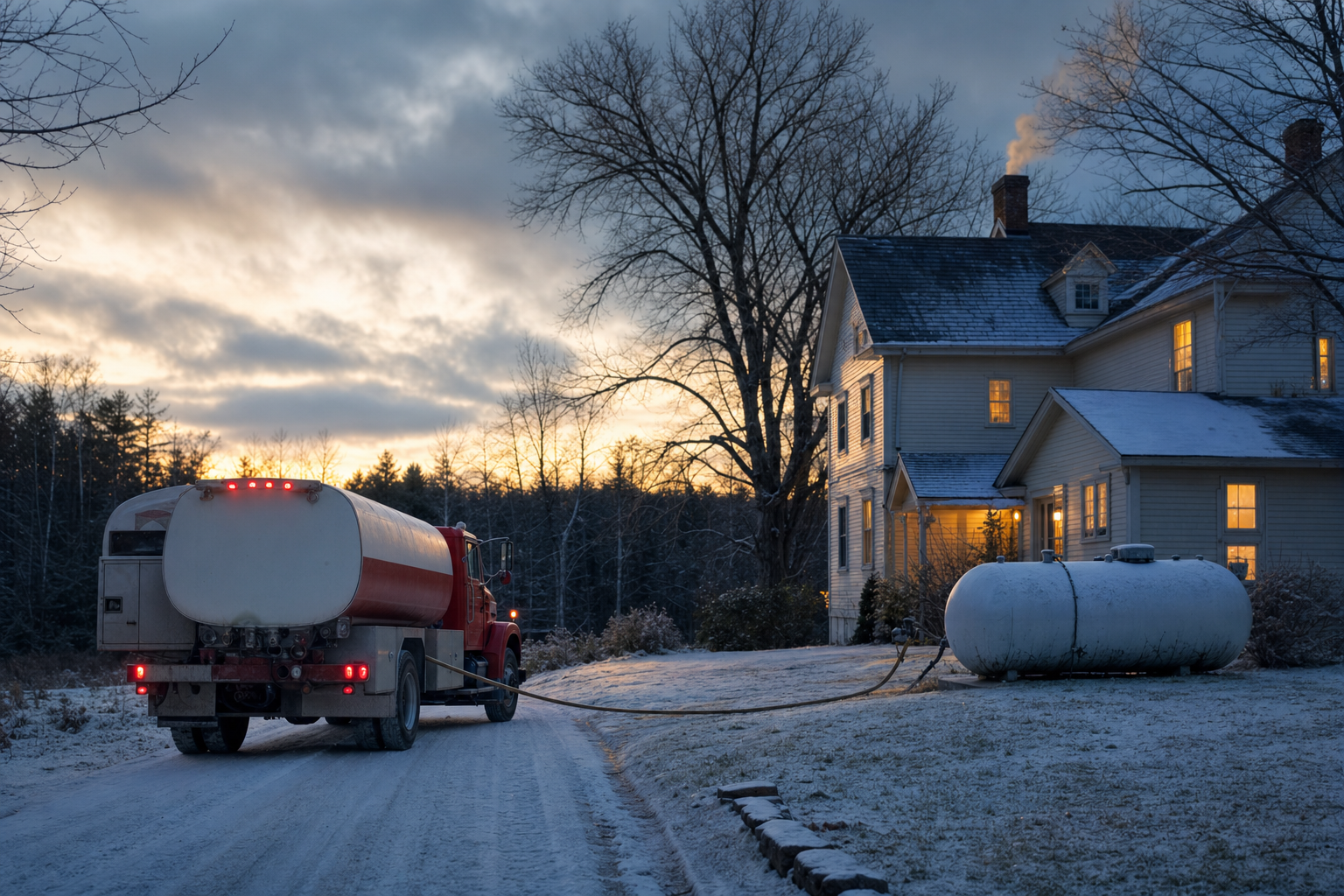
The call comes in at about 7pm on a Sunday. It is 11F outside, the furnace has been dead for two hours, and the woman on the phone is in a house that is already down to 54 degrees with a toddler in it.
Her tank had 110 gallons in it on Tuesday. She was fine on Tuesday. 40% of a 275 gallon tank, no reason to think about it. Then a cold front parked over the county on Thursday and stayed through the weekend, and by Sunday afternoon she was pulling sludge off the bottom of the tank and air into the fuel line.
So now the dealer is sending a truck out on a Sunday evening. The emergency delivery carries a flat fee somewhere between $75 and $150, plus a premium of $0.30 to $0.75 on every gallon. The burner has run dry, which means somebody has to bleed and prime it before it will fire again, and an after-hours call-out for that runs $100 to $200 on its own, or $300 to $500 once you count the diagnostic and the overtime. The owner is driving it himself because the drivers are at home.
And the part that actually costs him money is that she will tell everybody. For the next two winters, every time her neighbour mentions oil, she will say the name of the company that let her run out.
I have written the whole thing up as a complete build blueprint: Heating Oil & Propane Dealers, Degree-Day Tank Forecast & Automatic Delivery Scheduler. Master prompt, the full degree-day and K-factor maths, the 11 build steps, the 9 steps for selling and running it, and what to charge.
What the office actually knows on a Monday morning
At a 500 to 3,000 customer family fuel dealer, delivery scheduling is usually somewhere between a spreadsheet and a folk memory. Somebody in the office knows that the Hartleys on Mill Road take about 200 gallons and that you want to get to them every six weeks in a cold stretch. Somebody else knows the summer cottage on the lake is empty until May.
That knowledge is real and it is good, and it lives in one or two heads. It does not scale past the number of customers those heads can hold, and it falls apart in exactly the week it is needed most, because the week the weather turns is the week the phones do not stop.
Then there are the will-call customers, which at most dealers is a quarter to a half of the book. Those households are supposed to ring up when they are getting low. What they actually do is forget, look at the gauge on a Sunday, and call in a panic. Most dealers ask for 2 to 5 days notice and a 150 gallon minimum to honour a quoted price, which is a reasonable ask that a panicking customer cannot meet.
Every runout is a planned delivery that turned into an unplanned one, which is the most expensive way for a gallon of oil to leave a truck.
The arithmetic is old and most dealers do it in their head
The fuel trade has had the maths for this for decades. It just lives in the big dealers' back-office software and in the instincts of people who have been doing it since the 1980s.
It runs on two numbers.
The first is heating degree days. Take a day's high and its low, average them, and subtract that from 65F. A day averaging 55F gives you 10 degree days. A day averaging 70F gives you none. It is a measure of how hard a house had to work to stay warm, and it is a property of the weather, not of the house.
The second is the K-factor, which is the house. Count the degree days that piled up between two deliveries, divide by the gallons that went in at the second one, and you have it. A house that took 200 gallons after 1,000 degree days burns a gallon for every 5 degree days, so its K-factor is 5. Real ones land between 3 and 30. A low number is a thirsty house: big, draughty, old windows, tired boiler. A high number is a tight one.
Put the two together and the daily sum is one line:
Gallons burned today = today's degree days / this house's K-factor
Subtract that from what was in the tank yesterday. Do it again tomorrow. That is the entire mechanism. A dealer with 2,000 customers needs one weather reading a day to run it across the whole book, because the degree days are the same for every house in the service area and the only thing that differs is the K-factor.
Propane needs one extra term, because a propane house with a gas range and a gas water heater burns fuel in July when the degree days are zero. So each customer carries a base load as well, a flat gallons-per-day figure measured from their summer deliveries, and the sum becomes degree days over K, plus the base load.
That is the whole of it. No sensor in the tank, no float, no cellular modem, no battery to replace in 2041. Two numbers and a subtraction, run every morning, for every account.
The 10 day lookahead is the part that stops runouts
Knowing today's level is not enough, and this is where the woman with the toddler got caught.
She was at 40% on Tuesday. Any sensible threshold leaves her alone at 40%. The thing that killed her was the forecast, and 41 degree days over a weekend will take about 8 gallons a day out of a tank with a K-factor of 5.2.
So the useful version of this runs forward. Pull the next 10 days of forecast highs and lows, turn each day into forecast degree days, and walk every customer's tank down day by day. Now each account has two dates on it: the day it crosses the reorder threshold, and the day it hits 10% and runs dry. A cold snap drags both dates earlier, and the Tuesday house at a comfortable 40% lands on Friday's truck instead of calling on Sunday.
That reordering is the difference between a tool that reports and a tool that schedules. The build blueprint specifies it as a background job that runs at 6am, writes a fresh forecast row for every customer, groups the flagged ones into routes by delivery zone, and pulls forward anyone who would run dry before their zone's next normal day, with a tag on the row saying why.
The reason text matters more than it sounds. Every customer on the board gets a line in plain English next to their name, generated from the numbers: "At 24% this morning. 41 degree days forecast over the weekend puts this tank at 9% by Tuesday the 14th." An office manager who can read that will use the board. An office manager looking at a list of names with no explanation will go back to the spreadsheet by the second week, and they will be right to.
A worked example: the Hartley house, 275 gallon tank
Let us run one properly, because the sum is small enough to follow.
The Hartleys have the most common aboveground oil tank there is, a 275 gallon, which holds about 260 usable gallons. Their last delivery was on 3 January: 198 gallons, filled to 80%, so 208 gallons in the tank.
Their K-factor, measured over four previous fills, is 5.2. They burn a gallon for every 5.2 degree days.
The first week of January is mild for the time of year, averaging 38F, so about 27 degree days a day. That is 5.2 gallons a day, call it 36 a week. By 10 January they are at 172 gallons, which is 66%. By 17 January, 136 gallons, 52%.
Then the forecast turns. Ten days out, the model has highs in the low 20s and lows near 5F, so days averaging 14F and throwing off 51 degree days each. At a K-factor of 5.2 that is 9.8 gallons a day, nearly double their mild-week burn.
Run that forward from 52% and they cross the 28% threshold on 24 January and hit the 10% runout line on 29 January. Their zone runs on Thursdays. 24 January is a Friday. So the job puts them on Thursday 23 January, tagged as pulled forward, with the order quantity worked out as the gap between their projected 30% on the delivery date and the 80% fill target, which is 130 gallons.
At the $5.26 a gallon the EIA is forecasting for Northeast households this winter, that is a $684 planned delivery on a Thursday. The alternative was a $900-odd emergency run on a Sunday with a bleed-and-prime call-out attached and a customer who stops recommending you.
The last piece: when the driver logs 134 gallons actually delivered instead of the 130 predicted, the house's K-factor gets recalculated from that real number. Four gallons out on a 130 gallon prediction tightens the next forecast. A delivery that lands more than 25% off the prediction updates nothing automatically and goes on a review list for a human instead, because one partial fill when the truck ran low, or one tank size wrong on file, will wreck a K-factor for the rest of the season if you let it through.
Where the money is, and it is not the runouts
Runouts are the story you tell in the sales meeting. The will-call list is the invoice.
Once the forecast is running across the whole book, the dealer has something they have never had: a list of every will-call household with that household's own projected runout date next to their name, sorted soonest first.
You text them that date. Their date, not a generic reminder. Then you offer to put them on automatic delivery so they stop thinking about it and stop paying emergency rates.
The industry runs about $0.50 a gallon more on automatic delivery than on will-call, which is the price of the convenience and the planning. A Northeast household burns somewhere between 800 gallons a year in Pennsylvania and 1,050 in New Hampshire. So one converted household is roughly $400 to $525 a year of extra margin, on top of being a stop on a planned route instead of an emergency run.
Convert 60 of them and the dealer is looking at a five-figure annual swing from one screen.
And compare it to what the trade currently pays for a worse answer. More than 72% of propane dealers already offer tank monitoring, at an average fee of $54.32 per tank per year according to Gray, Gray & Gray's energy and propane survey. That is hardware, installation, a cellular connection and a subscription, per tank, to learn a number that two lines of arithmetic will give you across the entire customer book for the cost of one weather API call a day.
What you actually build, and what it runs on
The full blueprint is a single master prompt of about 21,000 characters that builds the lot in one paste. Six screens: a morning board that lists every flagged customer with the reason line, a route planner that groups stops by zone and shows planned gallons against each truck's capacity, a driver view built for one stop at a time on a phone in a cold cab, customer list and detail with the K-factor and the 10 day projection charted, the will-call conversion screen, and settings.
The stack is deliberately cheap, because a 900 customer dealer in rural Pennsylvania is not signing a per-seat enterprise contract. Lovable builds it. Supabase holds the customers, two seasons of daily weather and the full forecast audit trail, and it gets connected at project creation rather than afterwards, because that ordering cannot be fixed later. Open-Meteo supplies the daily highs and lows, historical back to 1940 and 10 days forward, at one call a day. Twilio sends exactly three customer texts and no more, because fuel customers will not tolerate a fourth. Stripe charges the card on file at the gallons that actually went in the tank, and runs the monthly budget-plan subscriptions separately. Resend sends the itemised ticket.
Then it ships as a real app through AppBuild.DIY, which is the last step in the blueprint for a specific reason. These customers are mostly older and mostly not technical, and an icon on a home screen showing their own tank level is a different object from a URL they bookmarked once in October. The driver app gets background location, so the office can answer "is he coming today" with a yes instead of a maybe, and arrival times get stamped without anyone tapping anything. And the push notification on a delivery notice gets seen in minutes, which stops the "is anyone coming" calls landing on the one office phone line during the one week of the year the office has no spare hands.
Who should sell this, and for how much
The target is the independent residential dealer running 2 to 6 trucks, 500 to 3,000 accounts, in the Northeast, the Mid-Atlantic, upstate New York, New England and rural Pennsylvania for oil, and anywhere off the gas main for propane.
The state and regional fuel dealer associations publish member directories, and those are the best prospect lists in the trade, because membership already tells you the firm is established. Local search works too: pick any rural county, search for heating oil delivery, and you will find a page of them with websites last touched in 2016.
A good fit has three markers. They have a real delivery history sitting in some back-office system, because that history is what seeds every K-factor on day one. They have a meaningful block of will-call customers. And the owner has personally driven an emergency delivery on a Sunday, which almost all of them have, so the problem needs no explaining.
The pricing in the blueprint is $3,500 to $6,500 to build it and $497 to $997 a month to run it, with a $40 performance bonus per will-call household converted to automatic delivery, capped at $1,200 a month. That conversion bonus is the cleanest structure in the whole library, because it is a single unambiguous event in the dealer's own records and the value to them is enormous next to the fee. Multi-depot dealers go on $1,400 a month for up to 3 depots, which is the best version of the deal, since the degree-day maths is identical everywhere and only the coordinates change.
Be honest about the timeline, because this is the one place a build like this gets oversold. Two or three days to build and test. One to two weeks to prise the delivery history out of their old software and clean it. Three weeks of supervised pilot on a single zone, running alongside their existing scheduling instead of replacing it. Six weeks or so from signature to running the whole book. The A2P 10DLC registration for the SMS takes 1 to 3 weeks on its own, so submit that on day one.
And tell them the first season is a calibration season. The forecast is rough for a month and sharp by the third. A dealer who was promised perfection in week two will throw the whole thing out in week three.
Why this winter
Because the gallons have never been worth more.
The EIA has Northeast household heating oil at an average $5.26 a gallon this winter, up 34% on last year. In Massachusetts it was already $6.12 on 5 October, against $3.53 a year earlier, which is a 73% jump. Household bills are forecast up about 21%.
Two things follow from that, and they both point the same way.
Customers are going to be tighter with their oil, which makes every K-factor shift and every guess based on last year's habits wrong. A household that burned 950 gallons last winter and decides to live at 64 degrees this one will blow up any schedule built on their history alone. The degree-day sum catches that at the next fill, because the gallons that went in are the measurement.
And a runout at $5.26 a gallon with an emergency premium on top is a conversation about an $1,100 delivery with a customer who is already furious about the bill. The cost of getting the scheduling wrong has gone up with the commodity.
The heating season has just started. A dealer who gets this running in October has the whole winter to measure every house properly. One who waits until January is being sold something in the worst month of their year.
The complete blueprint is here: Heating Oil & Propane Dealers, Degree-Day Tank Forecast & Automatic Delivery Scheduler. The full master prompt, all 8 client input fields, 11 build steps with the exact account setup for every service, 9 steps for selling and running it including the will-call conversion play, the pricing structure and a cold outreach email you can send as it stands. Go and get it.