
Heating Oil & Propane Dealers, Degree-Day Tank Forecast & Automatic Delivery Scheduler
The tool works out how much fuel is left in every customer's tank without any hardware in the tank. It turns each day's temperature into heating degree days, divides by the burn rate it measured from that house's own last delivery, and runs the result 10 days forward on the forecast. Tanks heading under the threshold land on a route grouped by zone, anyone who would run dry before their zone's next normal day gets pulled forward, and every delivery recalculates that house's burn rate so the next forecast is tighter. It also hands the office a list of every will-call customer with their own runout date on it, which is the screen that pays for the build.
This blueprint is free. Copy the master prompt below, build it with your own time, and the only outlay is a few low-cost tool subscriptions. Use it inside your own business, or sell it to clients. The numbers further down are what you can charge, not what you pay.
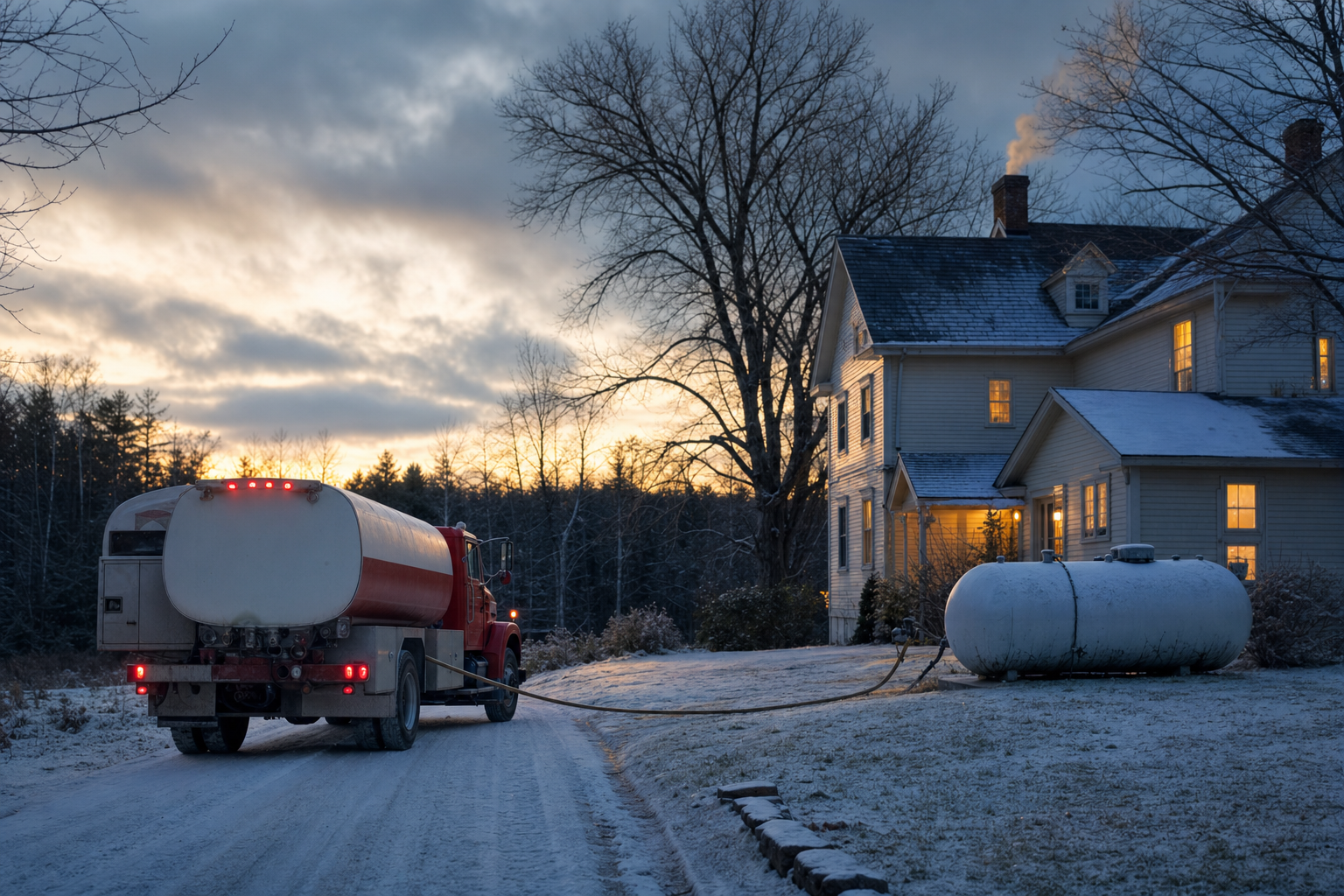
The House Sitting at 40% on Tuesday Ran Dry on Sunday Night
Read the articleWho you sell it to
Independent residential heating oil and propane dealers, the 500 to 3,000 customer family firms that run 2 to 6 trucks and still schedule deliveries out of a spreadsheet, a whiteboard, or the memory of whoever has worked the phones longest. They cluster in the Northeast, the Mid-Atlantic, upstate New York, New England and rural Pennsylvania for oil, and everywhere rural and off the gas main for propane.
Find them three ways. The state and regional fuel dealer associations publish member directories, and those directories are the single best prospect list in this trade because membership already tells you the firm is established and takes the business seriously. Propane and oil trade publications run supplier directories and conference attendee lists.
And local search works plainly: search any rural county plus 'heating oil delivery' and you get a page of them, most with a website that was last touched in 2016.
A good fit has three markers. They have a real delivery history sitting in some back-office system, because that history is what seeds the forecast and a dealer without it needs a season of data before the tool is sharp. They have a meaningful block of will-call customers, usually a quarter to a half of the book, because that is where the fast money is.
And the owner has personally driven an emergency delivery on a Sunday, which almost all of them have, and does not need the problem explained.
Time it right. Pitch in August and September, before the season, when the owner has time to talk and a budget to spend. Pitch in January and you are talking to someone who is on a truck.
If you sell it, here is the money picture:
The first tile is the value of your client's own jobs, which is the reason they will pay you. The other two tiles are what you charge them.
How it works
Every morning the tool pulls yesterday's actual high and low temperature for the dealer's service area, plus the next 10 days of forecast highs and lows. It averages each day's high and low, subtracts that from 65F, and the result is that day's heating degree days. A day averaging 55F gives 10 degree days.
A day averaging 70F gives none.
Each house carries its own burn rate, called a K-factor, which is simply the degree days that accumulated between two deliveries divided by the gallons that went in at the second one. A house that took 200 gallons after 1,000 degree days burns a gallon per 5 degree days, so its K-factor is
- Propane customers also carry a base load, the fuel the range and the water heater burn in July when there are no degree days at all.
Put those together and the daily arithmetic is one line: gallons burned today equals today's degree days divided by the K-factor, plus the base load. Subtract that from what was in the tank yesterday. Do it for every customer, every morning, and the office has a tank level for the whole book without a single sensor anywhere.
The 10 day lookahead is what actually stops runouts. The tool projects every tank forward day by day against the forecast and records two dates per customer: when they cross the reorder threshold, and when they would hit 10% and run dry. A cold snap moves both earlier, so a house sitting comfortably on Tuesday with a hard freeze coming lands on Friday's truck instead of calling the office on Sunday night.
Flagged customers get grouped by delivery zone onto that zone's normal weekday, and anyone whose runout date falls before their zone's next normal day gets pulled forward with a tag explaining why. The driver works one stop at a time on a phone, enters the gallons that actually went in and the level they filled to, and that number immediately recalculates the house's K-factor. A delivery that lands more than 25% off the prediction does not update anything automatically.
It goes on a review list for a human, because one partial fill or one wrong tank size on file will wreck a K-factor for the rest of the season.
The customer gets three texts and nothing else: you're on the truck Thursday, we delivered 187 gallons and your tank is at 80%, and for will-call households only, our forecast says you have about 9 days. The emailed ticket carries the gallons, the price per gallon, the before and after levels, and a plain line explaining the forecast that put them on the truck.
What to expect
The forecast is rough for the first month and sharp by the third. Seeding K-factors from imported history gets you most of the way on day one, but the figures only settle once real deliveries have been logged through the tool itself. Expect the first season to be a calibration season and tell the client that plainly, because a dealer who was promised perfection in week two will throw the whole thing out in week three.
Accuracy you can reasonably expect: predicted gallons within 10 to 15% of delivered gallons after 3 clean fills per customer, tightening to under 10% for the bulk of the book by the second season. Some houses never settle, usually holiday homes, rentals with changing tenants, and anyone running a wood stove alongside the furnace, because a wood stove makes a house's fuel use a function of how much somebody felt like splitting logs that week. Those accounts need a wider threshold and should be flagged as such rather than fought with.
Timeline: 2 to 3 days to build and test, 1 to 2 weeks to import and clean the client's history properly, 3 weeks of supervised pilot on one zone, and roughly 6 weeks from signature to running the whole book. The A2P 10DLC registration for the SMS takes 1 to 3 weeks on its own, so submit it on day one.
Where the client sees the money: runouts dropping to near zero, which removes the emergency fee, the premium gallon and the bleed-and-prime call-out, and more importantly removes the Sunday night. Fuller trucks and tighter routes, because stops get grouped by zone instead of chased one at a time. And the will-call conversions, which are the biggest single line.
The industry runs about $0.50 a gallon more on automatic delivery than on will-call, and 72% of propane dealers already pay an average $54 a tank a year for monitoring hardware that does a worse job than this arithmetic does.
Caveats worth saying out loud before you sign anything. Bad tank sizes on file will produce bad forecasts and about 5 to 10% of any dealer's book has the wrong tank size recorded, so budget time for that cleanup and make it a line item rather than a surprise. The tool needs the drivers to enter real numbers, so a dealer whose drivers will not use a phone is not a good client, full stop.
And the forecast is only ever as good as the weather feed, which is why the build refuses to run on missing weather and puts a banner up instead of carrying on as though the day was fine.
Finally, ship it as a real app rather than a web dashboard. This client's customers are mostly older and mostly not technical, and an icon on a home screen showing their own tank level is a different thing from a URL they bookmarked once. The push notification is the part that changes the office's day: a delivery notice that gets seen in minutes stops the 'is anyone coming today' calls landing on the one phone line during the one week of the year the office has no spare hands to answer it.
Master prompt
You are an expert full-stack builder. Build a production-ready tool that… (the complete master prompt, custom input fields, build phases, pricing guidance and sales script are part of this blueprint.)
Build phases
Required tools
Lovable
The AI builder that writes the whole application from the master prompt, including the scheduled daily forecast job
Free tier available but not enough for this build. Paid plans from $25/month
Sign upSupabase
The database behind it: customers, tank levels, two seasons of daily weather, delivery history and the forecast audit trail. Connect it at project creation, before the first prompt runs
Free tier covers a single dealer comfortably. Pro is $25/month if they want daily backups and more storage
Sign upOpen-Meteo
Daily high and low temperature, historical back to 1940 and 10 days forward, which is what the degree-day maths runs on. One call a day covers the entire customer book
Free for non-commercial use, 300,000 calls/month. Commercial API Standard plan covers 1M calls/month, priced at their Stripe checkout
Sign upTwilio
SMS for the three customer messages: delivery scheduled, delivery completed, and the low-tank warning that goes to will-call customers
About $0.0079 per SMS in the US, plus roughly $1.15/month for the local number
Sign upStripe
Card on file charged per delivery at the gallons that actually went in the tank, plus monthly subscriptions for budget plan customers
2.9% + $0.30 per card charge, no monthly fee
Sign upResend
The emailed delivery ticket with gallons, price per gallon, tank percentage before and after, and the daily office summary
Free for 3,000 emails/month, $20/month for 50,000
Sign upAppBuild.DIY (Vibes)
Wraps the finished web app into native iOS and Android apps plus a PWA. For this build enable Push Notifications (route released, runout alerts, delivery notices), Background Geolocation for truck tracking and automatic arrival stamps, and Photos/Camera so drivers can attach proof to a could-not-deliver code
From $49/month per app
Sign up