
The Insurance Claim That Took Six Weeks Because The Photos Were On Someone's Phone
The claim that took six weeks because the photos were on someone's personal phone
A pipe bursts under a kitchen sink on a Tuesday night. The restoration crew shows up, dries everything out over the next four days, and the job wraps up clean. Three months later the homeowner is still fighting with their insurance company, because the only proof any of it happened is a handful of photos scattered across two different technicians' phones, no timestamps anyone can point to, no record of what the moisture readings actually were on day one versus day four.
That's not a rare story in restoration. It's close to the default outcome when documentation is an afterthought, something someone remembers to do if there's time between jobs, instead of something the work itself produces automatically.
The Water Damage Restoration, AI Photo Damage Assessment & Insurance Documentation Tool pro prompt builds a company an app where every moisture reading comes with a timestamped photo by design, and the insurance report a homeowner needs writes itself the moment the job's done.
Why this vertical doesn't quote a price from a photo
A handful of pro prompts already published here let a homeowner snap a photo and get an instant price range, roofing, solar, tree removal. Water damage restoration doesn't work that way, and building it as if it did would be a mistake. Standard industry practice under IICRC guidelines is to document with moisture meter readings and drying logs, not quote blind from a photo, because the real scope of a job depends on how far water has traveled inside walls and under flooring, information a photo of a wet floor simply can't give you.
So this blueprint doesn't try to force an instant-quote pattern onto a vertical where it doesn't fit. What a photo submission can do reliably is triage urgency. Mold germination starts within 24-48 hours of water intrusion, and a leak caught and dried immediately typically costs a fraction of the same leak left sitting for a few days once it's progressed into mold and structural repair. That's a real, sourced multiplier, not a scare number, delay routinely turns a $1,500 job into an $8,000 one. A photo plus a couple of questions about the water source and how long ago it was discovered is more than enough to sort "get someone there today" from "schedule for tomorrow," which is exactly the decision that actually needs to happen fast.
How the blueprint works
A homeowner, or often the plumber who just found the mess, opens the app, enters the address, and answers a couple of quick questions: what caused it, and roughly how long ago it started. They photograph the affected rooms. The app classifies the water category, clean, gray, or contaminated black water depending on the source, and returns an urgency tier and a recommended response window. No price. The customer is told plainly that final scope gets confirmed once a crew actually assesses moisture penetration on-site.
Jobs that are close to or past that 24-48 hour mold window, or that involve contaminated water, get flagged emergency automatically and jump straight to the top of the company's dispatch queue, firing an internal alert the moment the photo lands rather than whenever someone happens to check the queue.
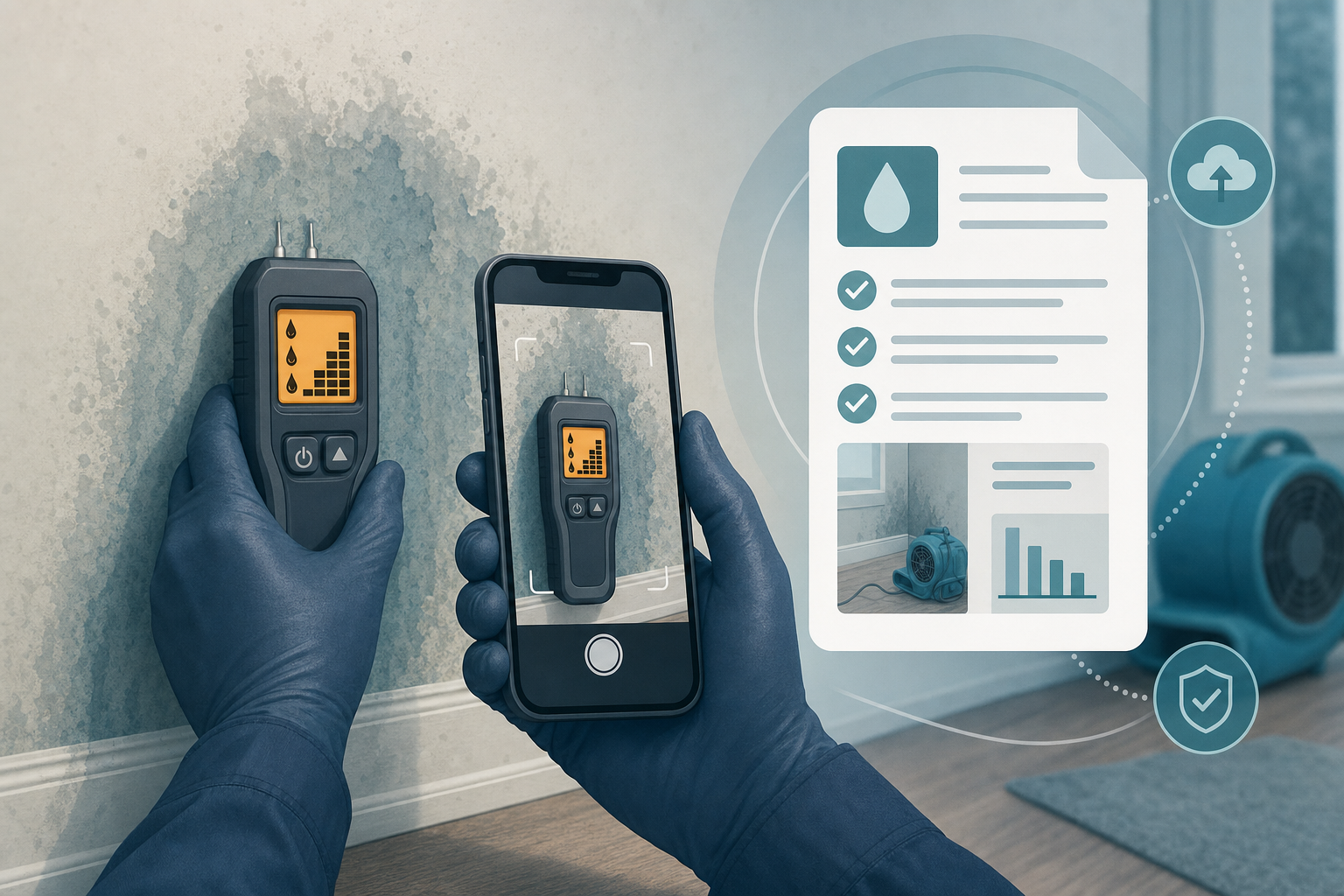
The real work happens once a crew is on-site. Every moisture meter reading gets photographed with the meter's digital readout and the affected material in the same frame, matching the documentation standard adjusters actually look for, verifiable proof, not a number someone wrote down from memory later. That happens again the next day, and the day after, building a room-by-room drying timeline automatically as the crew does the work they were already going to do anyway. Once every room hits an acceptable dry reading, the job locks and the app compiles every photo, every reading, and the full timeline into a formatted, shareable insurance report. No one has to sit down after the fact and reconstruct what happened from a camera roll.
Why the meter-and-material photo pairing matters more than it sounds
It would be easy to build this as "crew types in a number each day" and call the documentation problem solved. That version would be worse than useless, because a typed number carries no proof it was actually measured, and an adjuster who's seen enough disputed claims knows the difference between a verifiable reading and a technician's word for it.
Requiring the meter's digital readout and the affected material in the same photo frame closes that gap. It's a small habit change for crew, point the camera at both instead of just glancing at the number, but it turns every single reading into evidence rather than a claim. Multiply that by every room, every day of a multi-day drying job, and the company ends up with a complete, independently verifiable record without anyone having to think about assembling one, it falls out of the normal act of doing the work correctly.
This also protects the company, not just the homeowner. If a customer or an adjuster later disputes how long drying actually took, or claims a room was declared dry when it wasn't, a timestamped, photo-verified reading log settles that dispute in minutes instead of turning into a he-said-she-said conversation nobody can definitively win.
A worked example
Say a tenant discovers a slow leak from a washing machine that's been running for two days before anyone noticed. They photograph the damp flooring and the appliance, note it's been at least 48 hours, and submit through the app.
Given the timing, right at the edge of the mold window, and a clean water source, the app flags it as urgent but not the highest emergency tier a sewage backup would trigger, and routes it to same-day dispatch instead of the absolute front of the queue behind an active black-water job. The crew arrives that afternoon, photographs their first moisture readings in three affected rooms, meter and flooring in frame each time, and sets up drying equipment.
Over the next four days, the same crew or a colleague returns, logs new readings the same way each visit, and the app shows the drying timeline trending the right direction in two rooms while a third room's readings barely move day to day, a stall the admin dashboard surfaces clearly instead of letting it sit buried in a log nobody's re-checking. That flag prompts a second look, an extra day of drying equipment in that one room, and by day five all three rooms clear. The job locks, and the tenant's insurance adjuster gets a clean PDF with every dated photo and reading laid out in the order they happened, instead of a phone call asking the company to dig up records from a job that wrapped two weeks ago.
The dispatch side wins jobs, the documentation side wins trust
It's worth separating what each half of this tool actually does for the company, because they solve two different problems and both matter for different reasons. The urgency-triage and emergency-dispatch side is about winning the job in the first place: whoever gets a crew to a genuine emergency fastest tends to get hired, especially once a leak's already visible and a homeowner is calling around. That half is about speed and being first.
The moisture-reading and insurance-report side is about what happens after the job's won. A company can be the fastest responder in town and still lose money and reputation if their documentation can't get a claim paid promptly, or worse, gets a claim disputed months later over incomplete records. That half is about trust, both the homeowner's trust that the company did what it says it did, and the adjuster's trust that the numbers in the report are real and verifiable. A tool that only did one of these halves would leave real value on the table. Doing both together means the company wins the call and gets paid cleanly for the work once it's done.
Where the real economics are
Restoration jobs vary widely by severity: a caught-early clean-water leak runs around $1,500, while the same damage left unaddressed into mold and structural repair can run $8,000 or more, sometimes climbing into five figures for a full post-flood job. Mold remediation alone averages roughly $2,400 nationally, with whole-house jobs after serious flooding running $10,000-$30,000. Lead costs in this space aren't cheap either, Google Local Service Ads run roughly $150 per lead on average, and exclusive Angi or HomeAdvisor leads run $450-$1,250. Against those numbers, a tool that gets a company to a genuine emergency faster, and that removes the after-the-fact scramble to assemble insurance paperwork, pays for itself on a fraction of a single job's margin.
For whoever builds and sells this: setup runs $2,500-$4,000, covering the build, calibrating the insurance report format to what the client's usual adjusters actually expect, and onboarding crew on the moisture-reading discipline the whole system depends on. The monthly retainer runs $297-$497 for hosting and SMS costs. A performance-bonus option is worth offering too, tied to jobs originating through the emergency-flagged queue, since that's the piece of the tool most directly responsible for winning jobs a company might otherwise have lost to a faster-responding competitor.
Who should sell this
The buyer is a water damage restoration or mold remediation company, IICRC certified, already juggling insurance claims regularly, currently piecing documentation together from technicians' personal phones and handwritten drying logs. A company that's ever had a claim delayed or disputed over incomplete documentation is the clearest signal this is worth their time, and it's an easy thing to ask about on a first call: how do you currently prove to an adjuster that a room actually dried out on schedule? If the honest answer involves someone's camera roll, that's the gap the Water Damage Restoration, AI Photo Damage Assessment & Insurance Documentation Tool closes.
Companies with an existing relationship with a handful of insurance adjusters or agencies are an even better fit, since consistently fast, clean documentation tends to build a reputation with the people approving claims, and adjusters talk to each other about which restoration companies make their job easy versus which ones create extra work. A company that can point to that reputation as a selling point to homeowners, "ask your adjuster, they know us," is a stronger local competitor than one relying purely on being first to answer the phone.
Why now
Storm frequency isn't dropping, and insurance companies are only getting more particular about documentation before they'll pay a claim without friction. A company that can hand an adjuster a clean, timestamped report the moment a job's done gets paid faster and disputes less than one still explaining after the fact why a reading from three weeks ago doesn't have a timestamp anyone can verify. The tool just makes sure the proof of that work exists in the format the person cutting the check actually wants to see, without changing how the company does the restoration work itself.
There's also a quieter shift happening underneath all this: homeowners increasingly expect the same real-time visibility from a restoration company that they get from a food delivery app or a package tracker. A customer who can see their job's status and drying progress without having to call and ask feels handled, and a company that provides that starts a review or a referral conversation from a much better position than one whose only communication is a technician showing up when they show up. None of this replaces the crew's actual skill at drying out a house properly. It just makes the parts of the job that were always administrative, tracking, proving, reporting, run without eating into the hours that should go toward the work itself.
The complete master prompt, the full build spec, and the phase-by-phase setup and sales playbook are in the Water Damage Restoration, AI Photo Damage Assessment & Insurance Documentation Tool pro prompt. Get it built before the next storm season fills up your first client's dispatch queue.