
The Tree On The Roof Was Caller Number Twenty-Two
Thirty calls in an hour, and the tree on the roof is number twenty-two
A storm rolls through. Branches down everywhere, a few trees fully uprooted, one leaning into somebody's roofline. The tree company's phone starts ringing before the rain even stops. By the time anyone gets to answer number twenty-two, the tree on the roof, the caller has already tried three other companies and booked whoever answered first.
That's not a staffing problem. It's a triage problem. Every call sounds urgent to the person making it. Sorting a "there's a branch on my lawn" call from a "there's a tree resting on my house" call, in the order they came in rather than the order they matter, costs real jobs every single storm season.
The Tree Services, AI Photo Hazard Assessment & Instant Quote Tool pro prompt builds exactly this: a photo-based instant quote for routine jobs, and an automatic emergency queue that jumps a tree-on-a-roof straight to the top, alerting dispatch the second the photo lands instead of whenever someone works through the backlog.
Why tree companies still quote by hand
Tree work pricing has resisted the instant-quote treatment that's already standard in moving, painting, and pool remodeling. A tree removal runs anywhere from $150 for a small backyard tree to $5,000 for a large one near a structure, and the number depends on height, species, lean, proximity to power lines, and access for equipment, none of which come through reliably in a phone description. Every serious tree service guide says the same thing: don't quote from a phone call or a satellite photo alone, walk the property first.
That caution is well earned. A blind quote that turns into a bigger job on-site is how companies end up in disputes. So most of the industry still books a 20-45 minute site visit for every single lead, routine or not, which is fine on a normal Tuesday and a genuine bottleneck the day after a storm, when a backlog of thirty visits stretches into a week and the homeowner with a tree actually resting on their house has already called a competitor.
How the blueprint works
The master prompt replaces the wait for a first number, not the site visit itself, and makes sure the truly urgent jobs get triaged first instead of processed in call order.
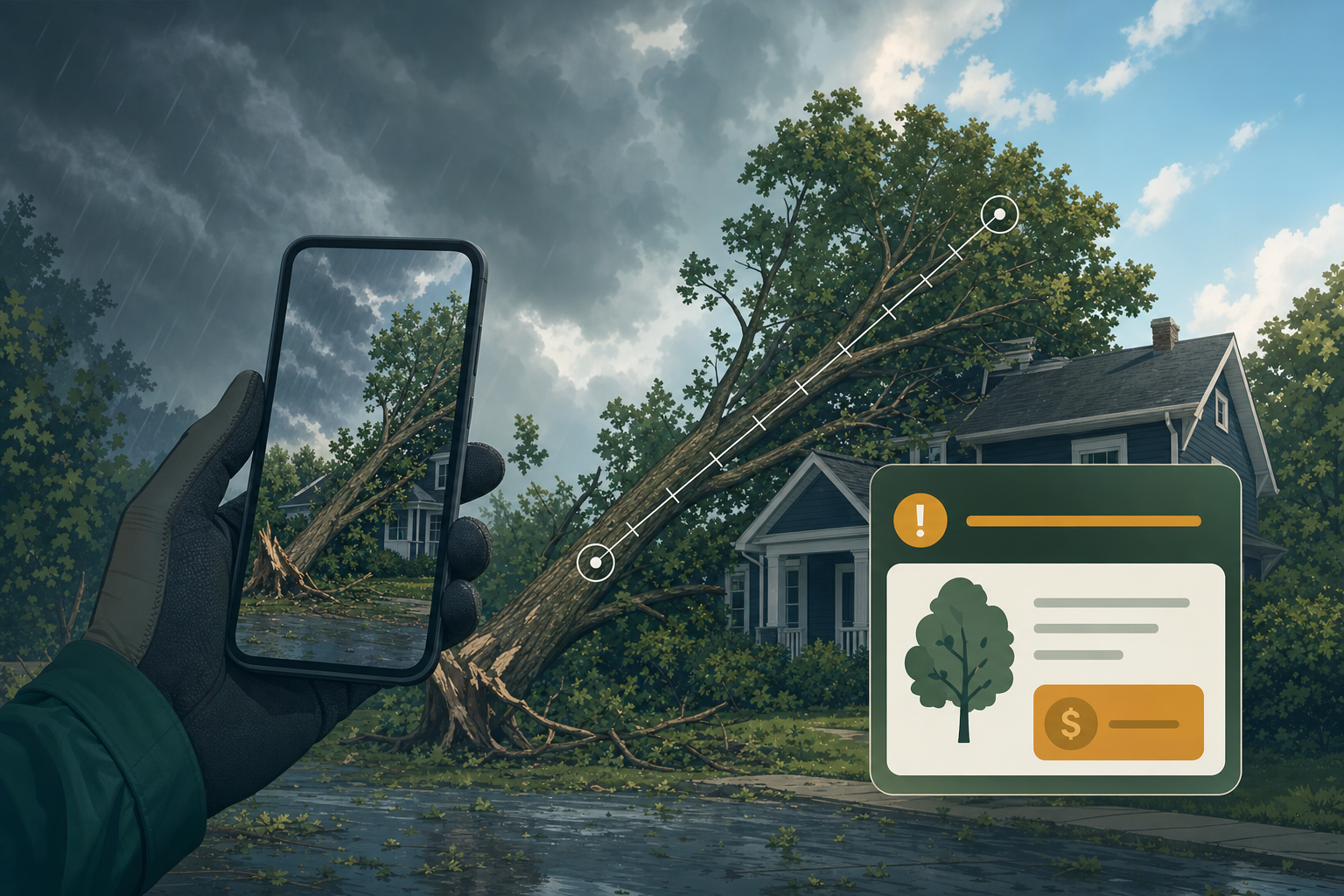
A homeowner opens the app, photographs the tree with one requirement baked into the flow: get a reference object of known height in the shot, a person standing near the trunk, a car, a garage door. Without that reference point, any height estimate is a guess, and the whole build is designed around never presenting a guess as a confident number. If the photo has a usable reference object and the tree looks routine, the app returns an instant quote range built from the company's own pricing bands. If the photo is blurry, missing a reference object, or shows something genuinely hazardous, the app skips the number entirely and routes straight to a scheduled site visit instead.
The homeowner also marks the job routine or emergency. Anything marked emergency, or anything where the photo shows a tree already down or resting on a structure, jumps to the top of the admin dispatch queue and fires an internal alert, SMS and push, so the company's response clock starts the moment the photo lands. On a genuine storm day, when dozens of submissions land within an hour, the admin queue supports bulk triage: separating a tree on a roof from a fallen branch on the lawn, instead of treating every storm-day submission as equally critical and burning out dispatch while the real emergency waits its turn.
The crew still does the final walk. On arrival, they confirm or adjust the price based on actual site conditions and get the customer's sign-off before cutting anything. The instant quote is a starting range from the first tap, never a binding price, and the app says so plainly on every quote screen.
Why the reference object isn't optional
The hardest part of this build is being honest about what a photo can and can't tell you, harder than the pricing logic itself. A single photo of a tree, with no scale reference, gives an AI vision model almost nothing reliable to work from. A 40-foot oak and a 15-foot ornamental can look nearly identical in a badly framed shot, and a company that ships an instant quote based on a wild guess is going to lose trust the first time a homeowner shows up expecting a $300 job and gets a $1,500 one.
That's why the reference-object requirement is baked into the flow rather than left as a nice-to-have. A person standing near the trunk, a car in frame, a garage door of known height, any of these give the model an actual scale to measure against. No usable reference object means no instant number, full stop, the app routes straight to a scheduled visit instead. That sounds like it's giving something up. In practice it's what makes the instant quotes the app does produce trustworthy enough for a homeowner to book straight through, and for the company to stand behind without walking it back on-site.
A handful of standalone tools already do pieces of this, satellite lot-measuring software and photo-based species identification exist as subscription products a company could buy separately. What this blueprint does differently is bundle the whole thing, instant quote, storm triage, crew dispatch, and billing, into one app built specifically for one company's actual pricing and service area, not a generic subscription tool the company has to bolt onto everything else they already run.
A worked example
Say a homeowner in the company's service area has a large oak leaning noticeably after a storm, close enough to the house that they're worried. They open the app, photograph the tree with their car parked next to it for scale, and mark the job as an emergency.
The app reads the lean and proximity to the structure as hazard signals and skips the instant quote entirely, routing the homeowner to same-day scheduling instead of a number. Dispatch sees it flagged red at the top of the queue the second it comes in, not buried under twelve routine trimming requests that landed the same morning, and the SLA alert fires immediately. The crew arrives within the company's committed window, confirms the actual price on-site once they can see the lean and the access up close, and the homeowner gets a real crew on a genuine emergency, faster than a company still working its inbox in call order.
Compare that to a routine job: a homeowner wants a medium maple in the backyard trimmed, no urgency, no hazard. They photograph it with a person standing nearby for scale, get an instant range in under a minute, and book a work date directly from the quote screen with a deposit through Stripe. No site visit needed at all for a job that simple.
The dispatch side matters as much as the customer side
It's easy to focus on the homeowner-facing quote screen and treat dispatch as an afterthought, but the queue is where a storm day actually gets won or lost. Speed-to-lead data across service industries consistently shows that a five-minute response converts far better than a thirty-minute one, and for storm-damage calls specifically, homeowners often decide who they're hiring within hours, not days. Whoever calls back first tends to win the job, well before price becomes the deciding factor.
An urgency-sorted queue with an automatic SLA alert means the company's fastest response goes to the job that actually needs it fastest, not whichever call happened to come in first that morning. That's the difference between a company that occasionally gets praised for showing up quick and one that structurally shows up quick every single storm, because the system is doing the sorting instead of a stressed dispatcher working a phone that won't stop ringing.
The bulk-triage view matters for the same reason on the other end of the queue. Not every storm-day submission is an emergency. A lot of them are a downed branch on the lawn that can wait a week. A system that treats all of them as equally urgent buries the one that's actually resting on someone's roof under a dozen that aren't, which defeats the entire point of building a triage system in the first place.
Who should sell this, and how to find them
The buyer here is a tree service or arborist company doing residential removal, trimming, and storm cleanup, big enough to have a real lead-response bottleneck (typically already running multiple crews) but small enough that they don't have an internal dev team building this themselves. A company still taking every lead through a manual phone-and-site-visit process, with no online quote option at all, is the clearest target. So is a company that's already lost a job they know they should have won because a competitor called back first.
Local tree services are easy to find and easy to qualify over a short call: ask how they currently handle storm-day call volume, and ask how they price a job today. A company that says "we just work through the calls in order" or "we send someone out for literally every lead" is telling you exactly where this tool earns its keep. Reference the Tree Services, AI Photo Hazard Assessment & Instant Quote Tool pro prompt's build spec when you're scoping the conversation, since it lays out the whole flow in enough detail to walk a non-technical owner through exactly what they'd be getting before you ever open Lovable.
Where the real economics are
Average tree removal jobs run $900 to $3,000 depending on size and complexity, with emergency and storm-damage work commanding a real premium, often 25-100% over standard pricing. Companies buying leads through shared marketplaces are paying $50-$100 per lead split three to five ways, or $15-$40 for cheaper shared leads that close at a much lower rate. Exclusive leads through Google Ads or Local Services Ads run $25-$120 depending on the market. A tool that converts a browsing homeowner into a booked job before they ever call a competitor is worth more than the marginal cost of one more lead, because it's capturing demand the company already has, faster, instead of buying more of it.
For whoever builds and sells this: setup runs $2,500-$4,000, covering the build, calibrating the pricing bands against the client's real numbers during a pilot, and onboarding crew and dispatch. The monthly retainer runs $297-$497 for hosting, SMS and Stripe costs, and ongoing tuning. There's also a performance-bonus option worth offering, 1-2% of revenue booked directly through the tool, which ties your fee to jobs it wins rather than a flat rate that doesn't reflect real usage.
Why now
Storm frequency and severity aren't trending down, and homeowners have gotten used to instant answers everywhere else in their lives. A company still quoting every lead through a scheduled site visit is competing against a market that increasingly expects a number in under a minute, at least a starting one. The gap between a company that can triage a storm surge by real urgency and one working strictly in call order shows up exactly on the days that matter most, and those are the days a tree company makes or loses its whole season.
None of this requires the client to change how they actually price a job. The pricing bands baked into the build are theirs, set during onboarding and calibrated against their real on-site numbers during the pilot, not some external estimator second-guessing their business. It's their pricing, just delivered a lot faster to the homeowner deciding right now whether to call them or the next company on the list.
Full build details, the complete master prompt, and the phase-by-phase setup and sales playbook are in the Tree Services, AI Photo Hazard Assessment & Instant Quote Tool pro prompt. Grab it and have this live for your first tree service client before the next storm season starts.