
Water treatment dealers buy 100 leads to get 12 sales. The fix starts with the test report.
Run the numbers on a residential water treatment dealer and the picture is uncomfortable.
A water treatment lead costs somewhere between $15 and $75. Industry benchmarks put the lead-to-appointment rate at 25% to 40%, and the appointment-to-close rate at 30% to 50%. So on 100 leads, roughly 30 become a booked appointment, and roughly 12 become a sale.
Which means a dealer pays for about 70 people who never let a technician through the door. And then pays again, in diesel and in an installer's afternoon, for the 18 appointments that go nowhere.
The usual explanation is lead quality. Buy better leads, the pitch goes, and the numbers improve. Except the leads are behaving exactly as advertised. Most of them came from a "free water test" or "win a filtration system" ad, so a good chunk of the people who filled the form in wanted a free thing. They are not pretending. They genuinely have no plan to spend $3,000.
The second problem is what happens to the ones who are real. The in-home water treatment presentation has a reputation, and it earned it. Consumer complaints about this industry describe sales visits running two to four hours. A homeowner who has read anything about buying a softener arrives at that appointment braced for a fight, which is a terrible place to start a $3,000 conversation.
The blueprint for all of this is published and ready to build: Water Treatment Dealers, Water Test Report Reader & System Sizing Quote Tool. One master prompt, the full sizing engine, the EPA threshold rules, the dealer dashboard, and the two-phase build and sell playbook.
The number that decides everything is already on a piece of paper
Here is the thing that makes water treatment different from every other home service trade. The job can be scoped from numbers.
A roofer needs to see the roof. A plumber needs to find the leak. But a water softener is sized from arithmetic, and the inputs to that arithmetic are printed on a lab report that an enormous number of homeowners already have sitting in a drawer.
Anyone who bought a house with a private well in the last few years got a water test as part of the sale. Anyone who called their county extension office got one. Anyone who bought a $25 mail-in kit off the internet got one. These reports exist, in their thousands, in kitchen drawers.
And the homeowner holding one usually cannot read it. They have a sheet with "Hardness: 239 mg/L" and "Iron: 1.2 mg/L" and "pH: 6.6" on it, and no idea whether that is normal, bad, or a reason to spend money.
So the tool does one job first: it reads the report they already have. Photo or PDF, phone camera, bad kitchen light, upside down. A vision model pulls out hardness, iron, manganese, pH, nitrate, total dissolved solids and any bacteria result, and normalizes the units.
That last part matters more than it sounds. Water reports print hardness in grains per gallon, in parts per million, or in milligrams per litre, and 1 grain per gallon is 17.1 mg/L of calcium carbonate. A homeowner looking at "239 mg/L" is looking at 14 grains per gallon, which is very hard water. Plenty of free online calculators get that conversion wrong or skip it entirely, which is how someone ends up convinced their water is fine at 239 of something.
Why so many softeners end up the wrong size
The sizing maths is not complicated. It is just done badly often enough that getting it right is worth something.
Start with hardness in grains per gallon. Then compensate it, because dissolved iron and manganese load the softener resin the same way hardness does. The trade convention is to add 5 grains for every 1 ppm of each.
So 14 grains of hardness with 1.2 ppm of iron is not a 14 grain problem. It is a 20 grain problem.
Then multiply by the household's daily water use. The standard figure is 75 gallons per person per day. Four people at 20 compensated grains is 4 times 75 times 20, which is 6,000 grains a day.
Take that out to a week, because a softener running at its best salt efficiency regenerates roughly every 7 days. That is 42,000 grains. Add the 25% reserve capacity that every competent installer designs in, and you need 52,500. Round up to a real unit size, and it is a 64,000 grain softener.
A dealer who skips the iron compensation sizes that same house at 36,750 and fits a 40,000 grain unit. It will run hard, regenerate too often, chew salt, and the homeowner will be back on the phone within 18 months. A dealer who guesses high sells a 96,000 grain cabinet to a family of three and loses the job to the guy who did the sum.
Both of those failures are entirely preventable with four numbers and a calculator. The master prompt in this blueprint spells the whole engine out, including the standard unit sizes to round to, so the build does the arithmetic the same way a good installer does it by hand.
The rules that stop you selling the wrong box
Sizing a softener is the easy half. The harder half is knowing when a softener is not the answer, and the EPA thresholds do most of that work for you.
Iron above 0.3 ppm crosses the EPA secondary standard, which is set on staining and taste rather than health. That is the orange ring in the bath and the rust marks on the laundry. Between 0.3 and 3.0 ppm, a correctly specified softener with iron-tolerant resin usually copes. Above 3.0 ppm it does not, and the build needs a dedicated air injection iron filter sitting ahead of the softener. Sell the softener alone into 5 ppm iron water and it fouls, and that is a warranty call plus a bad review.
Manganese has an EPA secondary standard of 0.05 ppm for the black staining, and a lifetime health advisory at 0.3 ppm because of the neurological risk to infants and young children. It also will not come out properly below pH 7.0, so if the water is acidic, the neutralizer has to come first in the treatment train. Order of operations, not an upsell.
pH under 7.0 is acidic water chewing through copper pipe and brass fittings, which is why some houses have blue-green staining around the sinks. That needs a calcite neutralizer.
Nitrate above 10 mg/L is a different category entirely. That is a health-based EPA limit, not an aesthetic one, and it carries a real warning about infant formula and pregnancy. The right output there is reverse osmosis at the kitchen tap, a retest, and a line telling the homeowner to contact their local health department. Not a sized softener.
Total coliform or E. coli present is the one where an honest tool earns its keep. A softener does nothing about bacteria. The answer is shock chlorination of the well followed by UV disinfection, and anyone selling a softener as the fix for a coliform hit is selling a lie. The rule set in the blueprint states that outright and refuses to produce a softener quote on it.
And if a reverse osmosis unit is going in, iron above 0.05 ppm in the feed water has to be dealt with upstream, because iron oxidizes inside the RO vessel and precipitates straight onto the membrane. That is a sequencing requirement that a homeowner will never ask about and will absolutely notice 14 months later when their water tastes odd again.
What this actually looks like for one house
Take a real-shaped example. Four people, three bathrooms, private well, rural Pennsylvania. The homeowner has a lab report from when they bought the house in 2024. Hardness 239 mg/L, iron 1.2 mg/L, manganese 0.02, pH 6.6, nitrate 3 mg/L, coliform absent.
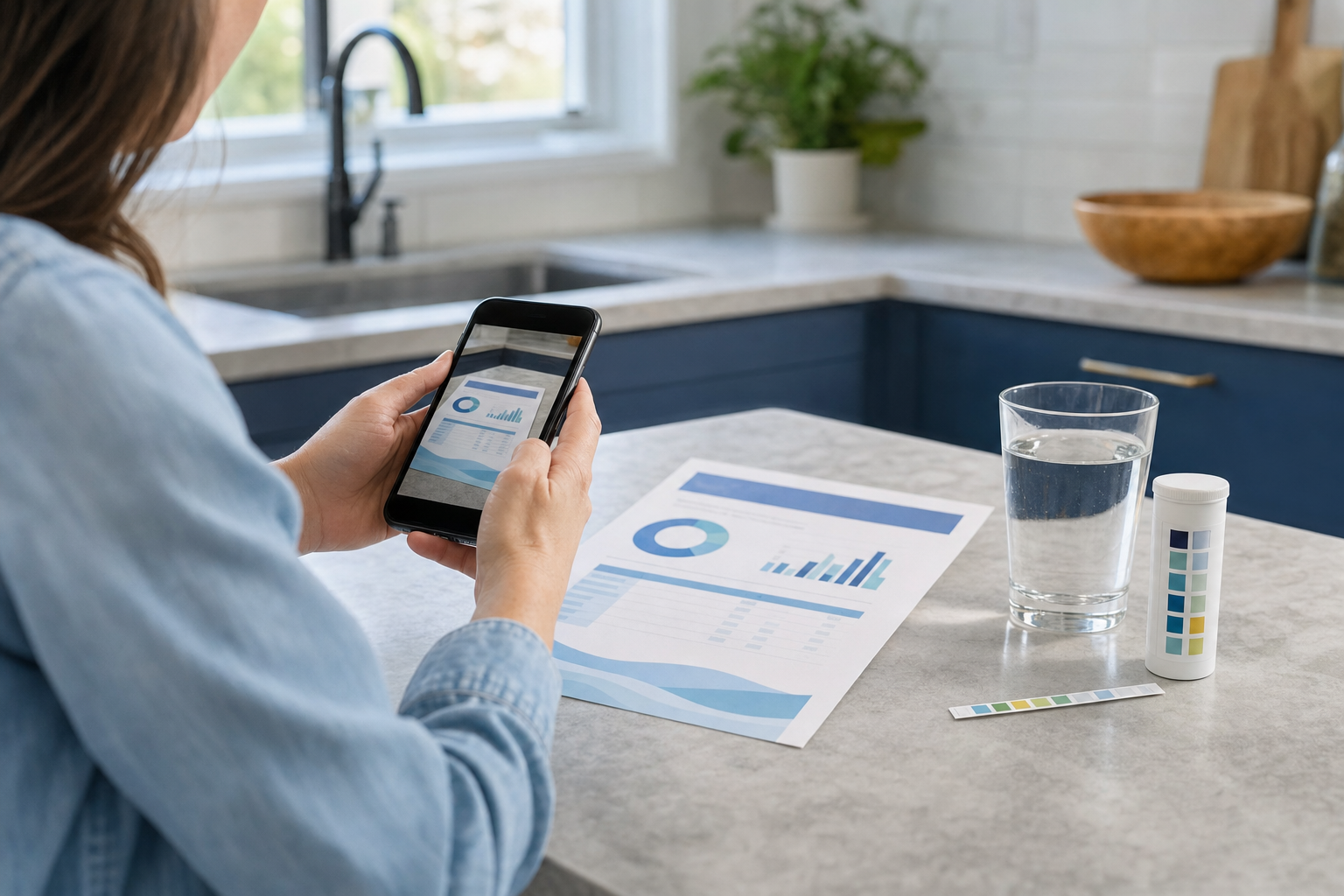
They see a Facebook ad, tap through, and photograph the report on their kitchen counter. Thirty seconds later they are looking at a results page.
First card: hardness, 239 mg/L as printed on your report, which is 14 grains per gallon, which is very hard. Amber. Second card: iron, 1.2 ppm, over the EPA secondary standard of 0.3, which is the orange staining in your bath you have probably stopped noticing. Amber. Third card: pH 6.6, acidic, and if you have blue-green marks around a sink drain, that is this. Amber. Nitrate and bacteria, both green, both fine.
Then the sizing, written out in words rather than symbols. Four people, about 75 gallons each a day, 20 grains per gallon once we account for your iron. That is 6,000 grains a day, 42,000 a week, 52,500 with the reserve every installer should design in, so a 64,000 grain softener.
Then the add-ons, in order: a calcite neutralizer first to bring the pH up, then the softener, with iron-tolerant resin because of the 1.2 ppm.
Then the price. Installed range, clearly labelled as an estimate, with the three things that move it: where the main water line enters the house, whether there is a drain within reach of the install point, and whether old equipment has to come out.
Then one button. Book a 30 minute verification visit, here is exactly what happens on it, no obligation.
Meanwhile the dealer's phone buzzes. New submission, 14 gpg plus 1.2 ppm iron, in area, mobile supplied, scored hot. In the dashboard, the original photo of the lab report sits next to the parsed numbers with a confidence flag on each one, so a technician can eyeball the read before anyone starts the van.
That homeowner shows up to the appointment already knowing their numbers, their system size and roughly what it costs. The two hour presentation has nothing left to do. The visit is a confirmation.
The screen that makes everything else believable
There is one output in this build that clients push back on every time, and it is the one worth fighting for.
If hardness comes back under 3.5 grains per gallon, the Water Quality Association classification for soft water, the tool tells the homeowner they do not need a softener. Plainly. It sets the record to no-system-needed and says that anyone trying to sell them one is selling them something they will not benefit from.
Dealers hate this on first viewing. Then they watch it work.
That visit was never a sale. Soft water is soft water, and the homeowner was going to find that out either during a wasted appointment or six months after a wasted purchase. Giving the answer away costs the dealer nothing in revenue and buys the one thing this industry struggles to get: a homeowner who believes the recommendation when it does come.
Monthly reporting to the client should include the no-system-needed count for exactly that reason. It is the number that proves the tool is honest, and the honesty is the asset.
Who builds this, and what it earns
The buyer is an independent residential water treatment dealer. Two to 15 vans, selling softeners, iron filters, neutralizers, UV and RO into homes. Culligan, RainSoft and EcoWater franchisees count, and so do the independents competing with them.
Finding them takes about an hour. Search "water softener installation" plus a county in any hard water or private well region. The US Midwest, Texas, Arizona, Florida, rural Pennsylvania and upstate New York are all strong. Then filter for the ones already running Google Local Services ads, because a dealer buying leads already knows exactly what a lead costs and does not need educating on the problem.
Three signals mark a good fit. They buy leads rather than living on referrals alone. They advertise a free in-home water test. And somebody in the business has complained out loud about tyre-kickers.
On money: the build goes out at $2,500 to $4,500 setup, then $397 to $697 a month. Add a performance bonus of $150 to $250 per installed system that came through the tool, which on a $2,400 to $3,600 average ticket is 5% to 8%. Dealers agree to that one without much argument, because it replaces lead spend rather than stacking on top of it.
The retainer covers hosting, the OpenAI and Twilio usage, hand-correcting low-confidence report parses, and tuning the rules when a technician disagrees with an output. That last item is real work in the first month and almost none after it.
Build time is 3 to 4 hours. Then 1 to 3 days waiting on A2P 10DLC registration before any SMS actually delivers, which the phase 2 playbook walks through step by step because skipping it means the follow-up texts get filtered with no bounce and the tool looks broken while half its messages vanish. Then two weeks of supervised pilot on one of the client's existing lead sources. Call it three weeks from signature to the client watching their own booking rate move.
One honest caveat
The parse is the fiddly part, and anyone who tells you otherwise has not run one of these on real leads.
Homeowners photograph lab reports at strange angles, in bad light, folded, with a thumb over one corner. The first fortnight of live traffic will turn up three or four report layouts that need the vision instructions tightened. That is why the two week pilot is a required step rather than an optional one, and why the dashboard puts the original image next to the parsed numbers with a confidence flag on each reading.
Budget for correcting parses by hand during those two weeks. After that it settles down, and the corrections become a once-a-month thing rather than a daily one.
Why it is worth building now
Two things make this a good build to pick up this month.
The first is that private well testing is seasonal, and autumn is when a lot of it happens. Reports are landing in kitchen drawers right now. A tool that reads a report someone received three weeks ago is pushing on an open door.
The second is that the whole industry's lead problem has got worse, not better. Shared leads sold to 3 to 5 dealers at once close at under 10%. Every dealer buying those knows the number and has no answer to it. Turning up with a mechanism that filters the list before anyone pays for a visit is a conversation they will take.
The full blueprint is live now, with the complete master prompt, the sizing engine, the EPA rule set, the lead scoring, the dealer dashboard spec and both build phases: grab the Water Treatment Dealers water test reader and sizing tool here.