
Water Treatment Dealers, Water Test Report Reader & System Sizing Quote Tool
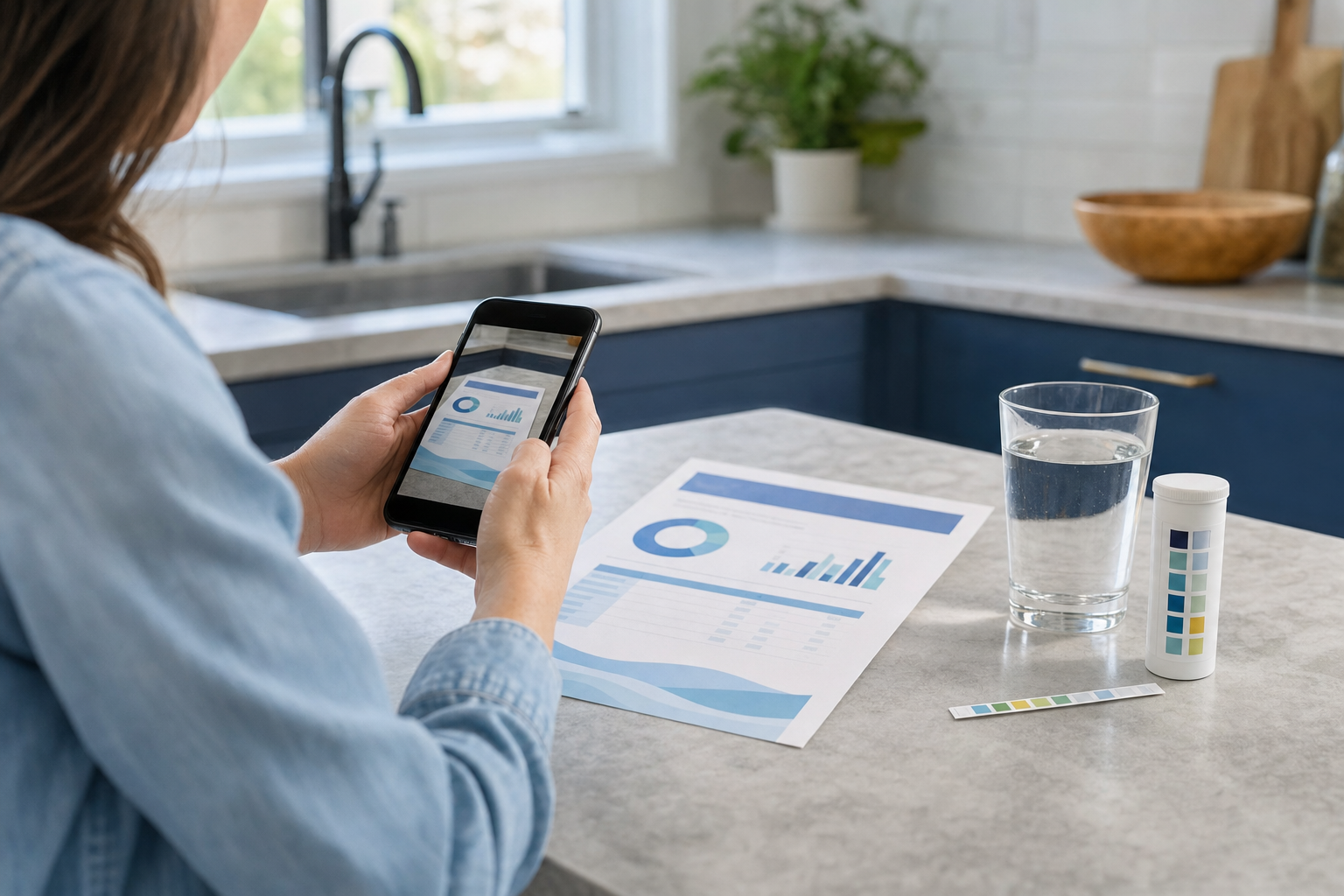
Homeowners upload a photo of a water test report they already have, and get back their real numbers, a correctly sized softener, an honest installed price range, and the option to book a 30 minute verification visit. The freebie-seekers drop out before anyone drives anywhere, and the ones who book already know what they need.
This blueprint is free. Copy the master prompt below, build it with your own time, and the only outlay is a few low-cost tool subscriptions. Use it inside your own business, or sell it to clients. The numbers further down are what you can charge, not what you pay.
Water treatment dealers buy 100 leads to get 12 sales. The fix starts with the test report.
Read the articleWho you sell it to
Independent residential water treatment dealers: the 2 to 15 van companies that sell and install softeners, iron filters, acid neutralizers, UV and reverse osmosis in homes. Culligan, RainSoft and EcoWater franchisees, plus the independents competing with them. Find them by searching 'water softener installation' plus a county in any hard-water or private-well area (the US Midwest, Texas, Arizona, Florida, rural Pennsylvania and upstate New York are all strong), then filter for the ones already running Google Local Services ads, because those are the dealers who already know what a lead costs them.
A good fit has three signs: they buy leads rather than living off referrals alone, they offer a free in-home water test, and somebody in the business has complained out loud about tyre-kickers. Plumbing companies with a water treatment sideline are a weaker fit, since treatment is not where their volume comes from. Skip anyone whose whole model is the old two to four hour in-home presentation and who likes it that way, because this tool shortens exactly the thing they believe in.
If you sell it, here is the money picture:
The first tile is the value of your client's own jobs, which is the reason they will pay you. The other two tiles are what you charge them.
How it works
A homeowner lands on the tool from an ad, a text, or a QR code on a van. They either upload a photo or PDF of a water test report they already have, or type their numbers in by hand. A vision model reads the report, pulls out hardness, iron, manganese, pH, nitrate, TDS and bacteria, and normalizes the units (water reports print hardness in grains per gallon, ppm or mg/L, and 1 gpg is 17.1 mg/L, which is where most online calculators get it wrong).
Then five questions: how many people, how many bathrooms, well or city, what are you noticing, and do you already have equipment. The sizing engine does the arithmetic every good installer does by hand. It compensates hardness for iron and manganese (add 5 grains per ppm of each), multiplies by people times 75 gallons a day, takes it out to a week, adds the 25% reserve, and rounds up to a real unit size from 24,000 to 96,000 grains.
A rule set checks every reading against the EPA standards and decides what else is needed: an iron filter above 3.0 ppm, an acid neutralizer below pH 7.0, RO for nitrate over 10 mg/L, shock chlorination plus UV if coliform shows up. The homeowner gets a results page showing their own raw numbers next to the normalized ones, what each one means for their house, the sized system with the arithmetic in plain English, an installed price range, and a button to book a 30 minute verification visit. The dealer gets the lead in a dashboard, scored hot, warm or cool, with the original uploaded report sitting next to the parsed numbers so a technician can eyeball the read before driving out.
Health flags, like nitrate over the limit or bacteria present, jump to the top of the list and fire a text.
What to expect
The first thing to expect is that the tool will tell some homeowners they do not need a softener, and the client will push back on it. Hold the line. Water under 3.5 gpg is soft, saying so costs the dealer nothing because that visit was never a sale, and it is the single biggest reason the other homeowners believe the recommendation they do get.
Expect the parse to be the fiddly part. Real homeowners photograph real lab reports in bad kitchen light at strange angles, and the first two weeks of live leads will turn up three or four report layouts that need the vision instructions tightened. Budget hand-correcting low-confidence parses in the dashboard during the pilot, which is why the two week supervised pilot is in phase 2 rather than optional.
On numbers, do not promise a lift in close rate, promise a cut in wasted visits. The appointment-to-close rate is already 30% to 50% for most dealers, and that is mostly down to their salespeople rather than anything a tool does. What changes is which homes get a visit at all, and how the visit starts, because a homeowner who already has their numbers and a price range does not need the two hour presentation they would otherwise sit through and resent.
Timeline: 3 to 4 hours to build, 1 to 3 days waiting on A2P 10DLC registration before any SMS works, then two weeks of pilot. Call it three weeks from signature to the client seeing their own booking numbers. The retainer sticks when the monthly report includes the no-system-needed count, because that is the number that proves the tool is honest, and an honest tool is the whole asset here.
Master prompt
You are an expert full-stack builder. Build a production-ready tool that… (the complete master prompt, custom input fields, build phases, pricing guidance and sales script are part of this blueprint.)
Build phases
Required tools
Lovable
The builder that creates the whole application from the master prompt
Free tier available, paid plans from $25/month
Sign upOpenAI API
Vision model that reads the uploaded water test report photo or PDF and pulls out the numbers
Roughly $0.01-$0.03 per report read, pay as you go
Sign upResend
Sends the homeowner their full water report by email and the daily digest to the dealer
Free up to 3,000 emails/month, then from $20/month
Sign upTwilio
SMS for the hot lead alert to the dealer and the single follow-up text to the homeowner
About $0.0079 per SMS in the US, plus $1.15/month per number and around $2/month for the A2P campaign
Sign upCal.com
Booking link for the 30 minute on-site verification visit, with the submission id passed through
Free for a single user, $15/user/month for teams
Sign upAppBuild.DIY (Vibes)
Wraps the finished build as a real iOS and Android app plus a PWA. For this build, enable push notifications for hot lead and health flag alerts, Photos and Camera so technicians can shoot the water main and drain run into the record on site, and Background Geolocation if the client runs multiple vans
Free for up to 10 users, Pro $49/month, Unlimited $99/month
Sign up