
Brand consistency checklist: free template and AI prompts

A brand consistency checklist helps your website, social posts, sales decks and emails sound like the same business and quote the same facts. This guide gives you a one-page brand reference, a 15-point checklist you can use today, four copy-paste AI prompts that do the audit and the fixes for you, and a worked example. A first audit of 10 pieces takes about an hour.
Want the AI to build a checklist tailored to your own channels first? Use the brand consistency checklist prompt. This guide is the hands-on version: a ready-made checklist plus the workflow to run it every quarter.
Why brand consistency slips
Drift rarely comes from one big mistake. It comes from small, sensible decisions made by different people at different times:
- A new hire copies an old caption with last year's price.
- Sales builds a deck in default fonts because the brand fonts are not installed.
- Someone shortens the business name to save space on a listing.
- Each team invents its own word for the same service.
The real cost is trust. A prospect who sees "48-hour repairs" on your site and "repairs in 3 days" on Instagram wonders which one is true. Wrong prices, phone numbers and opening hours cost you sales directly. That is why the checklist below puts facts first and fonts last.
Step 1: write a one-page brand reference
You cannot check consistency without something to check against. Most small businesses have no brand book, and a 40-page one goes unread anyway. One page is enough:
BRAND REFERENCE (one page)

Who we are, in one sentence: [e.g. "Family-run bike shop that fixes any bike in 48 hours"]
Our name, written exactly: [spelling, capitals, spacing, e.g. "GreenWheel Cycles" (never "Greenwheel" or "GWC")]
Tagline: [exact wording, or "none"]
The 3 things we always say: [core promises, e.g. "48-hour repairs", "free safety check", "local since 2009"]
Words we use: [e.g. "service", "ride", "fix"]
Words we avoid: [e.g. "cheap", "solutions", "world-class"]
Voice: [3 words, e.g. friendly, plain, confident] / [we / you or third person] / [contractions yes or no]
Facts that must match everywhere: [prices, opening hours, phone, address, guarantee terms, URL]
Colours: [hex codes for primary, secondary, accent, text]
Fonts: [heading font, body font, fallback for email and slides]
Logo rules: [which version on light and dark, minimum size, clear space]
Photo style: [e.g. real customers and staff, natural light, no stock handshakes]
Owner of this sheet: [name], last updated: [date]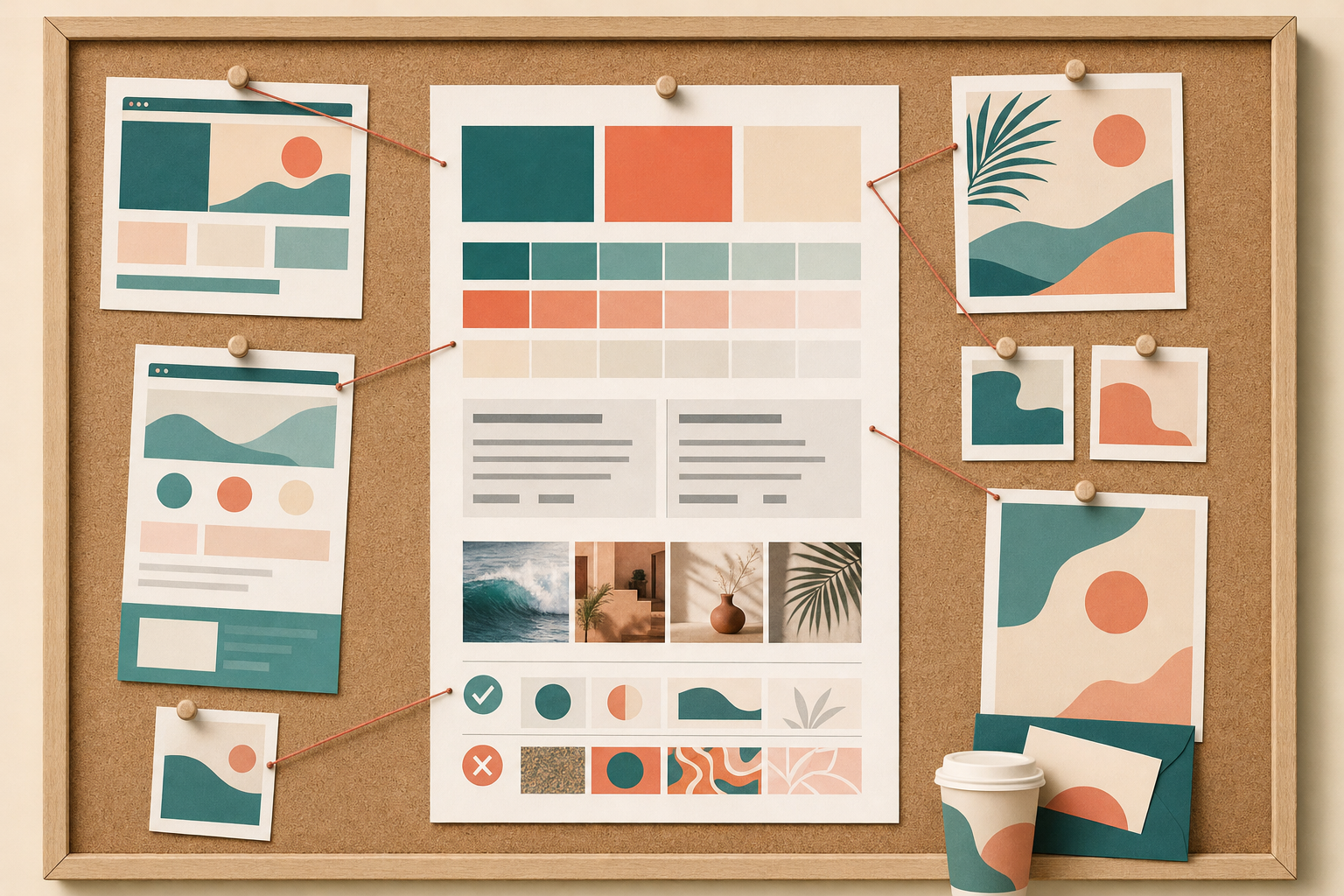
No time to fill it in by hand? Prompt 1 below drafts it from material you already have. To go deeper on voice, use the brand voice guide prompt that uses your real content, and for colours and type, pair a display and body typeface for your brand personality.
Step 2: the brand consistency checklist
Score each piece of material against these 15 points. Sections run in order of cost: a wrong fact (section A) loses you customers today, while a slightly off colour (section D) can wait a few weeks.
BRAND CONSISTENCY CHECKLIST (tick, cross or n/a for each piece)

Piece: [URL, file name or screenshot]   Channel: [website / social / sales / email / print / listing]   Owner: [name]

A. Facts (check these first; one wrong fact costs more than any font)
[ ] 1. Business name spelled and capitalised exactly as the reference
[ ] 2. Prices, offers and guarantee terms match the current reference
[ ] 3. Phone, email, address, opening hours and URL are current and match
[ ] 4. Any claim ("award-winning", "No. 1", "since 2009") is true and worded the same way

B. Message
[ ] 5. Uses at least one of the 3 things we always say, in our wording
[ ] 6. Same name for each product, plan and service as the reference
[ ] 7. None of the words we avoid
[ ] 8. Call to action matches what we want people to do on this channel

C. Voice
[ ] 9. Reads like the 3 voice words (read one paragraph aloud)
[ ] 10. Same person and contractions as the reference (we/you, I, they)
[ ] 11. Sentence length and formality fit the channel and still sound like us

D. Visual
[ ] 12. Only brand colours (hex codes match, no near-misses)
[ ] 13. Brand fonts, or the agreed fallback
[ ] 14. Correct logo version, size and clear space; not stretched or recoloured
[ ] 15. Photos match the photo style

Score: ticks / (15 minus n/a) = ___%
Fix now (any cross in section A): ___
Fix this month: ___
Owner and date: ___
Want a version shaped around your own channels and team? The brand consistency checklist prompt builds one from your guidelines and channel list, with a cadence you will keep to.
Step 3: choose what to audit
Pick 10 to 15 pieces across every channel a customer might see before they buy. A good first sample:
- Website: homepage, pricing or services page, contact page.
- Listings: Google Business Profile, any directory or marketplace listing.
- Social: the last 3 posts on your main channel and your bio.
- Sales: your current deck or proposal template, and a recent quote.
- Email: your signature, a welcome or confirmation email, a newsletter.
- Print and in person: flyer, business card, van or shop sign.
Older and less-watched pieces drift most, so include at least one thing nobody has touched in a year.
Four copy-paste prompts for the audit
Prompt 1: build the brand reference from what you already have
You are a brand manager setting up a brand consistency check for a small business. Build a one-page brand reference from the material below.

Business: [what you sell and to whom]
Material: [paste your homepage copy, your About page, 2 or 3 recent social posts, a sales email and your price list]
Brand assets I already have: [logo files, colours, fonts, any guidelines, or "none"]

Steps:
1. Fill in this template: [paste the BRAND REFERENCE template]
2. For "The 3 things we always say", pick the promises that appear most often in the material and quote where each appears.
3. For "Facts that must match everywhere", list every price, phone number, opening time, address and guarantee you find, and flag any that differ between pieces.
4. For voice, describe how the best piece of material sounds, and quote one sentence as the model.
5. Mark any field you had to guess with [CHECK], and list the questions I need to answer to finish the sheet.

Keep it to one page. Use only facts from the material.
Prompt 2: audit a batch of pieces against the checklist
You are auditing marketing material for brand consistency. Compare each piece below with my brand reference and score it with the checklist.

Brand reference: [paste your filled-in one-page reference]
Checklist: [paste the 15-point checklist]
Pieces to check (label each with channel and owner):
[piece 1: paste text, or describe the screenshot]
[piece 2]
[piece 3]

For each piece:
1. Mark every checklist item tick, cross or n/a.
2. For each cross, quote the exact words or describe the exact element, and say what the reference says instead.
3. Give the score as a percentage.

Then:
- List every cross in section A (facts) at the top, across all pieces, as "fix today".
- List terms used for the same thing in different ways across pieces (e.g. "service" vs "tune-up" vs "check-up").
- Rank the pieces from most to least on-brand.
Report only what you can see in the pieces. Where you cannot check something from text alone, such as a colour hex code, mark it n/a and tell me how to check it.
Paste text where you can. For visual checks, upload screenshots to a model that reads images, such as ChatGPT, Claude or Gemini, and still confirm hex codes with a colour picker.
Prompt 3: rewrite an off-brand piece
Rewrite this piece so it matches my brand reference. Keep its purpose, length and channel.

Brand reference: [paste]
Audit notes for this piece: [paste the crosses from the audit]
Piece: [paste the text]

Rules:
- Fix every cross from the audit notes.
- Use the exact business name, product names and facts from the reference.
- Match the voice words, person and contractions in the reference.
- Keep any facts that are correct. Do not add new claims or offers.
- Return the rewrite, then a short list of each change and the checklist item it fixes.
For a quick fix to a single paragraph, the rewrite off-brand copy prompt works on its own.
Prompt 4: the quarterly drift review
You are reviewing brand drift across a quarter. Compare this quarter's audit results with last quarter's.

Last quarter: [paste scores per piece and the repeated crosses]
This quarter: [paste scores per piece and the repeated crosses]
Who made each piece: [team or person per piece]

Tell me:
1. Average score per channel, this quarter vs last.
2. The 3 checklist items that failed most often, and the pieces where they failed.
3. For each of those 3, the likely cause (out-of-date template, a team without the reference, a new hire, an old file still in use) and one fix that stops it happening again.
4. Any field in the brand reference that people keep breaking because it is unclear, with a clearer rewording.
Keep the answer to one screen so I can share it with the team.
Worked example: a bike shop's Instagram post
GreenWheel Cycles promises "48-hour repairs" on its website. Here is how Prompt 2 scored a post written by a part-time staff member:
Piece: Instagram post, owner: Sam (part-time)
Score: 9 / 14 (64%), item 15 n/a

A. Facts
x 1. "Greenwheel" (reference: "GreenWheel Cycles")
x 2. "Repairs in 3 days" (reference: "48-hour repairs")
v 3. Phone and URL correct
v 4. No claims

B. Message
x 5. None of the 3 promises in our wording
x 6. "Tune-up" (reference: "service")
v 7. No avoided words
v 8. "Book online" matches

C. Voice  v 9  v 10  v 11
D. Visual  v 12  v 13  v 14  n/a 15

Fix today: name spelling, "48-hour repairs"
Cause: Sam copied an old caption from 2024
Fix that stops it: saved caption templates in the shared drive, old captions archived
Two facts were wrong, and the cause was an old caption being reused. Prompt 3 rewrote the post in a minute. The longer-term fix was saved templates, so the same mistake stops coming back next quarter.
A simple cadence you will keep
- Before anything new goes out: check section A (facts) only. Two minutes.
- Every quarter: full 15-point audit on 10 to 15 pieces with Prompt 2, then Prompt 4 to compare with last time.
- After any change to prices, hours, names or the logo: search every channel for the old version that day.
- When someone new joins: give them the one-page reference on day one.
Brand consistency challenges, and how to fix each
- Nobody owns the reference. Put one name and an update date on the sheet.
- Old files keep coming back. Archive old templates and keep one shared folder of current ones. To set up matching social templates, use design a social template system that matches your brand kit.
- AI tools write in a generic voice. Paste your reference into every prompt, or turn it into reusable instructions with translate your brand voice into prompts your team can reuse.
- Support replies sound like a different company. Build saved replies with draft an on-brand macro for a recurring support ticket type.
- Your core message is fuzzy, so everyone words it differently. Settle it first with find the one word your brand should own and check whether your name and tagline say what you do.
- You run franchises or several sites. Use the brand standards audit and cure plan prompt for site visits, with scores and deadlines per unit.
- The brand itself needs a refresh. Brief a designer with brief a designer on a rebrand without losing what works, then rebuild the reference.
For more design and brand prompts, see AI prompts for brand and design teams. Briefing a designer on new material once the audit is done? Use the free creative brief generator.
Run your first brand consistency audit this week
Run Prompt 1 to draft the reference, fix the guessed fields, pick 10 pieces and run Prompt 2. Fix every section A cross the same day, then put the next quarterly audit in your calendar. For a checklist built around your own channels, use the brand consistency checklist prompt.
For more prompts like these, with the method behind them, get the free Prompt King Handbook. It shows you how to get better results from ChatGPT, Claude and Gemini for brand work, marketing copy, client emails and the rest of your business.